
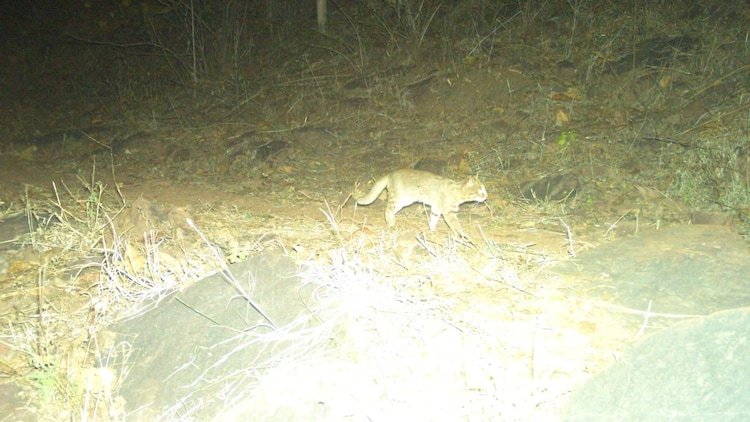
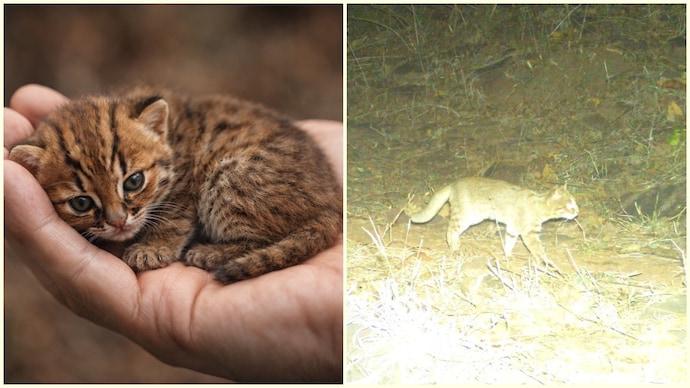
World's smallest wild cat that can fit into palm of the hand photographed in India
The rusty-spotted cat is listed as "Near Threatened" on the IUCN Red List due to habitat loss and fragmentation. In India, it is protected under Schedule I of the Wildlife Protection Act.
The image was recorded during a large-scale camera trap survey.

New Delhi,UPDATED: Apr 15, 2026 11:13 IST
In a rare and significant wildlife discovery, the world’s smallest wild cat, the elusive rusty-spotted cat, has been photographed in India’s Veerangana Durgavati Tiger Reserve (VDTR) in Madhya Pradesh.
The tiny feline, small enough to fit in the palm of a human hand, was captured on a camera trap, marking the first-ever visual record of the species in the reserve.
The image was recorded during a large-scale camera trap survey conducted between February and March 2024 by the Madhya Pradesh Forest Department and WWF-India. The survey, spread across 442 square kilometres, primarily aimed to estimate tiger populations.
However, while analysing the footage, researchers spotted the rarely seen rusty-spotted cat in the Dongargaon range on March 12.
The rusty-spotted cat (Prionailurus rubiginosus) is considered the smallest wild cat species in the world, typically measuring just 3 to 4 kilograms in weight and about 35-48 cm in length. It is identified by its short, rounded ears, large expressive eyes, and reddish-grey coat covered with distinctive rusty spots. Its bushy tail, nearly half the length of its body, adds to its unique appearance.
Despite its tiny size, the cat is a skilled hunter and thrives in dense undergrowth, rocky terrain, and forest edges. It feeds on small prey such as rodents, birds, and insects. The species is known to inhabit a wide range of environments, including dry and moist deciduous forests, scrublands, and even agricultural landscapes, although evergreen forests appear less suitable.
The discovery is particularly important for conservation science.
The rusty-spotted cat is listed as “Near Threatened” on the IUCN Red List due to habitat loss and fragmentation. In India, it is protected under Schedule I of the Wildlife Protection Act, offering it the highest level of legal protection.
For decades, the species was believed to be largely confined to southern India. However, recent sightings across central and northern regions, including Gujarat, Maharashtra, Uttar Pradesh, and Haryana, suggest that it is far more widespread and adaptable than previously thought.
The new photographic evidence from VDTR further strengthens this understanding.
The Veerangana Durgavati Tiger Reserve, spanning over 2,300 square kilometres, is already known for its rich biodiversity, including tigers, leopards, wolves, and sloth bears. The addition of the rusty-spotted cat highlights the ecological importance of the reserve and the need for continued monitoring of lesser-known species.
- Ends