
Happy Raj review: When a good idea gets lost in bad writing choices
Happy Raj explores familiar themes but fails to deliver with honest storytelling.

Can relatable themes, moments, and strong performances make a mediocre film work? Sometimes, yes. We’ve seen that happen with films like Don and Dragon, where even uneven writing found support in engaging setups and conflicts that kept things moving.
Happy Raj tries to be that film, but misses a crucial step. Here, the moments that are meant to engage either feel flat or drift into bizarre territory. Instead of building towards emotion, the film keeps taking strange detours in the name of comedy, and most of them neither land as funny nor meaningful.
Right from the opening scene, the film tells you what it is. A girl rejecting the hero purely because of his father’s appearance is not just insensitive, it feels completely artificial. It’s the kind of writing that exists only to push a point, not to reflect reality. In that moment, one thing becomes clear — this is a film heading towards a preachy climax, built on exaggerated situations rather than organic storytelling. There is a certain kind of film that believes one emotional climax can fix everything that came before it. Happy Raj is exactly that film.
It operates on a familiar idea — insecurity, inferiority complex, social judgement, acceptance — themes that have worked before when treated with care. But here, instead of building towards that emotion, the film spends most of its runtime testing your patience, only to expect redemption in the final stretch.
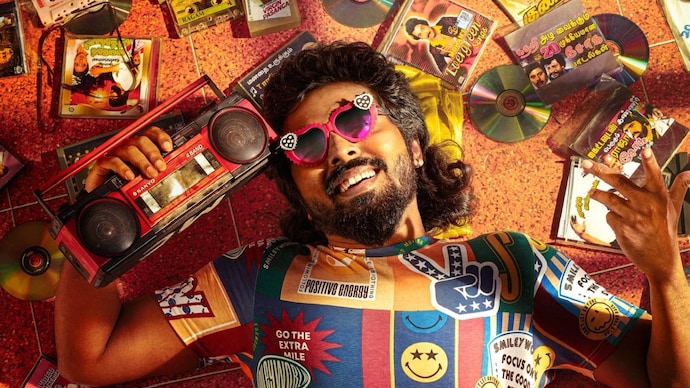
The story follows Anand Raj aka Happy (G.V. Prakash Kumar), a carefree young software developer who chooses optimism despite repeated failures. His life, however, is deeply affected by his father Kathamuthu (George Maryan), whose appearance becomes a constant source of ridicule. This insecurity shapes Happy’s relationships, including his romance with Kavya (Sri Gouri Priya). Kavya’s father Rajiv (Abbas), with his polished, upper-class presence, creates the core conflict when the two worlds collide.
On paper, there is merit in this setup. The idea of how inherited shame and social perception affect identity is interesting. But the problem lies in how the film chooses to explore it. Instead of treating the subject with sensitivity, the writing leans heavily on the very thing it later tries to criticise.
Most of the humour is built around Kathamuthu’s looks, and not in a clever or observational way — it is direct, repetitive, and often uncomfortable. The film keeps returning to the same joke until it stops being humour and becomes noise.
What makes this worse is how artificial many of the situations feel. The film keeps trying to create contrast — village vs urban, simplicity vs sophistication — but does so in the most surface-level way. Entire stretches exist just to highlight this difference, and after a point, you can see the next move coming from a mile away.
Even the comedy outside of this central idea struggles. Recurring gags don’t land, side characters don’t add much, and many sequences feel stretched far beyond their actual value. Whether it’s the Bengaluru roommate portions that never quite find a comic rhythm, or the recurring gag of the Hindi-speaking migrants Happy meets on the train — which keeps coming back without adding anything new — the humour feels forced. It doesn’t grow out of situations; it is imposed on them.
And yet, the film isn’t entirely without spark. There are moments where you see a better film trying to break through. The Bengaluru portions, especially involving Happy’s mother, played by Geetha Kailasam, bring a certain warmth. A few scenes — like the birthday stretch and the confrontation between Kathamuthu and Rajiv — feel emotionally honest. These are the rare instances where the writing pauses and allows the characters to breathe.
Here's the trailer:
George Maryan, in particular, holds the film together whenever it threatens to fall apart. Despite being at the receiving end of most of the film’s weakest writing choices, he brings sincerity and dignity to Kathamuthu. Whether it’s the confrontation with Rajiv (Abbas) or the emotional beats in the climax, he stands out as the film’s strongest pillar. Abbas, in his re-entry, gets a one-dimensional role, but his screen presence brings a polish the writing lacks.
G.V. Prakash Kumar delivers a neat performance. There’s an innocence to his portrayal that works, but the character itself feels inconsistently written. At times, his quirks feel borrowed — especially in the way frustration and awkwardness are played out, which strongly reminds you of Pradeep Ranganathan’s style. The similarity becomes harder to ignore, particularly with the same father-son dynamic in place, making the performance feel less distinctive than it should have been. Sri Gouri Priya and Prathana Nathan fit their parts, though the writing doesn’t give them enough to stand out.
The biggest issue, however, comes in the final act. After spending a large portion of its runtime exploiting its central idea for easy laughs, the film suddenly shifts gears and asks you to take its message seriously. The emotional intent is clear, and to an extent, it even works in isolation. But the journey to that point feels manipulative.
You can see the message coming from far away, and when it arrives, it doesn’t feel earned enough to justify everything that came before it. That is where Happy Raj ultimately falters — not because it lacks a good idea, but because it doesn’t trust that idea enough to build it honestly.
Director Maria Raja Elanchezian clearly has an idea he wants to communicate. The themes are relevant, but the execution leans too heavily on exaggerated humour and contrived situations, weakening the overall impact.
Technically, the film does what is required without adding much. The pacing is uneven, especially in the first half, and the editing could have easily trimmed several repetitive stretches.
In the end, Happy Raj sits in that familiar middle space. You don’t dislike it enough to dismiss it completely, but you also don’t carry anything from it once it’s over. A better version of this film exists somewhere within this one. Unfortunately, this isn’t it.