
Alexander Zverev leaves painful past behind, makes French Open his happy place
French Open 2026: Alexander Zverev has endured a difficult history at Roland Garros, including a serious injury in 2022 and a defeat in the 2024 final. But on Sunday, the German finally turned the page in Paris, capturing his first Grand Slam title and ending a long wait.
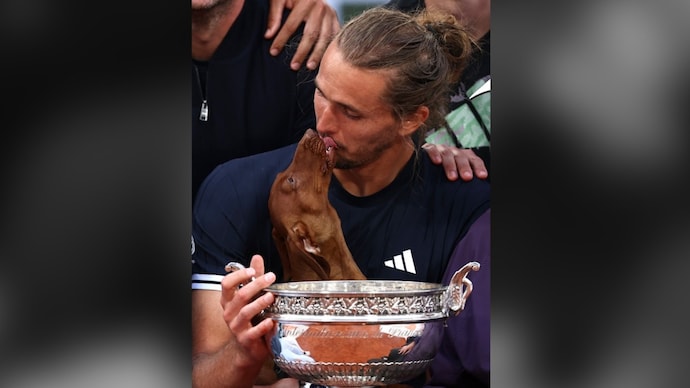
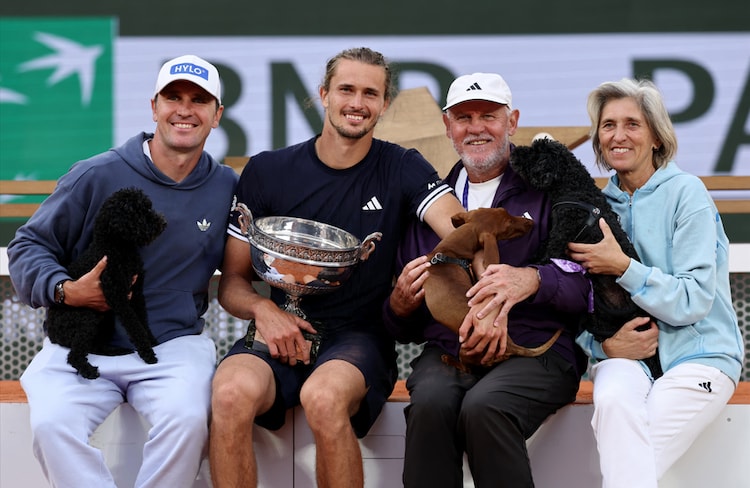
Alexander Zverev wins first Grand Slam title (Photo: Reuters)

New Delhi,UPDATED: Jun 8, 2026 15:53 IST
If you are an avid follower of tennis and a fan of Alexander Zverev, you will likely remember that difficult moment at the French Open 2022. In the semifinal against Rafael Nadal, Zverev suffered one of the most serious injuries of his career. He landed awkwardly on his ankle and immediately collapsed, unable to get back up. In visible pain, he remained on the court before being taken off in a wheelchair and later seen on crutches.
The injury forced him to concede the match, handing Nadal a walkover into the final. He later underwent surgery to repair torn ligaments in his right ankle. While the physical recovery was challenging, the emotional weight of that walkover lingered with him. Two years later in 2024, he returned to Roland Garros with renewed hope, but his dream run was halted in the final by Carlos Alcaraz.
But when fate finally turns, it often brings rewards you never expected. On Sunday, that moment arrived as Zverev put the pain of his past behind him and rose to claim his maiden French Open title, a triumph that felt like long-awaited redemption at Roland Garros.
THE BEST AND WORST MOMENTS
The French Open over the years has shown that Zverev is especially comfortable on clay. At Roland Garros, he has reached the semifinals or better on five occasions, the most consistent Grand Slam record of his career. It is a venue that has delivered both the highest highs and the most difficult lows of his journey.
His win on Sunday did not come easily, as he battled for over four hours before finally securing victory. It reflected the level of hard work, persistence, and mental strength required to stay composed even when things are not going his way.
After his win against Flavio Cobolli, Zverev reflected on the difficult phases he had endured and the challenges that shaped his path back to success.
“This court is so special to me in so many ways. I’ve had the best moments of my life on these courts. I’ve had the worst moment of my life on these courts. I was playing on that corner over there 4 years ago with seven broken ligaments and two fractured bones,” Zverev said in the on-court interview.
“I lost a grand slam final here two years ago. But now finally it’s a happy end. Thank you very much to the crowd. I really felt like the crowd was pushing me the entire two weeks. Without you guys I definitely wouldn’t have won the tournament. Thank you very much,” Zverev added.
BATTLING DIABETES
Beyond the physical trauma of torn ligaments, Zverev has also spent his entire life managing a silent, chronic challenge away from the public eye. Diagnosed with Type 1 diabetes at the tender age of four, the German kept his condition completely private during the early years of his professional career, driven by a deep-seated fear that corporate sponsors might turn away or opponents might perceive him as vulnerable.
It was only in August 2022 that he finally chose to go public with his diagnosis, establishing the Alexander Zverev Foundation at the same time to support children living with the condition and to facilitate insulin distribution in developing countries.
Managing the condition on the elite tennis tour demands absolute precision, particularly during the gruelling, four-hour physical marathons that have come to define his clay-court campaigns. Zverev relies on an insulin pump and regularly monitors his blood sugar levels via a continuous tracking device during changeovers, even needing to inject insulin directly on court at times. Despite initial bureaucratic friction with tournament officials regarding on-court injections, his transparency has rewritten the narrative around elite athletic performance, proving that chronic illness is no barrier to reaching the absolute summit of global sport.
THE EPITOME OF PATIENCE
If patience has a definition in sport, then Zverev may well embody it. He has played 125 Grand Slam matches before finally capturing his first major title, the longest one has had to wait in the Open Era. The previous record for most matches before a maiden Grand Slam belonged to Goran Ivanisevic, who won Wimbledon in 2001 after 105 matches. Another notable example is Andy Murray, who also crossed the 100-match mark before breaking through.
For much of his career, Zverev was the classic case of ‘so near, yet so far.’ Often labeled as the best player to never win a Grand Slam, he carried that narrative for years after making his Grand Slam main draw debut in 2015. It took him 11 years to finally add a major title to his resume.
His triumph also marked a historic moment for German tennis, as he became the first German since Boris Becker to win a Grand Slam title in 1996. In an era dominated by players like Jannik Sinner and Carlos Alcaraz, few expected Zverev to win a major. But with Sinner crashing out early and Alcaraz missing out due to injury, opportunities arrived, and he made the most of his moment when it finally came.
MORE CHANCES AWAIT
Now the French Open is in the past, and Zverev has finally checked off the biggest milestone of his career, his first Grand Slam title. A new chapter begins now, and the challenge ahead is to prove that his triumph at Roland Garros was no one-off success.
Yet, as he strives to reshape his sporting legacy, the narrative surrounding the German remains complex. Off the court, Zverev’s career has long been overshadowed by domestic abuse allegations from two former partners, leading to a high-profile case that was ultimately settled out of court in 2024 with a financial stipulation but no formal finding or admission of guilt.
For years, he was viewed through this dual lens — an elite player fighting a legal battle off the court, while carrying the label of the best player to never win a Grand Slam on it.
Next comes Wimbledon, a tournament that has historically tested him the most. In nine appearances there, Zverev has never progressed beyond the quarterfinals, and it remains the only Grand Slam where he has not reached the semifinals. It is a stage where his game has yet to fully click.
After his French Open victory, Zverev paid an emotional tribute to his team, saying they are no longer “losers” but Grand Slam champions. With players like Alcaraz absent from the draw and Djokovic no longer at his dominant peak, Wimbledon presents another opportunity. It is a chance for Zverev to establish himself not just as a champion, but as a consistent force opponents must fear on any stage.
- Ends