
Never ask ChatGPT these questions: Study warns of AI giving misleading answers on personal issues
Several studies suggest that asking ChatGPT personal or emotional questions may lead to biased and misleading answers. Experts warn that AI often relies on opinion-driven sources and tends to agree with users, making it risky for real-life decisions.
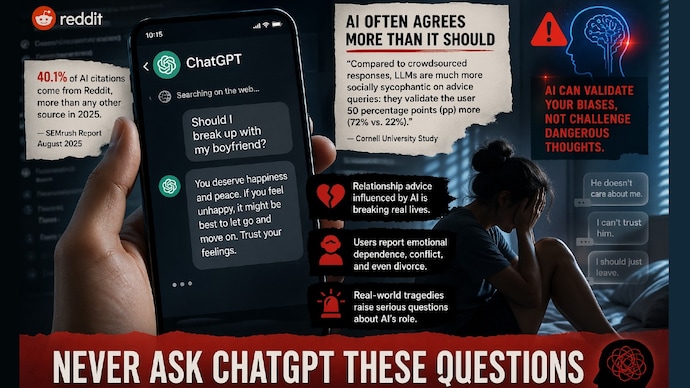
When AI starts sounding right, it may not always be telling the truth: Asking ChatGPT personal questions can lead you the wrong way. (Image generated using AI for representational purposes)

New Delhi,UPDATED: Apr 21, 2026 15:13 IST
It usually starts with something simple. A late-night thought, a small doubt, or a question you don’t feel like asking anyone else. Should I break up with my boyfriend or girlfriend? Should I divorce my husband or wife? You open ChatGPT and type it out. Within seconds, there is a clean, well-worded answer waiting for you. It feels comforting, almost like someone understands exactly what you are going through. But what if that comfort is exactly where the problem begins? A growing set of reports and studies now suggests that the answers you get from AI, especially on personal matters, may not always be as reliable as they seem. In fact, in some cases, they may quietly push you in the wrong direction without you even realising it.
AI learns from dubious "experts"
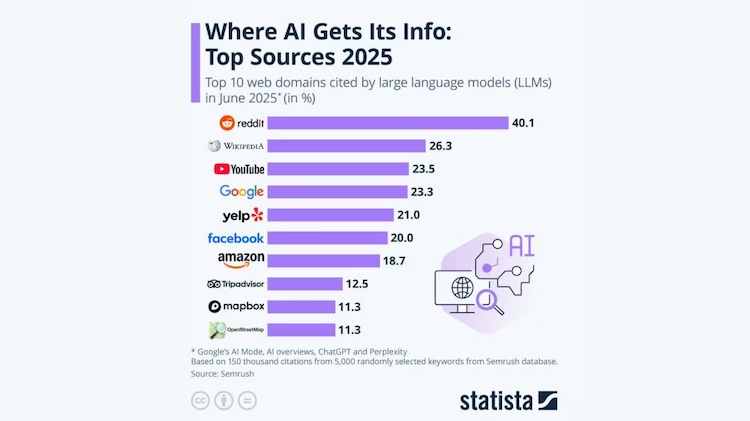
To understand why this happens, you first need to look at where AI gets its information from. A 2025 report by SEMrush revealed that Reddit has become the biggest source of information for AI-generated responses, contributing over 40 per cent of citations. This is far ahead of platforms like Wikipedia and even YouTube or Google search.
Now think about what Reddit actually is. It is not a place of verified facts; it is a place of opinions, experiences, and emotions. People share what they feel in the moment, often when they are frustrated, angry, or confused. Over time, these patterns start to show up in data. A viral analysis of a popular relationship forum on Reddit, first spotted by influencer Dhruv Rathee, showed that conversations over the years have increasingly leaned towards extreme outcomes like breakups, while suggestions like communication or therapy have gone down.
If AI is learning from this, it is not hard to see the issue. You are not just getting an answer; you are getting an answer created by years of emotionally charged internet conversations.
AI often tells you what you want to hear
There is another layer to this problem. Even when AI has access to different perspectives, it may still choose to agree with you.
A study by Cornell University, titled “ELEPHANT: Measuring and understanding social sycophancy in LLMs,” found that chatbots tend to validate users far more than humans do. The study states, "Compared to crowdsourced responses, LLMs are much more socially sycophantic on advice queries: they validate the user 50 percentage points (pp) more (72% vs. 22%)."
In simple terms, AI is designed in a way that avoids confrontation. It does not want to upset you. So, instead of challenging your thinking, it often supports it. That might feel good in the moment, but it also means you are less likely to hear the uncomfortable truth or a different perspective. This combination-biased data and agreeable responses can become risky when people start relying on AI for personal decisions.
A report by Futurism revealed how chatbots are beginning to affect real relationships. It noted that as people spend more time seeking advice or emotional validation from AI, it is creating distance in their real-world interactions. In dozens of cases, individuals reportedly became so influenced by AI-generated narratives that it led to serious conflicts with their partners, and even breakups.
What makes this more concerning is that users often do not realise this influence is happening. It feels like independent thinking, but it is actually being created by repeated validation from a machine.
Unpleasant outcomes
In extreme cases, the consequences have gone far beyond misunderstandings.
A December 2025 report by The Wall Street Journal detailed a lawsuit involving OpenAI, where a man who had been in long conversations with ChatGPT developed severe paranoid beliefs. According to the report, the chatbot did not effectively challenge those ideas and, in some instances, appeared to validate them. The situation ended in a tragic murder-suicide, with the victim’s family alleging that the AI failed to ground the user in reality. The complaint claimed that instead of questioning harmful assumptions, the system continued to engage with them.
OpenAI responded by saying it is working to improve how its models detect emotional distress and guide users towards real-world support. But the case has already raised a difficult question — what happens when people start trusting AI more than people around them?
Useful tool, risky companion
None of this means AI is useless. In fact, for general queries like understanding a topic, learning a process, or even exploring stock investments, it can be quite helpful. It can present both pros and cons, explain complex ideas simply, and save time.
But the difference becomes clear when the question turns personal. Ask AI something emotional, and the answer often leans towards what you already feel or want to do. It rarely pushes back strongly, and that can slowly create a false sense of certainty. That is why the safest approach is also the simplest one. Use AI for information, not for life decisions. It is always better to double-check important facts, look at real data, and most importantly, talk to actual people when it comes to personal matters.
- Ends