
Campus politics ban, KP Oli arrest: 3 days into office, Balen Shah shakes up Nepal
Balen Shah, who stormed to power on the back of a Gen Z revolution, has dived headfirst into major political and institutional reforms, signalling a tenure as disruptive as his unconventional rise to Nepal's top job.
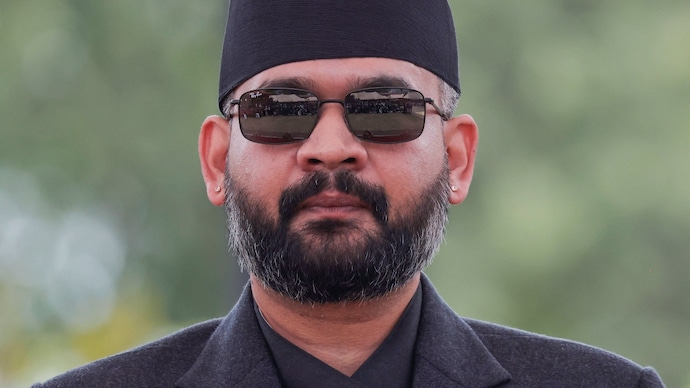
Newly appointed Nepal Prime Minister Balendra Shah, also known as Balen.

Nepal’s new Prime Minister Balendra ‘Balen’ Shah is on a roll. Within 48 hours of taking oath, the rapper-turned-politician unveiled a 100-point action plan to remake government institutions. The most contentious step: a blanket ban on student politics.
At 35, Shah became Nepal’s youngest Prime Minister in decades after his fledgling Rastriya Swatantra Party won the March 5 national elections by a landslide. With mass appeal and public mandate secured, he now faces the daunting task of delivering on the aspirations of young Nepalis after nearly two decades of revolving-door leadership.
But the very Gen Z that catapulted him to power with their September revolution are now staring at the prospect of having their wings clipped.
POLITICS OUT OF CAMPUSES
One of the first decisions of the Balen Shah government was to order political student unions off campuses. In their place, non-partisan bodies like 'Student Council' or 'Voice of Students' will be set up within 90 days.
The move is at odds with Balen Shah’s persona as an anti-establishment rebel. After fuelling a youth uprising with his songs, he now argues that campuses have no business being a hotbed of politics.
Student wings linked to major parties and Maoist groups have long been accused of violence, vandalism and extortion. Exams are delayed, teachers are attacked, and party flags dominate lecture halls. The only solution is to free education from the clutches of politics, he asserted.
Critics see a different picture. Liberal voices warn the move could curb democratic participation and weaken a key training ground for political leadership.
DEPOLITICISING THE BUREAUCRACY
The new, youthful Cabinet has also barred civil servants and teachers from holding party affiliations. Partisan trade unions within state bodies will be scrapped.
Supporters of Balen Shah claim this could streamline governance and cut interference.
Critics, however, have pushed back, saying it risks stripping workers of protections and silencing dissent within institutions.
EDUCATION SHAKE-UP
Shah’s reforms extend deep into the education system.
The government will remove the citizenship requirement for undergraduate admissions and enforce strict academic calendars for publishing exam results.
Internal exams up to Grade 5 will be scrapped from the next academic year, replaced by alternative assessments.
In a symbolic break from colonial and elite branding, institutions using foreign names -- such as Oxford, Pentagon, St Joseph’s and St Xavier’s -- have been told to adopt original names starting this year.
RIVALS ARRESTED
Even as reforms rolled out, the new regime acted against political opponents.
Former Prime Minister KP Sharma Oli was arrested on Saturday, a day after the Balen Shah government implemented findings of a probe into last year’s Gen Z protests. Another ex-Minister, Ramesh Lekhak, was also nabbed.
Both face charges linked to the suppression of the September uprising, in which at least 77 people were killed. The protests began over a brief social media ban but quickly snowballed into a wider anti-corruption movement which toppled the Oli government.
In a separate case, MLA Rekha Sharma was arrested on Sunday night on charges of abusing a minor domestic worker over eight years. The case had been filed earlier but not pursued under the erstwhile Oli dispensation.
Balen Shah, then Kathmandu’s mayor, had promised the survivor justice.
HONOURING FALLEN GEN Z PROTESTERS
In a move aimed at cementing his reformist credentials, Balen Shah made sure to swiftly deliver on a key campaign promise.
The government will provide jobs to families of 27 students killed during the Gen Z protests. The decision was cleared in the first Cabinet meeting and is already being implemented.
The Nepal Electricity Authority has issued notices to recruit one eligible family member per victim, with postings in their home districts based on qualifications.
INDIA TIES: A CAUTIOUS RESET?
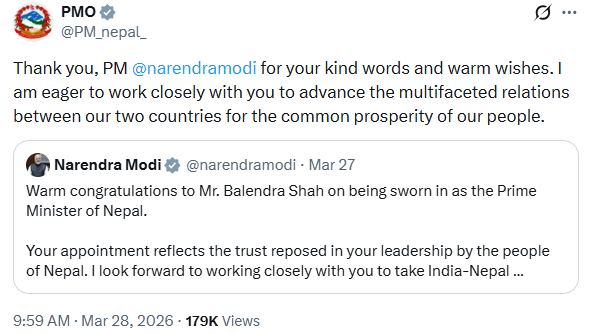
In the first exchange of messages with Prime Minister Narendra Modi, Balen Shah, who is something of an India hawk, said he is "eager to work closely" with New Delhi. In a congratulatory message to his new Nepali counterpart, PM Modi had talked about taking India-Nepal ties to greater heights. Shah agreed with him.
The outreach signals a possible reset in a relationship marked by deep interdependence and periodic strain -- from constitutional disputes to border tensions and trade disruptions.
As Kathmandu mayor, Balen Shah often projected overt nationalism, and rejected the “hegemony” of India and others in the Himalayan nation’s vicinity. His rhetoric on a “Greater Nepal” had raised eyebrows in New Delhi.
While having a ‘Neighbours First’ policy, PM Modi’s message to Balen Shah stopped short of extending an invite to visit India soon, signalling that New Delhi’s in wait-and-watch mode.
Shah’s opening moves have been swift and sweeping. They have also drawn clear battle lines. Either way, Nepal’s youngest prime minister in decades has set the tone: decisive, disruptive — and unafraid of a fight.
- Ends