
Trump eyeing key trade route vital to India as Hormuz burns?
All eyes are on the Strait of Hormuz as the US flexes its military muscle to enforce a blockade on Iranian ports. However, a hush-hush meeting between the US defence secretary and his Indonesian counterpart has set off fresh speculation. Is Donald Trump now turning his focus toward another vital chokepoint closer to India?
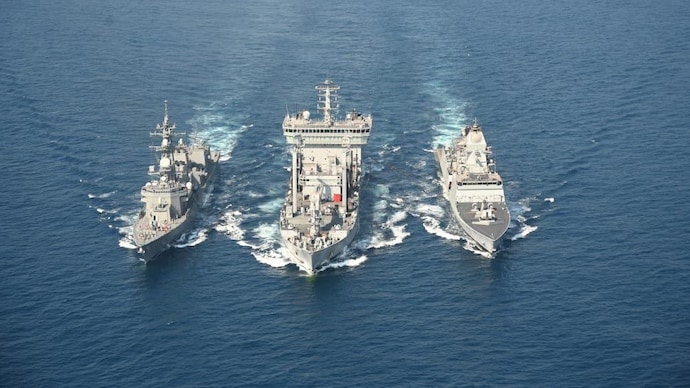

All eyes are on the Strait of Hormuz as the US puts all its might to enforce a blockade on all Iranian ports along the key energy chokepoint. However, even as tensions spike in Hormuz, a quiet move in the US has set off fresh speculation. Is Donald Trump now turning his focus toward another vital shipping chokepoint closer to India - the Strait of Malacca?
On Monday, the US and Indonesia sealed a major defence cooperation partnership. It included blanket access for American military aircraft over Indonesian airspace, multiple reports said. It didn't take long for strategic watchers to read between the lines. Such access will give the US a greater ability to keep an eye on the Malacca Strait.
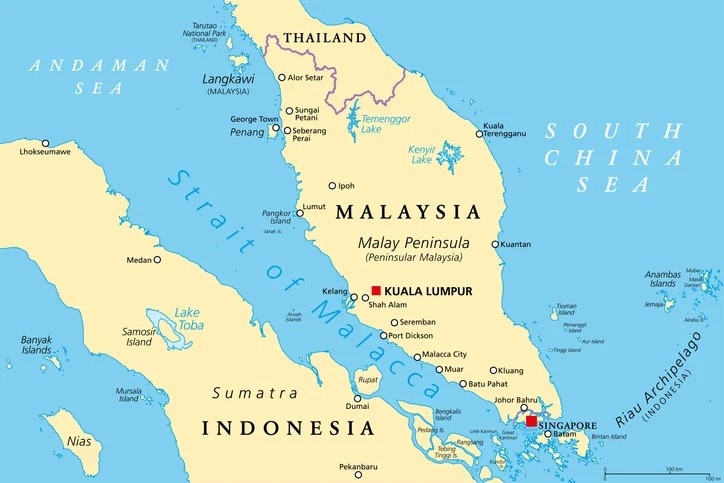
Along with Malaysia and Singapore, Indonesia controls the Strait of Malacca, one of the world's busiest sea lanes through which 40% of global trade flows. The timing has raised eyebrows. It has stirred chatter that Trump may now be looking to deepen the US footprint across the Indo-Pacific's most critical trade corridor.
IS TRUMP EYEING STRAIT OF MALACCA?
The reason - while Hormuz moves oil, Malacca moves everything, from oil to cars to semiconductors and finished goods. Trump is well aware of the fact. Iran's grip on Hormuz has given a live demonstration of how a chokepoint crisis can unfold and hold the world economy hostage.
While the US is not heavily dependent on Malacca economically, the narrow strait, just 3 km wide at the Phillip Channel, holds military and strategic significance for it. In fact, the Malacca Strait is around nine times narrower than Hormuz.
"President Trump remains laser-focused on securing the world's choke points. The Strait of Malacca is unequivocally more important than Hormuz," tweeted US defence strategist John Konrad. US Army veteran Jacob Creech also echoed him. "Global oil shipping chokepoints are being secured by the US military and their partners," he posted.
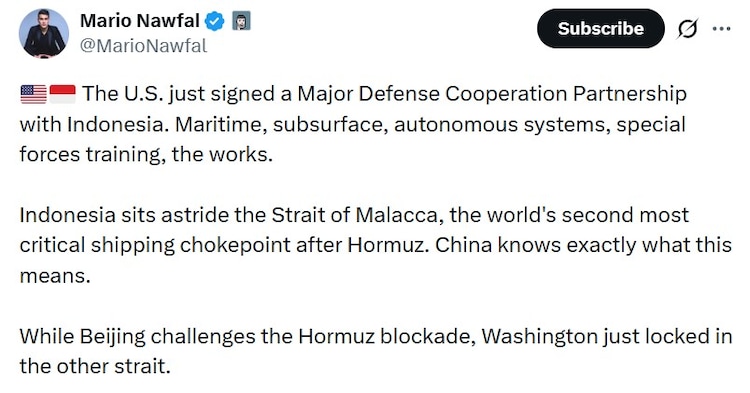
Another geopolitical analyst, Mario Nawfal, spelt it out clearly - "Indonesia sits astride the Strait of Malacca... While Beijing challenges the Hormuz blockade, Washington is just locked in the other strait".
WHY MALACCA STRAIT IS IMPORTANT?
The strait, which connects the Indian Ocean to East and Southeast Asia, accounts for 30% of total oil flows -- even bigger than Hormuz. In fact, it is the main gateway through which China and Japan receive their oil and LNG. As per data, 80% of China's oil imports pass through the strait - a dependence Beijing calls the "Malacca dilemma" - a phrase coined by former president Hu Jintao way back in 2003. The corridor is also indispensable for Beijing's industrial economy and its 'Made in China' products.
In short, more than Hormuz, the Strait of Malacca is the real Achilles' heel for China. And Beijing is not sitting back. Recently, China carried out an extensive ocean-mapping and monitoring exercise across the Pacific and Indian oceans, including near the Strait of Malacca. It has been viewed as a broader attempt by China to prepare itself for any potential blockade of the strait in future conflicts.
While the Strait of Malacca is China's vulnerability, India's geography gives it proximity. This is one of the major reasons why past US presidents have warmed up to India, propping it as a counterbalance to China in the Indian Ocean region. Thus, any US manoeuvres in the strait will need India to be roped in. Stay with us, and we will explain exactly why.
INDIA'S ROLE IN STRAIT OF MALACCA
Around 55% of India's trade moves through the Strait of Malacca and Singapore, known as the SOMS region. For China, a worry is that the mouth of the strait opens perilously close to the southern tip of the Andaman and Nicobar Islands. To put it in perspective, it takes less than 24 hours to reach the Malacca Strait from Port Blair.
Crucially, INS Baaz, India's southernmost military air station at Campbell Bay, gives India the ability to monitor the western approaches of the strait. In fact, it is central to the Great Nicobar Project, which will only strengthen India's strategic presence at the mouth of one of the world's busiest shipping lanes.
While the infrastructure project, which includes a terminal at the Galathea Bay, will not give India an Iran-like leverage, it will make it a major maritime power in the Malacca Strait. "India's Nicobar Islands are an unsinkable aircraft carrier: massive air, naval, and nuclear submarine power," an expert, Arun Pudur, tweeted.
Last year, Singapore also formally acknowledged for the first time India's interest in joining the Malacca Strait Patrol (MSP) to provide security to the vital waterway.
This makes India central if Trump plans any moves in the future.
THE SINGAPORE FACTOR
However, any such US ambition will not be a walk in the park. It is because the Malacca Strait has been at the centre of dispute, largely between Indonesia and Singapore over maritime boundaries and control over nearby small islands.
Now, if we see geographically, the strait runs primarily between Malaysia and Indonesia. Singapore only controls a small stretch at the southeastern exit. However, Singapore, a key US ally, captures most of the strait's commercial value. Ships prefer to stop there due to its efficient and world-class port infrastructure. This makes Singapore one of the largest ship-fueling or bunkering hubs.
Significantly, the maritime sector accounts for 7% of Singapore's GDP and employs nearly 2 lakh people.
It is exactly the reason why Singapore has firmly opposed the move by Iran to impose a toll on ships passing through the Strait of Hormuz. Experts have pointed out that Singapore fears that Indonesia and Malaysia, both of which have larger and better-equipped militaries, might follow Iran's lead in the Strait of Malacca.
"If it's set as a precedent and a toll were to exist on the Strait of Malacca, it would basically kill Singapore's current business model," Arnaud Bertrand, an analyst, tweeted.
Thus, as the US eyes the Strait of Malacca, it needs to be aware of the several pitfalls and gain the confidence of the several players, including India, in the region.