
No Iran-US talks planned: Tehran says engagement via Pakistan as delegation arrives
Iran's foreign minister Abbas Araghchi arrived in Islamabad with a delegation as Pakistan mediates renewed US-Iran talks, with US envoys also heading there to restart stalled negotiations.
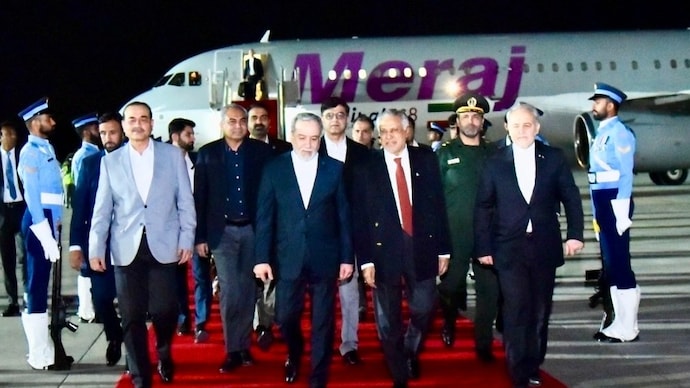

Iranian Foreign Minister Abbas Araghchi arrived in Islamabad on Friday with a senior delegation, signalling renewed diplomatic efforts to revive stalled negotiations between Iran and the US, with Pakistan emerging as a key intermediary.
The Pakistani PMO posted a short video on X showing the Iranian Foreign Minister and his delegation meeting Pakistan Prime Minister Shahbaz Sharif. The meeting was also attended by Deputy Prime Minister and Foreign Minister Muhammad Ishaq Dar and army chief Syed Asim Munir. Further details about the meeting were not shared by the Pakistani government.
IRAN RULES OUT DIRECT MEETINGS WITH US
Meanwhile, a top Iranian official confirmed that there would be no direct US–Iran talks this time, with Pakistan conveying Tehran’s concerns and position to Washington through an indirect channel.
Esmaeil Baqaei, Head of the Centre for Public Diplomacy and spokesperson for Iran’s Foreign Ministry, said that the Iranian delegation would hold meetings with senior Pakistani officials as part of Pakistan’s ongoing mediation efforts aimed at ending what he described as an “American-imposed war of aggression” and restoring peace in the region.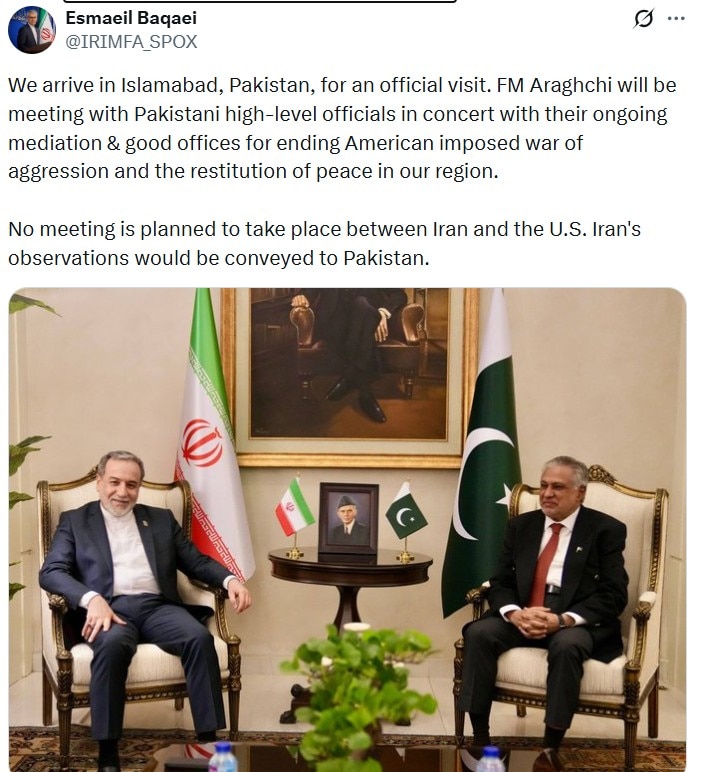
Baqaei clarified that no meeting was planned between Iran and the United States, adding that Tehran’s views and concerns would instead be conveyed to Washington through Pakistan.
PAKISTAN’S MEDIATION EFFORTS GAIN MOMENTUM
Despite the uncertainty, Pakistani officials said efforts are underway to facilitate a second round of dialogue. Islamabad has been quietly working behind the scenes to bring both sides back to the negotiating table, with its role as a mediator gaining traction in recent weeks.
US DELEGATION EXPECTED IN ISLAMABAD
The United States is also preparing diplomatic outreach, with special envoy Steve Witkoff and Jared Kushner expected to arrive in Islamabad for discussions.
White House Press Secretary Karoline Leavitt confirmed the development, stating that talks would be conducted directly but facilitated by Pakistan. She added that Vice President JD Vance would remain engaged from Washington, coordinating with Secretary of State Marco Rubio and the national security team.
TRUMP SAYS IRAN PREPARING OFFER TO MEET US DEMANDS
US President Donald Trump said on Friday that Iran is preparing to make an offer aimed at meeting US demands, as peace talks are expected to resume in Pakistan.
“They’re making an offer and we’ll have to see,” Trump said in a phone interview with Reuters, adding that he is yet to learn the details of the proposal.
He reiterated that any potential agreement must include Iran giving up its enriched uranium and ensuring free movement of oil shipments through the Strait of Hormuz.
Trump also raised concerns over Iran’s leadership, with US officials suggesting internal divisions within Tehran’s power structure. When asked who Washington is negotiating with, he declined to name individuals, saying, “We’re dealing with the people that are in charge now.”
The US President further stated that the American military will continue its blockade of Iranian ports until a deal is reached. On what conditions could lead to lifting the blockade, Trump said he would decide after reviewing Iran’s offer.
DEADLOCK OVER STRAIT OF HORMUZ
Negotiations had previously stalled over key issues, including tensions surrounding the Strait of Hormuz. Iran has linked any future engagement with Washington to developments related to the maritime situation in the region.
Meanwhile, US President Donald Trump on Thursday said he is seeking an “everlasting” agreement with Iran, while maintaining that Washington holds the upper hand in the standoff over the Strait of Hormuz, a critical global energy route.
The United States has yet to find a way to reopen the strait, where Iran has blocked nearly all vessels except its own since the conflict began eight weeks ago. Tehran underscored its control earlier this week by seizing two large cargo ships.
Trump last week imposed a separate blockade on Iranian shipping, a move that Iran says must be reversed before it considers reopening the strait.
Shipping traffic has dropped sharply, with only five vessels passing through the waterway in the past 24 hours, compared to around 130 daily before the conflict, according to shipping data. The limited movement included one Iranian oil products tanker, but no large crude supertankers that typically supply global markets.
German container shipping firm Hapag-Lloyd also confirmed that one of its vessels transited the strait, though it did not provide further details.
DIPLOMATIC PUSH ACROSS CAPITALS
Araghchi had earlier confirmed a multi-leg diplomatic tour covering Islamabad, Muscat, and Moscow, signalling renewed engagement after weeks of deadlock.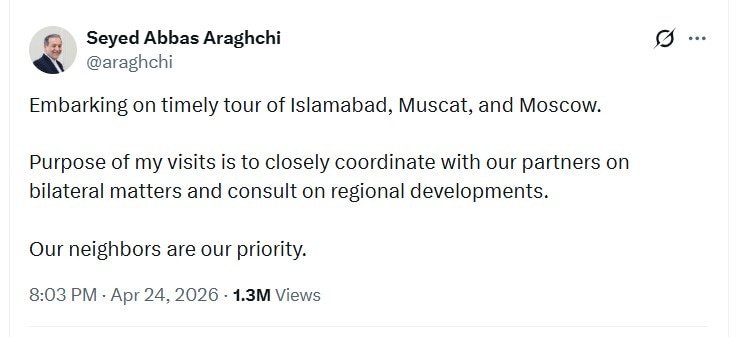
While Tehran has not officially confirmed a second round of talks, parallel diplomatic activity from both sides suggests a coordinated attempt to break the impasse.