
Video: Buildings collapse, streets shake as powerful quake strikes Philippines
Viral videos showed the southern Philippines earthquake shaking cities, collapsing buildings and driving seawater inland. The footage underscored the scale of damage, panic and tsunami fears as authorities issued alerts.
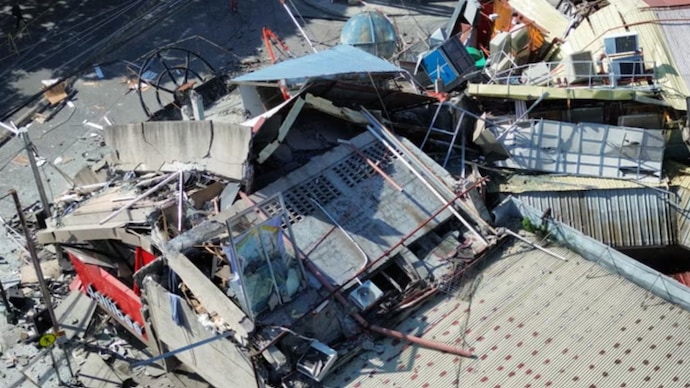

A city camera going dark mid-shake, buildings crumbling into clouds of dust, seawater flooding coastal roads and terrified children scrambling for safety - a flood of viral videos has captured the chaos unleashed by the powerful earthquake that struck the southern Philippines on Monday.
According to the US Geological Survey (USGS), the earthquake measured magnitude 7.8 and struck off Mindanao island at a depth of 39 miles (63 kilometres), triggering tsunami alerts across parts of the Pacific.
BUILDINGS COLLAPSE, DUST FILLS THE AIR
Several videos circulating online appear to show extensive structural damage in parts of Mindanao.
Footage from General Santos City shows a building partially collapsing as the ground shakes beneath it. Another clip appears to show smoke and visible damage near General Santos International Airport in the aftermath of the quake.
A separate video believed to be from an area close to the earthquake's epicentre captures the upper floors of a building crumbling as large plumes of dust rise into the air.
Another widely shared clip appears to show structural failure at a Jollibee building during the violent shaking.
PANIC AND RUSH TO SAFETY
Many videos focused not on damaged buildings but on the fear experienced by residents.
Students were seen running from buildings as the ground shook. In other clips, people clung to motorcycles, walls and nearby objects in an effort to keep their balance.
Several videos showed students gathering in open areas, sitting on the ground and waiting anxiously for the tremors to stop.
CITY CAMERA GOES DARK
One of the most dramatic clips emerged from Davao City, where a live camera recorded the moment the earthquake began.
The footage shows buildings and infrastructure shaking violently before the camera feed abruptly cuts out after a power outage, offering a chilling glimpse of the force of the tremor.
TSUNAMI WAVES SEEN ALONG COAST
As fears of a tsunami spread, videos from coastal communities began surfacing online.
Footage believed to be from Bula in General Santos shows large waves surging along the coastline after the earthquake.
Another widely circulated video from Kalamansig in Sultan Kudarat shows seawater pushing into homes and roads, with floodwaters rapidly spreading through coastal areas.
Authorities urged residents to remain alert as they continued monitoring sea-level changes following the earthquake.
TSUNAMI ALERTS ACROSS THE PACIFIC
The earthquake prompted tsunami alerts from authorities in the Philippines, Indonesia and the United States.
The Philippine Institute of Volcanology and Seismology (Phivolcs) measured the quake at magnitude 7.0 and warned of possible damage and tsunami waves exceeding one metre that could continue for several hours.
Indonesia's Meteorology, Climatology and Geophysics Agency (BMKG) estimated the magnitude at 7.7, while an initial assessment by Germany's GFZ research centre placed it at 8.2.
US tsunami monitoring agencies warned that waves between one and three metres were possible along parts of the Philippines. Forecasts also suggested waves between 0.3 and one metre for parts of Malaysia, while tsunami advisories were issued for Guam and the Commonwealth of the Northern Mariana Islands.
As authorities continued to assess the damage, the viral videos offered a stark picture of the devastation, fear and confusion that unfolded within moments of one of the strongest earthquakes to strike the region in recent years.