
Power shift in Iran? IRGC sidelines president, tightens grip around Mojtaba
Iran's IRGC has reportedly blocked President Pezeshkian's appointments and tightened control over leadership access, deepening political deadlock and raising concerns over growing military dominance in Iran's decision-making system.
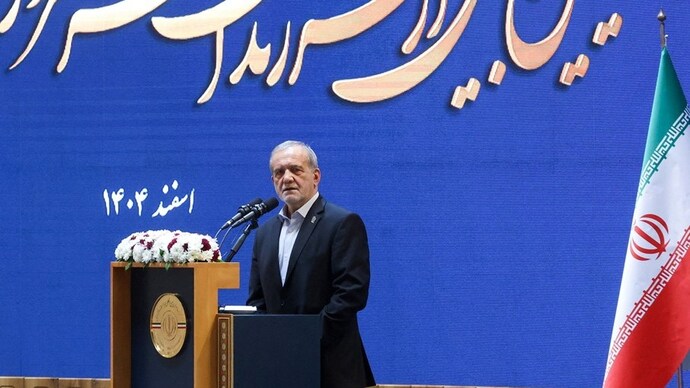

Iran’s powerful military establishment appears to be tightening its grip on the country’s political system, with the Islamic Revolutionary Guard Corps (IRGC) reportedly blocking key presidential appointments and restricting access to the country’s top leadership, according to a report cited by Fox News.
The report, based on findings by Iran International, claims the IRGC has effectively stepped in to control critical state functions, raising fresh questions about who is actually running the country amid escalating internal tensions.
“Iran’s Islamic Revolutionary Guard Corps has blocked President Masoud Pezeshkian’s presidential appointments and erected what sources described as a security cordon around Supreme Leader Mojtaba Khamenei,” the report said.
PRESIDENT FACES POLITICAL DEADLOCK
President Masoud Pezeshkian is said to be facing a complete political deadlock as friction between his administration and military leadership deepens.
His attempt to appoint a new intelligence minister reportedly collapsed after pressure from IRGC commander Ahmad Vahidi, with all proposed candidates rejected.
According to the report, Vahidi insisted that under wartime conditions, “all critical and sensitive positions must be chosen and managed directly by the Revolutionary Guard.”
The situation appears to have escalated further, with the IRGC reportedly controlling access to Supreme Leader Mojtaba Khamenei.
Sources cited in the report said a military council of senior IRGC officials now filters communication to the leadership, preventing government reports from reaching Khamenei and isolating him from the elected administration.
Pezeshkian has allegedly sought urgent meetings but has been unable to establish contact.
NOT A COUP, BUT A LONG TREND
Analysts caution against viewing the developments as a sudden takeover, describing it instead as part of a gradual shift in Iran’s power structure.
“It was always a matter of when, not if, the IRGC was going to step forward even more,” Behnam Ben Taleblu of the Foundation for Defense of Democracies told Fox News Digital.
“But it’s a mistake to assume this is some sort of coup,” he added, arguing the process has been unfolding for years as the regime strengthened its security apparatus.
GROWING DOMINANCE OF THE IRGC
Experts say the IRGC’s expanding role could have far-reaching consequences beyond Iran’s borders. A more dominant Revolutionary Guard could signal a harder line in foreign policy, with Tehran becoming less willing to compromise in negotiations with Washington and more inclined toward military escalation.
The report also points to tensions within Iran’s leadership circle, particularly over succession. A senior official, Ali Asghar Hejazi, is said to have opposed Mojtaba Khamenei succeeding his father, warning that such a move would hand control to the Revolutionary Guard and sideline civilian institutions.
That concern, analysts say, may already be materialising.
A SYSTEM UNDER STRAIN
The IRGC, originally formed after the 1979 revolution, has steadily expanded its influence across Iran’s military, economic and political systems.
The latest developments suggest it may no longer be operating behind the scenes, but increasingly shaping decisions at the highest level.
For President Pezeshkian, who came to power promising reform, the challenge now appears stark — navigating a system where real authority may be slipping further out of civilian hands.