
Fires at refineries in India and four other countries. Global pattern amid Iran war?
A fire at a refinery in Rajasthan, just a day before its inauguration, has delayed its operations. In just 45 days since the Iran war, there have been reports of fire at oil installations in five countries, including the US and Australia. Is there a pattern to the fires amid a war in which energy has been weaponised?
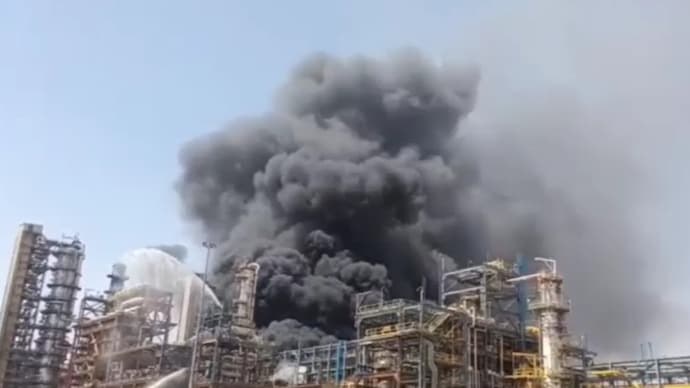

Prime Minister Narendra Modi was all set to inaugurate a refinery at Pachpadra in Rajasthan on Tuesday. This refinery was a vision seen 13 years ago and was all set to be fulfilled. But just a day ahead of the inauguration, a massive fire engulfed its core processing units, stalling the inauguration. A probe is on to ascertain the cause of the fire at the Hindustan Petroleum Corporation Limited (HPCL) Rajasthan Refinery. What is curious is that there seems to be a pattern of oil assets, especially refineries on fire, across the world. This comes even as oil and gas are weaponised amid the war in the Middle East.
Oil refineries in six countries, including the one in India, that are outside the war zone have witnessed disruptions and incidents of fire, from February 28, the day when the US and Israel launched airstrikes on Iran, triggering a wider conflict in the Middle East. There are discussions about the "pattern" of such fires in oil refineries.
Refineries in the United States, Australia, Mexico, Ecuador, and Russia have witnessed disruption due to fires. The case of Russia is different because its oil plants were attacked by Ukraine, with which it has been at war. But all the remaining countries' refineries have reported fire tragedies due to internal issues in the plants and not direct strikes.
There have been fire incidents at two oil assets in India. Other than the fire at HPCL's Rajasthan refinery, ONGC's oil field off Mumbai's shore too reported an incident. The fire at ONGC's facility started on April 4 and was contained.
It was a relief that all units of the Rajasthan refinery are "structurally safe". The Ministry of Petroleum and Natural Gas said that it had constituted a high-level committee to "assess and investigate the root cause behind the incident and take remedial actions on an urgent basis".
HPCL said an initial internal probe suggested leakage of hydrocarbons through one of the valves/flanges in the heat exchanger circuit caused the fire.
These are all mishaps for all we know, but there is a pattern and there's discussion about it. Explosions and fire incidents were reported at two oil facilities in the US—the Valero Port Arthur refinery and the Marathon El Paso refinery. There have been fire incidents at one of the biggest refineries in Australia, and it isn't fully functional yet. Ecuador and Mexico also have seen fire incidents.
Also on April 20, a powerful explosion engulfed 10 fuel tankers and vessels at the Hmawbi River port in Myanmar's Sagaing region. Flames spread quickly, setting the fuel tankers on fire. Emergency crews have been unable to fully contain the blaze, and the fire continued even on Tuesday.
"It hasn't been 24 hours since the fire at the oil refinery in India, and now another "coincidental" fire has engulfed over 10 fuel tankers following a major explosion at the port in Homalin, Sagaing Region, Myanmar. This is getting ridiculous," posted a handle on X.
"Indian oil refineries must take extra steps on security, and sabotage from the inside," Aravind, a verified account on X, posted on April 16, four days before the Rajasthan refinery fire broke out. The handle said they "had a bad hunch" that the "adversaries could burn an oil refinery" in the country. "Adversaries can burn a refinery to increase oil prices for geopolitical reasons and derail India's economy," Aravind wrote on April 16. The HPCL refinery saw the fire incident just four days later, on April 20.
In the US-Israel-Iran war, the biggest takeaway is the dependency of countries across the world on crude oil, natural gas, and petrochemical products.
After the US and Israel attacked Iran, Tehran retaliated with missile and drone strikes on several US bases in the Gulf and also targeted civilian sites of Israel. Iran also attacked oil refineries of the Gulf countries. Iran has also blocked shipments of oil and gas through the narrow Strait of Hormuz. A big chunk of the world's energy supply passes through Hormuz.
The conflict in the Middle East has disrupted the oil and gas market.
In February, crude oil prices were around $66, and in March, the price of crude oil per barrel shot up to more than $100. The two-week ceasefire, which was announced by US President Donald Trump and is set to end this week, saw a marginal dip in crude prices.
Refineries in five different countries were engulfed in fire, reportedly due to technical difficulties or minor leaks, not drones or missiles, because they were not near the war zone, in the 45 days of the US-Iran war.
FIRES AT OIL ASSETS ACROSS WORLD: SEVEN CASES IN A MONTH
The series of fire tragedies in the oil assets of countries outside the war zone began on March 01. The first case of fire was reported in Ecuador, a South American country. Operations had to be halted at Petroecuador's Esmeraldas oil refinery, Ecuador's largest, after a fire broke out in the charge pumps of one of its units. The plant has a processing capacity of 110,000 barrels of oil per day.
On March 17, a refinery in Mexico caught fire. Five people were killed in the blaze. The fire broke out at Olmeca oil refinery after the oily water spread around the perimeter. The refinery is part of Mexico's largest refining installation, and began operations in 2024.
The next case was of an explosion at the Valero Port Athur Energy in Texas on March 23. A diesel hydrotreater caught fire, which led to the explosion. Initially, there were speculations of Iran's involvement, but there was no official confirmation by officials. A high-level investigation was ordered to look into the matter.
On April 4, 10 personnel sustained minor injuries after a fire broke out on ONGC's SHP Platform at Mumbai High. The fire was promptly brought under control and extinguished by emergency response teams. ONGC has not disclosed the cause of the fire.
On April 10, a major fire tragedy was reported in Texas, US. Marathon's El Paso refinery caught fire due to "technical issues", and the company was quick to extinguish the fire.
Australia witnessed a fire at one of its two biggest functioning refineries on April 16, even as it faced pressure to shore up fuel security amid the conflict in the Middle East. Emergency crews rushed to Viva's Corio oil refinery in Geelong, south-west of Melbourne, to control the fire. The refinery, which produces 50% of Victoria's fuel and 10% of the nation's, is still not fully functional, and the government has warned of an impact on petrol production.
Then came the fire at HPCL's refinery in Rajasthan on April 20, a day ahead of its inauguration. Dozens of fire tenders were deployed, and the blaze was controlled later.
WHY ARE OIL REFINERIES ACROSS THE WORLD IN FLAMES?
One North American-based X account claimed this is "no coincidence but a pattern to disrupt the oil supply." After the HPCL Rajasthan Refinery case, writing on X on Monday, Aravind described these incidents of refineries burning across countries as a global pattern to disrupt refined oil supply.
Referring to the situation between the US and Iran in the war, he said, "One side wants to cause an oil crunch, having prepared for the war with all sorts of buffers, and another wants oil to flow in plenty to arm-twist the other more."
Oil has become the biggest weapon in the US-Iran war. There is no comparison between the military strength of the US and that of Iran. Even President Trump had thought that the war with Iran would end in weeks. But after Iran choked the Strait of Hormuz, the only maritime exit for oil and gas exports from the Persian Gulf producers, and hit oil installations of Gulf nations, the war took a different turn. Iran pressured several countries that were not involved in the war by disrupting their oil supply. Oil prices skyrocketed, causing distress to industries across the world.
If the oil refining capabilities of countries get disrupted, both the warring countries could benefit because of their oil reserves. Venezuela has the largest oil reserves in the world, with 303.2 billion barrels, and it is now being controlled by the US after the capture of President Nicolas Maduro. Iran has the third-largest oil reserves in the world, with 208.6 billion barrels. Even as the global oil supply gets disrupted, and if the refineries become non-functional in different countries, it will be those countries with the largest oil reserves that benefit. Interestingly, no refinery in China, which is the world's biggest crude importer, has reported any fire incident.