
US-Iran War Highlights: No ceasefire in south Lebanon as fight against Hezbollah continues, IDF chief says

All updates to this blog have ended.
All updates to this blog have ended.
Middle East Crisis: Putin discusses Iran war resolution with Trump
Russia’s President Vladimir Putin discussed possible ways to resolve the Iran conflict during a phone call with US President Donald Trump, according to the Kremlin. Putin also proposed a temporary ceasefire in Ukraine to mark the anniversary of the end of World War II next month, a Kremlin aide said.
Middle East Crisis: US blockade ineffective, fuel supply stable, Iran oil minister says
Iran’s Oil Minister Mohsen Paknejad said the United States blockade of Iranian ports has had limited impact, insisting fuel supply and distribution remain stable across Iran. Speaking to IRIB, he said oil sector workers are operating around the clock to avoid disruptions. The blockade, in place since April 13 and covering key routes including the Strait of Hormuz, has raised concerns that Iran could face storage constraints and be forced to cut production.
Middle East Conflict: Israel says it struck Hezbollah targets in Lebanon overnight
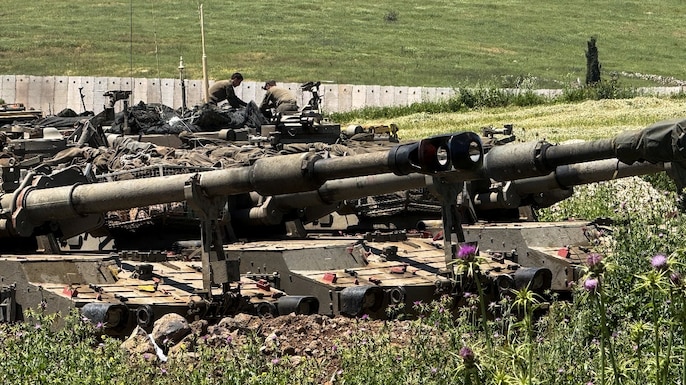
Israel Defense Forces said it carried out 20 overnight strikes in southern Lebanon, targeting what it described as Hezbollah “command centres and military structuresâ€.
In one incident, the military said a drone strike killed a Hezbollah fighter who was approaching Israeli troops. Despite a declared ceasefire, Israel said it will continue to “operate to remove threats†to its forces and civilians in the north.
Middle East Crisis: Iran blockade to continue until nuclear deal is reached, says Trump
US President Donald Trump said the United States will maintain its blockade on Iran until a nuclear deal is reached, describing the measure as “more effective†than military strikes.
In remarks to Channel 12, Trump said Iran is “choking†under the blockade and is seeking a deal to ease pressure. He also warned that Iran’s energy infrastructure could face serious strain if oil exports remain restricted.
Middle East Conflict: War is not a solution, says Iran deputy FM
Iran’s Deputy Foreign Minister Saeed Khatibzadeh said war is not a solution to the ongoing crisis, stressing that diplomacy remains the only viable path as talks with the United States remain stalled.
“War is not a solution. It is part of the problem,†he said, adding that alternatives to diplomacy are “unattractiveâ€. He also noted that Iran has put forward proposals in recent weeks to end the conflict through negotiations based on “equal terms and conditionsâ€.
Middle East Crisis: Iran’s Araghchi speaks with S Jaishankar on Hormuz
Iran’s Foreign Minister Abbas Araghchi held a phone call with India’s External Affairs Minister Subrahmanyam Jaishankar to discuss developments related to the Strait of Hormuz, along with broader regional and international issues, Iran’s foreign ministry said.
Both leaders also reviewed the ceasefire situation and bilateral ties, with further details expected to be announced later.
With inputs from Pranay Upadhyaya
Hegseth backs Trump’s $1.5 trillion US defence budget
Pete Hegseth said Donald Trump’s proposed $1.5 trillion defence budget for fiscal year 2027 “reflects the urgency of the momentâ€, as he testified in support of the request.
He added that he “appreciates the opportunity†to present the case for what he described as a landmark defence spending plan.
Middle East Crisis: Five killed in Israeli attacks in southern Lebanon
Israeli strikes in southern Lebanon have killed at least five more people, according to the National News Agency. One attack in Jouaiyya left two dead, with rescuers searching for four missing.
A separate strike in al-Hanniye killed three members of the same family, the report said.
Middle East Conflict: Democrats question Hegseth on Iran war plan
Democratic lawmakers pressed US Defence Secretary Pete Hegseth to clarify the direction of the war with Iran during a tense House hearing marked by a packed room and overflow crowds.
Adam Smith, the top Democrat on the House Armed Services Committee, called it “absurd†to describe the Pentagon’s strategy as realistic. “We started a full scale war in the Middle East against Iran to try to reshape the Middle East,†he said, adding that Hegseth must explain the administration’s goals.
“Where is this going? What is the plan…? We’ve seen the cost, and the cost is very, very high,†he said.
Middle East crisis: Israel mistaken on security approach, says Lebanon President
Lebanon President Joseph Aoun has said Israel is mistaken if it believes security can be achieved through “violations and the destruction of border villagesâ€. He stressed that stability depends on the full deployment of the Lebanese state’s authority across the south.
The Lebanon President said efforts are underway to reach a solution through negotiations, but insisted a ceasefire must come first. He added that Beirut is waiting for the United States to set a date for talks.
Middle East Conflict: US-Iran deal needs political will, IAEA chief says
A nuclear deal between the United States and Iran will depend on “political willâ€, Rafael Grossi said, pointing to ongoing disagreements over the sequence of key steps. The International Atomic Energy Agency has held talks with both sides, but gaps remain.
Iran has proposed delaying nuclear discussions while easing tensions in the Strait of Hormuz if Washington lifts its blockade. Grossi said both sides remain divided on what should come first. “Where the frustration kicks in… is that they do not seem to come to agreement… on what needs to be done first,†he said.
Middle East Conflict: Iran’s enriched uranium likely still at Isfahan, IAEA chief says
Most of Iran’s highly enriched uranium is likely still stored at its Isfahan nuclear site, according to Rafael Grossi. The head of the International Atomic Energy Agency said satellite images show damage from recent US-Israeli strikes, but the material appears to remain in place. Iran currently holds 440.9 kg of uranium enriched up to 60%, with about 200 kg believed to be stored in tunnels at the site.
Iran war: IAEA discusses moving Iran’s enriched uranium with Russia, others
The International Atomic Energy Agency has held discussions with Russia and other parties about the possibility of removing Iran’s highly enriched uranium from the country, Director General Rafael Grossi said. He said a significant portion of the material was believed to be stored in Isfahan during the June 2025 strikes by Israel and the United States, and “it has been there ever since.â€
He added that transferring the uranium out of Iran would be a complex process, requiring either a political agreement or a major US military operation in hostile territory. “What’s going to be important is that that material leaves Iran†or is blended down to reduce its level of enrichment, Grossi said.
Middle East Conflict: Russia yet to decide on Bushehr staff return to Iran
Russia has not yet taken a decision on whether to send its personnel back to the Bushehr Nuclear Power Plant, according to Alexey Likhachev, head of state nuclear corporation Rosatom. Likhachev said the situation around the plant remains uncertain, and any move to return staff will depend on security conditions in the region.
Middle East Crisis: Trump, oil firms mull months-long Iran blockade
US President Donald Trump and top oil industry executives have discussed plans to sustain the blockade of Iran for months if required, a White House official told news agency Reuters, signalling a long-term strategy to maintain pressure on Tehran.
Middle East Conflict: Hegseth to face Congress for first time since Iran war
US Defense Secretary Pete Hegseth is set to appear before lawmakers for the first time since the outbreak of the Iran war. The session comes at a critical moment, with the administration facing mounting scrutiny over its military strategy and spending priorities following the escalation in the Middle East.
According to the Associated Press, the hearing will take place before the House Armed Services Committee, where Hegseth is expected to field questions not only on the ongoing conflict with Iran but also on the administration’s long-term defence outlook. Lawmakers are likely to press him on operational decisions, troop deployments and the broader implications of the war.
Middle East Crisis: Russia backs OPEC stability role amid UAE exit plan
The Kremlin has reaffirmed its commitment to the OPEC+, describing the grouping as a key stabilising force in global energy markets, even as the United Arab Emirates moves ahead with plans to leave. Speaking to journalists, Kremlin spokesperson Dmitry Peskov said: “This is a very important area of work and it is especially crucial at the current moment, when energy markets are, to put it mildly, in turmoil,†he said.
Peskov added that Moscow respects Abu Dhabi’s decision, while noting that it expects the UAE to continue playing a constructive role. “We welcome statements from Abu Dhabi that the Emirates will continue to take a responsible position in the energy market,†he said.
Middle East Conflict: EU chief urges targeted energy aid as Iran war drives costs up
The president of the European Commission, Ursula von der Leyen, has warned EU countries to carefully direct energy support towards vulnerable households and industries, saying poorly targeted aid could waste billions of euros. Speaking to EU lawmakers in Strasbourg, von der Leyen stressed that member states must avoid repeating past mistakes. She pointed to the 2022 energy crisis, when Russia leveraged its energy supplies to weaken European backing for Ukraine.
“Our over dependency on imported fossil fuels makes us vulnerable,†she said. Von der Leyen added that the bloc should accelerate efforts to reduce reliance on external energy sources by investing more heavily in renewable energy and nuclear power, in a bid to shield the EU economy from future shocks.
Middle East Crisis: UK urges refineries to maximise jet fuel supply
Britain has asked its refineries to maximise jet fuel output as part of contingency planning to keep supplies stable, Energy Department Minister Michael Shanks said.
The move comes as airlines brace for rising fuel costs linked to the war involving Iran, just ahead of the peak holiday season. On Tuesday, the head of the International Air Transport Association warned that the jet fuel crunch is likely to hit Asia first, before spreading to Europe, and later to Africa and Latin America.