
Vladimir Putin decodes why Brics nations are moving beyond the dollar
At the SPIEF plenary session moderated by India Today's Geeta Mohan, Vladimir Putin argued that growing distrust of Western sanctions, financial controls and asset freezes is pushing Brics nations and other countries away from the US dollar and euro.
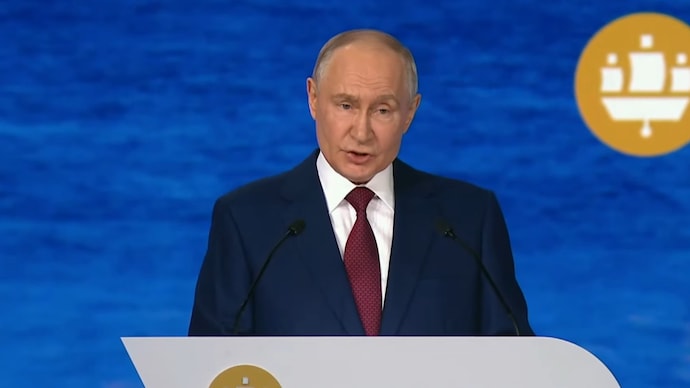

Russian President Vladimir Putin on Friday delivered a sweeping critique of the Western-dominated global financial order, claiming that countries across the world, particularly Brics nations, are steadily reducing their dependence on the US dollar and euro amid growing distrust over sanctions, asset freezes and Western financial controls.
Speaking at a plenary session of the Saint Petersburg International Economic Forum, moderated by India Today's Geeta Mohan, Putin said the rise of Brics nations and the Global South was fundamentally reshaping global trade, finance and technology systems, accelerating the transition toward a multipolar world order.
"We see the short-sighted policies pursued by the European bureaucracy, which is accompanied by aggressive rhetoric and leads to further loss of Europe's position in the world economy. Moreover, it undermines regional as well as global security. As a matter of fact, the European elites are provoking chaos, and they are trying to plunge more and more countries into this chaos," the Russian President said, referring to the Middle East.
He argued, "This is a consequence of the fact that, over the last few decades, the world has been undergoing a profound structural transformation, which is not merely a transition from one stage of the cycle to another. The very paradigm of global development is shifting".
Putin directly linked the growing shift away from the dollar to what he described as the misuse of Western financial systems for geopolitical purposes.
"Settlements, technology, logistics, and sometimes even access to information can be switched off in the blink of an eye in order to punish those who choose to act in their own national interests," he said. According to him, this created "a deliberately created system of dependence or system for taking someone else's resources out of them".
The Russian President, addressing the session moderated by India Today's Geeta Mohan, argued that nations, companies and investors now increasingly fear that their access to Western financial infrastructure could be abruptly cut off.
"All countries, without exception, now understand that just as Russia can instantaneously lose access to their legitimate assets denominated in USD or euro, they can also lose access to the Western financial and payment infrastructure," Putin said.
Referring to sanctions imposed on Russia over the Ukraine conflict, Putin said the freezing of Russian reserves had permanently damaged confidence in Western currencies.
"Sanctions and basically the theft of Russia's international reserves has had an irreversible effect on the positions of the world currencies, namely the US dollar and euro," he said.
Putin claimed countries were increasingly turning to alternative systems because of these concerns.
"They are transitioning to payments in national currencies. They are making wider use of alternative payment systems, increasing the role of digital financial assets as well as the digital currencies of their central banks," he said. He added that Russia now conducts most of its trade with major partners in national currencies, with the ruble accounting for "sixty-five per cent or so" of Russian exports.
The Russian President repeatedly highlighted the growing economic weight of Brics nations, presenting the bloc as the primary driver of future global growth. He said Brics countries accounted for 49 per cent of global GDP growth over the last five years, compared to 18 per cent for the G7. He further said Brics now represents 40 per cent of global GDP based on purchasing power parity, while the G7 accounts for less than 20 per cent.
"So Brics has already overtaken the G7, and it did so back in twenty-twenty. But this gap is increasing," Putin said, adding that Brics economies are projected to grow by more than four percent annually, compared to around one point one per cent for G7 countries.
Putin also argued that the centre of global commerce was steadily moving eastward and southward. "The centre of the global trade, as well as the financial system, is going to shift. It is already shifting, and the trend is going to persist," he said.
According to Putin, international trade routes and logistics systems are increasingly bypassing traditional Western-controlled hubs. He pointed to projects including the North-South Corridor, the Transarctic Transportation Route, and trade links through the Caspian Sea, Central Asia, the Black Sea and the Middle East as evidence of an emerging alternative economic architecture.
Putin also accused Western countries of undermining the rules-based trading order they once promoted. "When it benefited them, they promoted the World Trade Organisation (WTO). They invited other countries to join. But once the West started to lose in this competition, universal common rules for the trade introduced by the WTO lost their interest to them," he said.
He said the growing use of unilateral sanctions and trade restrictions had weakened confidence in global institutions. "Once there is no trust, the institution can no longer function properly,” Putin added, saying countries were instead turning toward bilateral and regional trade arrangements.
While Western nations continue to defend sanctions as a legitimate response to Russia’s actions, the Russian President argued that the growing use of financial restrictions and asset freezes is accelerating the fragmentation of the global economic order and driving countries toward alternative trade, payment and financial systems outside Western control.