Plot twists, panic, and public outrage: Why CBSE's OSM crisis feels like peak OTT drama
CBSE's On-Screen Marking (OSM) controversy has unfolded like a high-stakes OTT drama. What began as routine post-result complaints escalated into claims of system failure and cybersecurity concerns, triggering nationwide backlash. Union Education Minister Dharmendra Pradhan took responsibility, assured corrective action, and defended the digital reform initiative system.
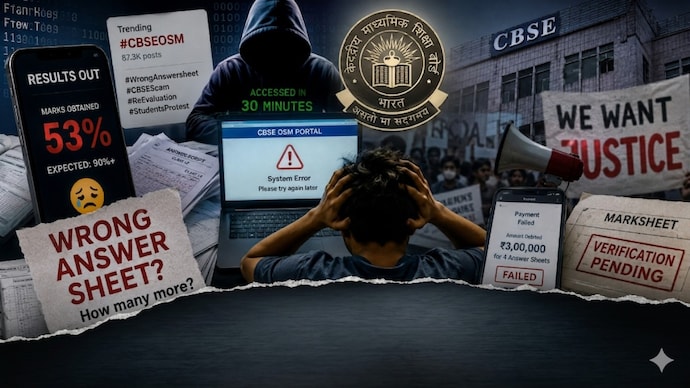
In India, an examination season without controversy now feels almost unusual. Every year brings the same familiar rhythm, anxious students, disappointed reactions, social media outrage, and renewed demands for re-evaluation. But the backlash surrounding CBSE’s On-Screen Marking (OSM) system refused to stay within that predictable script. What began as routine complaints over unexpectedly low marks soon escalated into a story that felt less like an education reform update and more like a high-stakes digital thriller unfolding in real time.
Within days, the controversy took on the shape of a full-blown OTT-style cyber drama. Portals crashed repeatedly. Students alleged they had received incorrect or mismatched answer sheets. Verification deadlines kept shifting without clarity. Claims of cybersecurity loopholes began circulating widely online. And then came the twist that pushed the narrative into overdrive: a 19-year-old claimed he had accessed parts of the system within “30 minutes”.
With every new claim, the debate moved further away from marks and percentages. It turned into a larger question of trust, in technology, in process, and in the system responsible for evaluating millions of academic futures. For nearly 17 lakh students on the edge of college admissions and cut-off-driven anxiety, this was no longer a technical issue. It was a real-time disruption of their future.
CHAPTER 1: WHEN EFFICIENCY MET RESISTANCE, THE BEGINNING OF CHAOS
This year, the Central Board of Secondary Education introduced its ambitious On-Screen Marking (OSM) system for Class 12 board examinations. Under this digital framework, nearly 98.66 lakh answer sheets were scanned and evaluated online by around 70,000 examiners across the country.
On paper, the system promised speed, uniformity, and greater transparency, with automated totalling and reduced human error. But the promise of a seamless digital upgrade began to crack the moment results were declared on May 13.
Early signals of unease quickly turned into visible outrage. The overall Class 12 pass percentage dropped from 88.39% in 2025 to 85.2% in 2026. Soon after, social media was filled with posts from students claiming unexpectedly low marks in core subjects like Physics, Chemistry, Biology, and Mathematics. Screenshots of scorecards went viral, with students alleging losses of 20, 30, or even 40 marks compared to expectations.
And just like that, the noise turned into a storm.
Parents began cross-checking board scores with pre-board results and coaching test performances. The gap, many argued, was too wide to dismiss as a coincidence. Students alleged incomplete checking, unfair marking, and, in some cases, unclear or blurred scanned answer sheets.
What started as complaints about “strict evaluation” quickly evolved into something sharper; a crisis of confidence in the digital marking system itself.
CHAPTER 2: TRANSPARENCY OPENS A NEW FRONT
As outrage intensified, CBSE introduced a revised grievance mechanism allowing students to access scanned copies of their evaluated answer sheets before applying for verification or re-evaluation.
In principle, it was meant to build trust. In practice, it widened the fault lines.
Instead of calming concerns, the move triggered a surge in demand. Reports suggested applications for scanned copies hit record levels, with nearly every fourth student seeking access to their evaluated scripts. What was intended as a transparency measure instead became evidence of how deeply the system’s credibility had been shaken.
CHAPTER 3: THE PORTAL BREAKS UNDER PRESSURE
The moment students began applying for scanned answer sheets, the system itself began to falter.
Payments failed mid-process, applications froze without warning, and several students alleged multiple deductions for a single request. Some even claimed the portal generated extreme charges, with one widely circulated case reporting nearly billed Rs. 3 lakh for just four answer sheets.
What was meant to restore confidence instead became the most visible crack in the digital rollout.
As frustration mounted, CBSE acknowledged technical glitches and assured refunds for affected students. But by then, the damage had already moved beyond technical errors; it had become a narrative of breakdown.
To contain the situation, the board brought in experts from IIT Madras and IIT Kanpur, along with support from four public sector banks, to stabilise the failing infrastructure.
CHAPTER 4: THE ANSWER SHEET SWAP THAT CHANGED THE STORY
Just when the controversy seemed saturated, a new allegation escalated it further.
The claim spread rapidly across social media.
CBSE later admitted that an incorrect answer sheet had indeed been uploaded and subsequently shared the correct one with the student. But the clarification did little to contain the fallout.
Because the real question had already shifted: if one student’s identity-linked answer sheet could be mismatched, how many others might be affected?
At that point, the issue was no longer about marks or evaluation standards. It had entered a more unsettling space, the accuracy of identity itself within a fully digital examination system.
CHAPTER 5: THE HACKER CLAIM ADDS A NEW LAYER
Then came what looked like the ultimate OTT plot twist.
A Class 12 student, claiming to be an ethical hacker, alleged that he accessed parts of CBSE’s evaluation ecosystem within 30 minutes, months before the controversy surfaced publicly.
He claimed potential access to examiner-level functions and evaluator details.
CBSE strongly denied any breach of its current evaluation portal, stating that only a testing environment with sample data had been accessed, while the live OSM system remained secure.
Still, the claim added a fresh layer of uncertainty. Even unverified, it amplified public anxiety about the security of a system responsible for evaluating millions of academic records.
CHAPTER 6: VENDOR SCRUTINY ENTERS THE FRAME
As online debate intensified, attention shifted towards Coempt Eduteck, a Hyderabad-based third-party vendor associated with parts of the digital evaluation infrastructure.
The company came under scrutiny from students, parents, and educators, questioning how a system of such a scale could appear to face disruptions across multiple layers simultaneously.
However, no official findings have established wrongdoing against the vendor so far.
Even so, the episode deepened the larger narrative of systemic fragility.
CHAPTER 7: THE OPPOSITION ENTERS THE SCENE
Inevitably, the controversy moved beyond classrooms and portals into the political arena.
Leader of the Opposition Rahul Gandhi accused the Centre of failing to take responsibility for what he called “massive tampering” in CBSE results, questioning the lack of accountability despite weeks of disruption.
“And Mr. Modi? As always, no answers, no accountability, no shame,” he wrote on X.
He also questioned the awarding of contracts to Coempt, citing its previous identity as Globarena, and demanded a judicial enquiry and SIT probe into the matter.
CHAPTER 8: 'I TAKE RESPONSIBILITY,' SAYS EDUCATION MINISTER
As pressure mounted, Union Education Minister Dharmendra Pradhan finally addressed the issue, stating that he takes responsibility and assuring that “no one will be spared” if irregularities are found.
“I take responsibility. It will be fixed, and a solution will be found. We are all working on that task,” he said.
He defended the digital evaluation system while acknowledging student stress, noting that nearly 98 lakh answer scripts were processed for about 17 lakh students, involving an estimated 40 crore scanned pages.
Responding to criticism from the Opposition, he said CBSE had followed due process and accused critics of opposing systems linked to Digital India.
At the same time, he urged restraint in public statements, warning that escalating rhetoric could worsen anxiety among already stressed students.
EPILOGUE: A SYSTEM UNDER THE SPOTLIGHT
So, is this the climax of the controversy, or just another episode in an unfolding series?
That question remains unanswered.
But one thing is already clear: CBSE’s OSM rollout, intended as a step towards modernisation, has instead triggered a rare collision of technology, trust, and public sentiment.
And in that collision, what was meant to be a reform story began to feel like something else entirely, a high-drama reminder that in the age of digitisation, scale without readiness can turn even an examination system into a nationwide crisis.
In India, an examination season without controversy now feels almost unusual. Every year brings the same familiar rhythm, anxious students, disappointed reactions, social media outrage, and renewed demands for re-evaluation. But the backlash surrounding CBSE’s On-Screen Marking (OSM) system refused to stay within that predictable script. What began as routine complaints over unexpectedly low marks soon escalated into a story that felt less like an education reform update and more like a high-stakes digital thriller unfolding in real time.
Within days, the controversy took on the shape of a full-blown OTT-style cyber drama. Portals crashed repeatedly. Students alleged they had received incorrect or mismatched answer sheets. Verification deadlines kept shifting without clarity. Claims of cybersecurity loopholes began circulating widely online. And then came the twist that pushed the narrative into overdrive: a 19-year-old claimed he had accessed parts of the system within “30 minutes”.
With every new claim, the debate moved further away from marks and percentages. It turned into a larger question of trust, in technology, in process, and in the system responsible for evaluating millions of academic futures. For nearly 17 lakh students on the edge of college admissions and cut-off-driven anxiety, this was no longer a technical issue. It was a real-time disruption of their future.
CHAPTER 1: WHEN EFFICIENCY MET RESISTANCE, THE BEGINNING OF CHAOS
This year, the Central Board of Secondary Education introduced its ambitious On-Screen Marking (OSM) system for Class 12 board examinations. Under this digital framework, nearly 98.66 lakh answer sheets were scanned and evaluated online by around 70,000 examiners across the country.
On paper, the system promised speed, uniformity, and greater transparency, with automated totalling and reduced human error. But the promise of a seamless digital upgrade began to crack the moment results were declared on May 13.
Early signals of unease quickly turned into visible outrage. The overall Class 12 pass percentage dropped from 88.39% in 2025 to 85.2% in 2026. Soon after, social media was filled with posts from students claiming unexpectedly low marks in core subjects like Physics, Chemistry, Biology, and Mathematics. Screenshots of scorecards went viral, with students alleging losses of 20, 30, or even 40 marks compared to expectations.
And just like that, the noise turned into a storm.
Parents began cross-checking board scores with pre-board results and coaching test performances. The gap, many argued, was too wide to dismiss as a coincidence. Students alleged incomplete checking, unfair marking, and, in some cases, unclear or blurred scanned answer sheets.
What started as complaints about “strict evaluation” quickly evolved into something sharper; a crisis of confidence in the digital marking system itself.
CHAPTER 2: TRANSPARENCY OPENS A NEW FRONT
As outrage intensified, CBSE introduced a revised grievance mechanism allowing students to access scanned copies of their evaluated answer sheets before applying for verification or re-evaluation.
In principle, it was meant to build trust. In practice, it widened the fault lines.
Instead of calming concerns, the move triggered a surge in demand. Reports suggested applications for scanned copies hit record levels, with nearly every fourth student seeking access to their evaluated scripts. What was intended as a transparency measure instead became evidence of how deeply the system’s credibility had been shaken.
CHAPTER 3: THE PORTAL BREAKS UNDER PRESSURE
The moment students began applying for scanned answer sheets, the system itself began to falter.
Payments failed mid-process, applications froze without warning, and several students alleged multiple deductions for a single request. Some even claimed the portal generated extreme charges, with one widely circulated case reporting nearly billed Rs. 3 lakh for just four answer sheets.
What was meant to restore confidence instead became the most visible crack in the digital rollout.
As frustration mounted, CBSE acknowledged technical glitches and assured refunds for affected students. But by then, the damage had already moved beyond technical errors; it had become a narrative of breakdown.
To contain the situation, the board brought in experts from IIT Madras and IIT Kanpur, along with support from four public sector banks, to stabilise the failing infrastructure.
CHAPTER 4: THE ANSWER SHEET SWAP THAT CHANGED THE STORY
Just when the controversy seemed saturated, a new allegation escalated it further.
The claim spread rapidly across social media.
CBSE later admitted that an incorrect answer sheet had indeed been uploaded and subsequently shared the correct one with the student. But the clarification did little to contain the fallout.
Because the real question had already shifted: if one student’s identity-linked answer sheet could be mismatched, how many others might be affected?
At that point, the issue was no longer about marks or evaluation standards. It had entered a more unsettling space, the accuracy of identity itself within a fully digital examination system.
CHAPTER 5: THE HACKER CLAIM ADDS A NEW LAYER
Then came what looked like the ultimate OTT plot twist.
A Class 12 student, claiming to be an ethical hacker, alleged that he accessed parts of CBSE’s evaluation ecosystem within 30 minutes, months before the controversy surfaced publicly.
He claimed potential access to examiner-level functions and evaluator details.
CBSE strongly denied any breach of its current evaluation portal, stating that only a testing environment with sample data had been accessed, while the live OSM system remained secure.
Still, the claim added a fresh layer of uncertainty. Even unverified, it amplified public anxiety about the security of a system responsible for evaluating millions of academic records.
CHAPTER 6: VENDOR SCRUTINY ENTERS THE FRAME
As online debate intensified, attention shifted towards Coempt Eduteck, a Hyderabad-based third-party vendor associated with parts of the digital evaluation infrastructure.
The company came under scrutiny from students, parents, and educators, questioning how a system of such a scale could appear to face disruptions across multiple layers simultaneously.
However, no official findings have established wrongdoing against the vendor so far.
Even so, the episode deepened the larger narrative of systemic fragility.
CHAPTER 7: THE OPPOSITION ENTERS THE SCENE
Inevitably, the controversy moved beyond classrooms and portals into the political arena.
Leader of the Opposition Rahul Gandhi accused the Centre of failing to take responsibility for what he called “massive tampering” in CBSE results, questioning the lack of accountability despite weeks of disruption.
“And Mr. Modi? As always, no answers, no accountability, no shame,” he wrote on X.
He also questioned the awarding of contracts to Coempt, citing its previous identity as Globarena, and demanded a judicial enquiry and SIT probe into the matter.
CHAPTER 8: 'I TAKE RESPONSIBILITY,' SAYS EDUCATION MINISTER
As pressure mounted, Union Education Minister Dharmendra Pradhan finally addressed the issue, stating that he takes responsibility and assuring that “no one will be spared” if irregularities are found.
“I take responsibility. It will be fixed, and a solution will be found. We are all working on that task,” he said.
He defended the digital evaluation system while acknowledging student stress, noting that nearly 98 lakh answer scripts were processed for about 17 lakh students, involving an estimated 40 crore scanned pages.
Responding to criticism from the Opposition, he said CBSE had followed due process and accused critics of opposing systems linked to Digital India.
At the same time, he urged restraint in public statements, warning that escalating rhetoric could worsen anxiety among already stressed students.
EPILOGUE: A SYSTEM UNDER THE SPOTLIGHT
So, is this the climax of the controversy, or just another episode in an unfolding series?
That question remains unanswered.
But one thing is already clear: CBSE’s OSM rollout, intended as a step towards modernisation, has instead triggered a rare collision of technology, trust, and public sentiment.
And in that collision, what was meant to be a reform story began to feel like something else entirely, a high-drama reminder that in the age of digitisation, scale without readiness can turn even an examination system into a nationwide crisis.

