Nobody warned us: Engineering students say JEE barely prepares you for college
They spent years mastering Physics, Chemistry and Maths to crack JEE. But once college began, many engineering students realised nobody had prepared them for teamwork, coding, networking, communication, stress, or real-world problem-solving. Now, these engineering students are revealing the skills they wish they had learnt before entering college life.
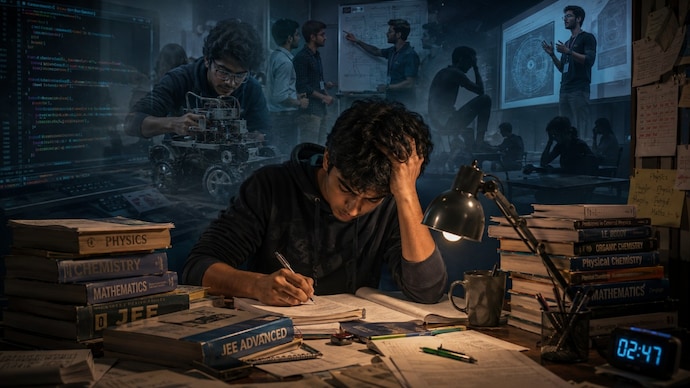
For most JEE aspirants, life shrinks into coaching classes, mock tests, rank predictions and endless MCQs. Sleep schedules collapse, hobbies disappear and everything starts revolving around one exam.
But many students say the real shock came after they finally entered engineering college.
Suddenly, marks alone were not enough. Students who had mastered formulas struggled with communication, teamwork, coding, networking and even basic confidence.
Now, engineering students across colleges are opening up about the skills they wish they had built alongside JEE preparation, and why cracking the exam was only the beginning:
AVIPSA, BTECH, COMPUTER SCIENCE AND ENGINEERING, 2ND SEMESTER, MANAV RACHNA UNIVERSITY
"While preparing for JEE, a large part of the focus is naturally on entrance exam preparation. While studying hard is important, there are several other skills that also make up a successful engineer.
Communication, time management, teamwork and conflict resolution are some of the skills that are equally important in engineering and professional environments.
Engineers often work in teams and the ability to collaborate and communicate effectively makes a huge difference during projects and practical work.
Another set of valuable skills are those related to technical work, such as programming knowledge and understanding technical concepts.
Many engineering students have limited exposure to these areas before starting university and this can make the transition into engineering more challenging initially.
Additionally, students preparing for JEE may also benefit from developing stronger logical thinking and problem-solving abilities alongside exam preparation, as these skills become extremely useful during engineering coursework and practical applications.
Lastly, many students feel that creative problem-solving, understanding how theory applies in real-life situations and managing stress are equally important skills that deserve attention alongside JEE preparation.
Building strong peer relationships, learning from others, and taking care of mental well-being also become extremely important later during engineering and professional life."
AARNAV AJIT LAD, FIRST YEAR BTECH COMPUTER SCIENCE AND ENGINEERING, DR. VISHWANATH KARAD MIT WORLD PEACE UNIVERSITY, PUNE
"The world turned lopsided when I entered college. Everything I thought would make me excel in college simply did not apply. There I was, studying day and night, cramming textbooks, spreading it all over test papers. I believed success meant locking myself in, working hard, maximising productivity.
Almost completing my first year of BTech in Computer Science and Engineering, I realised the ‘success’ I chased was only to get into college, not through. The definitions of hardwork, productivity and success changed completely.
Honestly, maintaining a good GPA keeps you sorted. The real challenge is preparing yourself to thrive beyond the classroom.
The skills I wish I had built alongside JEE preparation boil down to three: Time-Management, Research and Networking (the TRN formula.)
Time is your real currency. Manage it well, and you find space for everything you want to do.
Research keeps you six steps ahead. Knowing more about one important topic daily makes college far less overwhelming.
Your network is your net worth. You are the average of the people around you, and a strong network fills the gaps your research cannot.
Mastering these skills would have definitely made me stronger now, but also strengthened my JEE preparation."
ARAVINDAN D, SECOND YEAR AEROSPACE ENGINEERING, KCG COLLEGE OF TECHNOLOGY
"When I cleared the JEE, I was initially allotted a seat in Civil Engineering at NIT, Puducherry. However, I knew my heart was in the skies and propulsion systems, so I made the bold decision to drop that seat and pursue Aerospace Engineering instead. This journey taught me that true success is built on a foundation of clarity and following your genuine interests.
My preparation was defined by a peaceful, late-night study routine where I focused on goal-oriented targets rather than counting hours. To protect my focus, I enforced a strict ‘Do Not Disturb’ policy on my phone, treating it purely as a tool for doubt resolution.
In subjects like Physics and Inorganic Chemistry, I moved beyond rote memorisation by seeking the logical ‘why’ behind every formula.
Looking back, I realise that while MCQs clear exams, real-world engineering requires much more. I wish I had explored technical skills like Python or CAD earlier to prepare for the hands-on nature of aerospace design.
My advice to Class 11 students is simple: build your basics from the ground up, prioritise your health, and research engineering branches deeply. Don't just follow the crowd; choose the path that keeps you curious."
SRIRAM, SECOND-YEAR AEROSPACE ENGINEERING, KCG COLLEGE OF TECHNOLOGY
"Having successfully qualified for the JEE, I’ve come to realise that the ‘qualified’ tag is only half the battle. As a general category candidate, the stakes are significantly higher; simply clearing the cut-off isn't enough to secure a seat in a top-tier institution.
To actually land a spot, you need to push for a much higher percentile, which adds an entirely different layer of pressure to the preparation process. Looking back from the perspective of a second-year college student, I’ve gained a lot of clarity on what that grind actually requires and how it differs from the reality of engineering.
My own preparation was defined by early morning discipline rather than the stereotypical ‘night owl’ marathon sessions. I started my days at 5 am, revising the previous day’s syllabus while my mind was freshest.
I quickly learnt that long, uninterrupted hours usually lead to burnout; instead, I relied on frequent breaks and a daily to-do list to keep my momentum steady.
Success in core subjects really came down to regular revision and keeping a meticulous ‘error book.’ I treated NCERT textbooks as the ultimate bible, ensuring I mastered the theory before even touching practice questions.
By documenting every mistake from weekly mock tests, I turned my failures into a structured roadmap for improvement.
However, being in college now has highlighted the ‘missing pieces’ of that intense coaching grind. While cracking MCQs is essential for entry, they don’t prepare you for the professional world where skills like Python programming and team communication are what actually define your success.
I also now recognise that physical fitness isn't a distraction -- it’s vital for the mental endurance you need to survive both the JEE and an engineering degree.
My advice to aspirants is to stay focused on your passion and research your chosen branch deeply. Remember that understanding how the world actually works is just as important as the marks on your result sheet."
SHRIKA RANA, BTECH IN CSE, WOXSEN UNIVERSITY
"As someone who prepared seriously for JEE but still could not clear the cutoff percentile I wanted, I honestly feel the biggest mistake I made was focusing only on studying for long hours instead of studying smart.
Looking back now as an engineering student, I realise consistency mattered much more than motivation.
One thing I also wish I had focused on alongside JEE preparation was communication and practical problem-solving skills.
In engineering college, marks are important, but teamwork, confidence, and learning how to apply concepts matter a lot too.
I genuinely feel I should have been more disciplined with revision, time management, and self-belief instead of panicking near the exam."
MADHURIMA MARRI, BTECH IN AI & ML, WOXSEN UNIVERSITY
"When you prepare for JEE, the entire world narrows down to Physics, Chemistry, and Maths. Everything else feels like a distraction, and honestly, for a while, you genuinely believe it should be.
I appeared for JEE twice and while my score did improve between attempts, I can say with complete honesty that I could have performed significantly better on both if I had been a more well-rounded student going in.
The truth is, I already possessed the skills that college demands but they were entirely unrefined because those two years had only conditioned me to grind and absorb book knowledge rather than think practically or independently.
So, when college began, I had the foundation but not the structure.
JEE trains you to arrive at the right answer. College expects you to present, collaborate, and think well beyond the formula.
My sincere advice to every aspirant is to protect your revision habits because they are genuinely invaluable, but also dedicate even 20 minutes a day toward building your communication or practical thinking.
You are not simply preparing for an examination. You are preparing for everything that follows it."
---
Most students agree that clearing JEE opens the gate, but surviving and growing in engineering college requires far more than exam-solving ability.
Practical thinking, communication, research habits, discipline, emotional balance and technical exposure become equally important once classes, projects and internships begin.
Their experiences show that students do not need to sacrifice preparation time completely, but even small efforts toward personal growth alongside JEE studies can make a huge difference later in both academics and professional life.
For most JEE aspirants, life shrinks into coaching classes, mock tests, rank predictions and endless MCQs. Sleep schedules collapse, hobbies disappear and everything starts revolving around one exam.
But many students say the real shock came after they finally entered engineering college.
Suddenly, marks alone were not enough. Students who had mastered formulas struggled with communication, teamwork, coding, networking and even basic confidence.
Now, engineering students across colleges are opening up about the skills they wish they had built alongside JEE preparation, and why cracking the exam was only the beginning:
AVIPSA, BTECH, COMPUTER SCIENCE AND ENGINEERING, 2ND SEMESTER, MANAV RACHNA UNIVERSITY
"While preparing for JEE, a large part of the focus is naturally on entrance exam preparation. While studying hard is important, there are several other skills that also make up a successful engineer.
Communication, time management, teamwork and conflict resolution are some of the skills that are equally important in engineering and professional environments.
Engineers often work in teams and the ability to collaborate and communicate effectively makes a huge difference during projects and practical work.
Another set of valuable skills are those related to technical work, such as programming knowledge and understanding technical concepts.
Many engineering students have limited exposure to these areas before starting university and this can make the transition into engineering more challenging initially.
Additionally, students preparing for JEE may also benefit from developing stronger logical thinking and problem-solving abilities alongside exam preparation, as these skills become extremely useful during engineering coursework and practical applications.
Lastly, many students feel that creative problem-solving, understanding how theory applies in real-life situations and managing stress are equally important skills that deserve attention alongside JEE preparation.
Building strong peer relationships, learning from others, and taking care of mental well-being also become extremely important later during engineering and professional life."
AARNAV AJIT LAD, FIRST YEAR BTECH COMPUTER SCIENCE AND ENGINEERING, DR. VISHWANATH KARAD MIT WORLD PEACE UNIVERSITY, PUNE
"The world turned lopsided when I entered college. Everything I thought would make me excel in college simply did not apply. There I was, studying day and night, cramming textbooks, spreading it all over test papers. I believed success meant locking myself in, working hard, maximising productivity.
Almost completing my first year of BTech in Computer Science and Engineering, I realised the ‘success’ I chased was only to get into college, not through. The definitions of hardwork, productivity and success changed completely.
Honestly, maintaining a good GPA keeps you sorted. The real challenge is preparing yourself to thrive beyond the classroom.
The skills I wish I had built alongside JEE preparation boil down to three: Time-Management, Research and Networking (the TRN formula.)
Time is your real currency. Manage it well, and you find space for everything you want to do.
Research keeps you six steps ahead. Knowing more about one important topic daily makes college far less overwhelming.
Your network is your net worth. You are the average of the people around you, and a strong network fills the gaps your research cannot.
Mastering these skills would have definitely made me stronger now, but also strengthened my JEE preparation."
ARAVINDAN D, SECOND YEAR AEROSPACE ENGINEERING, KCG COLLEGE OF TECHNOLOGY
"When I cleared the JEE, I was initially allotted a seat in Civil Engineering at NIT, Puducherry. However, I knew my heart was in the skies and propulsion systems, so I made the bold decision to drop that seat and pursue Aerospace Engineering instead. This journey taught me that true success is built on a foundation of clarity and following your genuine interests.
My preparation was defined by a peaceful, late-night study routine where I focused on goal-oriented targets rather than counting hours. To protect my focus, I enforced a strict ‘Do Not Disturb’ policy on my phone, treating it purely as a tool for doubt resolution.
In subjects like Physics and Inorganic Chemistry, I moved beyond rote memorisation by seeking the logical ‘why’ behind every formula.
Looking back, I realise that while MCQs clear exams, real-world engineering requires much more. I wish I had explored technical skills like Python or CAD earlier to prepare for the hands-on nature of aerospace design.
My advice to Class 11 students is simple: build your basics from the ground up, prioritise your health, and research engineering branches deeply. Don't just follow the crowd; choose the path that keeps you curious."
SRIRAM, SECOND-YEAR AEROSPACE ENGINEERING, KCG COLLEGE OF TECHNOLOGY
"Having successfully qualified for the JEE, I’ve come to realise that the ‘qualified’ tag is only half the battle. As a general category candidate, the stakes are significantly higher; simply clearing the cut-off isn't enough to secure a seat in a top-tier institution.
To actually land a spot, you need to push for a much higher percentile, which adds an entirely different layer of pressure to the preparation process. Looking back from the perspective of a second-year college student, I’ve gained a lot of clarity on what that grind actually requires and how it differs from the reality of engineering.
My own preparation was defined by early morning discipline rather than the stereotypical ‘night owl’ marathon sessions. I started my days at 5 am, revising the previous day’s syllabus while my mind was freshest.
I quickly learnt that long, uninterrupted hours usually lead to burnout; instead, I relied on frequent breaks and a daily to-do list to keep my momentum steady.
Success in core subjects really came down to regular revision and keeping a meticulous ‘error book.’ I treated NCERT textbooks as the ultimate bible, ensuring I mastered the theory before even touching practice questions.
By documenting every mistake from weekly mock tests, I turned my failures into a structured roadmap for improvement.
However, being in college now has highlighted the ‘missing pieces’ of that intense coaching grind. While cracking MCQs is essential for entry, they don’t prepare you for the professional world where skills like Python programming and team communication are what actually define your success.
I also now recognise that physical fitness isn't a distraction -- it’s vital for the mental endurance you need to survive both the JEE and an engineering degree.
My advice to aspirants is to stay focused on your passion and research your chosen branch deeply. Remember that understanding how the world actually works is just as important as the marks on your result sheet."
SHRIKA RANA, BTECH IN CSE, WOXSEN UNIVERSITY
"As someone who prepared seriously for JEE but still could not clear the cutoff percentile I wanted, I honestly feel the biggest mistake I made was focusing only on studying for long hours instead of studying smart.
Looking back now as an engineering student, I realise consistency mattered much more than motivation.
One thing I also wish I had focused on alongside JEE preparation was communication and practical problem-solving skills.
In engineering college, marks are important, but teamwork, confidence, and learning how to apply concepts matter a lot too.
I genuinely feel I should have been more disciplined with revision, time management, and self-belief instead of panicking near the exam."
MADHURIMA MARRI, BTECH IN AI & ML, WOXSEN UNIVERSITY
"When you prepare for JEE, the entire world narrows down to Physics, Chemistry, and Maths. Everything else feels like a distraction, and honestly, for a while, you genuinely believe it should be.
I appeared for JEE twice and while my score did improve between attempts, I can say with complete honesty that I could have performed significantly better on both if I had been a more well-rounded student going in.
The truth is, I already possessed the skills that college demands but they were entirely unrefined because those two years had only conditioned me to grind and absorb book knowledge rather than think practically or independently.
So, when college began, I had the foundation but not the structure.
JEE trains you to arrive at the right answer. College expects you to present, collaborate, and think well beyond the formula.
My sincere advice to every aspirant is to protect your revision habits because they are genuinely invaluable, but also dedicate even 20 minutes a day toward building your communication or practical thinking.
You are not simply preparing for an examination. You are preparing for everything that follows it."
---
Most students agree that clearing JEE opens the gate, but surviving and growing in engineering college requires far more than exam-solving ability.
Practical thinking, communication, research habits, discipline, emotional balance and technical exposure become equally important once classes, projects and internships begin.
Their experiences show that students do not need to sacrifice preparation time completely, but even small efforts toward personal growth alongside JEE studies can make a huge difference later in both academics and professional life.

