
 Handcrafted ByOur Editors
 IIT, IAS, MBA: The hidden dowry rate card still haunting Indian marriages
Dowry may be illegal in India, but unofficial "rates" linked to education and jobs still survive. From IAS officers to IIT graduates, groom value often rises with degrees and salaries. This article explores dowry deaths, academic research, and why families are questioning a system that still monetises educated men.

Dowry may be illegal in India, but unofficial “rates” linked to education and jobs still survive. From IAS officers to IIT graduates, groom value often rises with degrees and salaries. (AI-generated image)

New Delhi,UPDATED: May 23, 2026 09:00 IST
He could barely sit still, the excitement was spilling out of him.
Aman (name changed) had cracked the SSC exam in 2023, a gateway to coveted Group B and Group C government jobs across ministries and departments, involving everything from taxation and investigations to clerical and administrative work.
The moment his boss walked into office, he asked for a meeting, in private. "Ma’am, I’m going to resign," he said, unable to hide his grin. His reporting manager was stunned, Aman was doing well at work, and the announcement came out of nowhere. When she asked why he was leaving so suddenly, he replied proudly,
"I cleared SSC, I am worth Rs 25 lakh now. Finally."
His boss was confused. "The salary is that high?" Aman laughed, "No ma’am. My salary will be around Rs 35,000 a month. But my marriage rate card is now Rs 25 lakh because I’m a government employee."
The room fell silent.
Curious, his manager asked if such things still openly happened in India. "In Bihar? Absolutely," Aman replied matter-of-factly. "My family has already started discussing marriage proposals, and every year in government service, the rate only goes up."
Few people talk about their "rates" this freely.
Instead, it comes wrapped in softer words. "Expectations." "Wedding standards." "Gifts." "Settling the couple." "Status matching."
But across many parts of India, an unofficial price chart for grooms still exists. And the higher a man's education or salary, the higher the expected dowry often becomes.
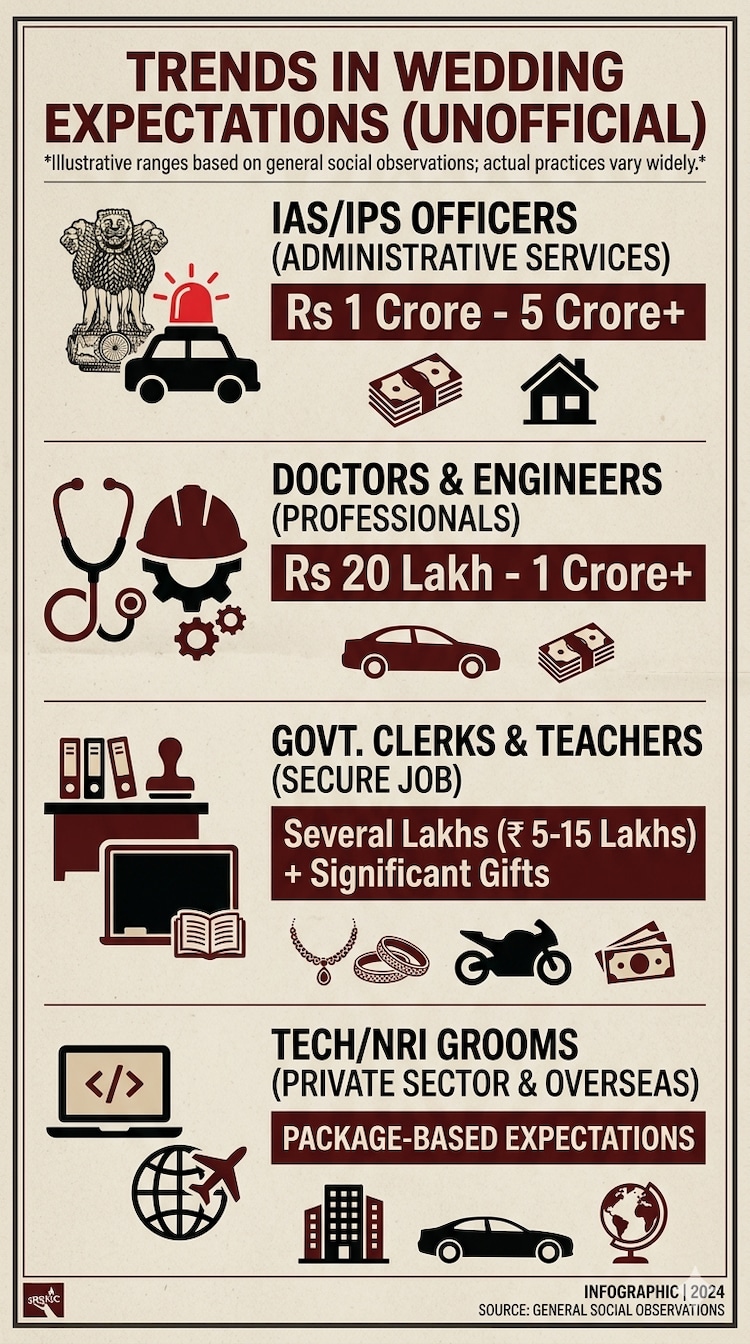
An IIT graduate may attract demands running into tens of lakhs. An IAS officer is often considered a "premium match". In several old reports from Bihar and Uttar Pradesh, families and marriage brokers have spoken of IAS and IPS officers attracting dowries worth Rs 1 crore to Rs 5 crore, depending on rank, family background and posting.
A 2013 report by Business Standard noted that the "going rate" for an IAS officer in Bihar could range between Rs 1 crore and Rs 5 crore, while engineers and doctors could attract dowries worth several lakhs.
Older Bihar-focused reports in The Telegraph and regional Hindi media have also described approximate expectations where doctors and engineers could attract dowries ranging from Rs 20 lakh to Rs 1 crore, while government clerks and teachers often came with demands involving several lakhs along with cars, jewellery or gold.
INDIA'S UNOFFICIAL GROOM MARKET
Some regional reports during UPSC result season have even described successful candidates as becoming "crorepati grooms overnight".
There have also been reports of "package-based dowry", where expectations rise according to annual salary packages, especially in tech jobs, private sector roles and NRI matches.
Still, there is no official national "dowry rate card". Since dowry is illegal, the numbers exist mostly through regional reporting, field studies, community discussions and anecdotal accounts.
But decades of academic research and on-ground reporting point to one consistent pattern: higher education and secure government jobs often attract higher dowry expectations.
A few sociology studies focused on Bihar and Uttar Pradesh villages have also noted that government jobs sharply increased expected dowry amounts compared to private employment or agricultural backgrounds.
At the same time, the "rate card" is deeply hyperlocal. A Bihar IAS groom may command dramatically different expectations from one in Kerala or Bengaluru. Caste, land ownership, NRI status, family reputation and even district-level social dynamics can influence negotiations. In many ways, these expectations fluctuate more like social market value than fixed pricing.
And in 2026, the contradiction feels sharper than ever because families are now spending lakhs, sometimes crores, educating daughters too.
So why does the old math still survive?
INDIA'S DOWRY PROBLEM NEVER REALLY WENT AWAY
India continues to report thousands of dowry deaths every year.
According to NCRB data, India recorded 5,737 dowry deaths in 2024. That means around 16 women died every single day due to dowry-linked violence. Uttar Pradesh alone accounted for more than 2,000 of those deaths, followed by Bihar.
In 2023, more than 15,000 cases were registered under the Dowry Prohibition Act. Over 6,100 women lost their lives that year.
The numbers become even more disturbing because activists have long argued that dowry harassment is underreported. Many cases are buried as "kitchen accidents", suicides, family disputes or sudden illness.
And despite urban education, social media awareness and women entering high-paying careers, dowry culture has not disappeared. In many places, it has simply modernised itself.

DOWRY WAS NOT ALWAYS ABOUT GREED
Historically, dowry in India did not begin in the same form it exists today.
In several communities centuries ago, families voluntarily gave daughters jewellery, clothes, cash or property as a form of inheritance and financial security because women often had limited rights to ancestral property.
But over time, especially during colonial and post-colonial periods, marriage became increasingly tied to caste status, land ownership, income and social mobility. Dowry shifted from voluntary gifting to financial extraction.
The groom’s education became a status symbol. Marriage negotiations started sounding more like business deals.
A doctor groom meant a bigger dowry.
An engineer meant more.
An IAS officer meant even more.
And government jobs became the jackpot because they represented stability, pensions, housing benefits and lifelong financial security in a country where employment uncertainty is high.
WHAT THE RESEARCH ACTUALLY SAYS
This link between education and dowry is not just anecdotal anymore. Academic research has repeatedly found that a groom’s education directly affects dowry expectations.
A widely cited paper titled 'Education and Dowry: An Economic Exploration' by economist Soumyanetra Munshi found that dowry rises with the groom’s level of education and is "largely unrelated" to the bride’s education. The paper argues that education functions as a signal of "groom quality" in the marriage market.
In simple terms, the degree itself becomes economic value.
Another study published by Cambridge University using Indian Human Development Survey data reached a similar conclusion. Researchers found that dowry payments rise with the husband's education level. However, the increase becomes smaller when the bride is also highly educated.
That finding reflects a changing reality in urban India. Families are now spending huge amounts educating daughters too. Engineering colleges, private universities, study abroad degrees, coaching centres, MBAs. Raising daughters is no longer financially "lighter" than raising sons.
Yet many families still face dowry pressure during marriage negotiations.
Researchers have also warned that dowry expectations can directly affect girls' education. One paper on dowry economics argued that expected dowry payments may discourage investment in daughters because families fear future marriage costs.
In other words, dowry does not just affect marriages. It can shape how families value girls from childhood itself.

THE 'RATE CARD' EVERYONE KNOWS EXISTS
Nobody publishes an official dowry list. But speak to people involved in arranged marriage networks and a pattern quickly appears.
A private sector employee may attract expectations for luxury weddings, cars or cash.
A government officer may attract far higher demands.
An IAS or IPS officer can become the centre of bidding wars in some regions.
Old reports from Bihar have described families openly discussing approximate "rates" for government employees. Teachers, bank officers, engineers and bureaucrats all carried different expectations.
Even online, the conversation is startlingly open.
On Reddit forums discussing arranged marriages, users frequently mention "government job premium", "IAS rates", and "package-based marriages".
One user wrote, "In Bihar, UPSC groom rates are insane." Another commented, "A government job is basically a dowry multiplier."
These are anecdotal statements, not verified datasets. But what makes them powerful is how casually people discuss them. The idea feels socially understood even when nobody says it publicly.
And the irony is impossible to ignore.
The same families who encourage daughters to become doctors, engineers or MBA graduates may still feel pressured to "give well" during marriage negotiations.
EDUCATED WOMEN, SAME OLD EXPECTATIONS
This is where the system starts looking irrational even to families participating in it.
Middle-class Indian parents today spend enormous amounts on daughters' education.
Coaching classes, hostel fees, private schools, laptops, foreign degrees, internships, competitive exams. In many urban households, daughters are earning equally or more than male partners.
Yet dowry expectations survive because marriage in India is still deeply tied to social prestige.
Families fear judgment.
Parents worry daughters may face mistreatment if demands are not met.

In many communities, the pressure is so deeply normalised that refusing dowry itself can become socially awkward. Families that do not "give enough" are sometimes judged as stingy, disrespectful or incapable of properly marrying off their daughters.
In some cases, parents of brides themselves insist on expensive gifts, cars or lavish weddings because dowry has become tied to family honour and social image, not just direct demands from the groom’s side.
Some even justify dowry as "helping the couple start life".
But critics argue that when "help" flows mostly one way, it stops being help and becomes pressure.
WHY GOVERNMENT JOBS STILL DOMINATE THE MARRIAGE MARKET
India’s obsession with government jobs plays a huge role here.
A stable government salary still carries enormous social power, especially in smaller cities and towns. It represents security in an economy where layoffs and job uncertainty are constant fears.
That stability often converts directly into marriage bargaining power.
A UPSC rank, SSC posting, PSU job or state government role can dramatically raise matrimonial demand.
In many communities, a government-employed groom is seen as "safe", "respectable" and financially dependable for life.
And where demand rises, social pricing follows.
WHEN EDUCATION FAILS TO CHANGE MINDSETS
Perhaps the biggest irony is this: education, which should reduce regressive thinking, sometimes increases dowry expectations instead.
Degrees become status markers, salaries become bargaining chips, and marriage becomes an economic transaction disguised as tradition.
And that raises an uncomfortable question for modern India.
If both sons and daughters are now equally educated, equally ambitious and equally employable, why is the daughter’s family still expected to "pay extra" for marriage?
For a country racing toward global economic power, the persistence of dowry reveals how old social systems can survive inside modern lifestyles.
The wedding hashtags may change.
But the negotiations often do not.
- Ends