Thucydides Trap: How an Ancient Greek warning applies to US–China tensions today
'Thucydides Trap' is back in focus as tensions between the United States and China sharpen. When Xi Jinping invoked the idea during talks with Donald Trump, it was less about explaining history and more about signalling a concern. As China rises and the US guards its position, the fear and competition that once shaped ancient conflicts are now being used to frame a fragile moment in global power politics.
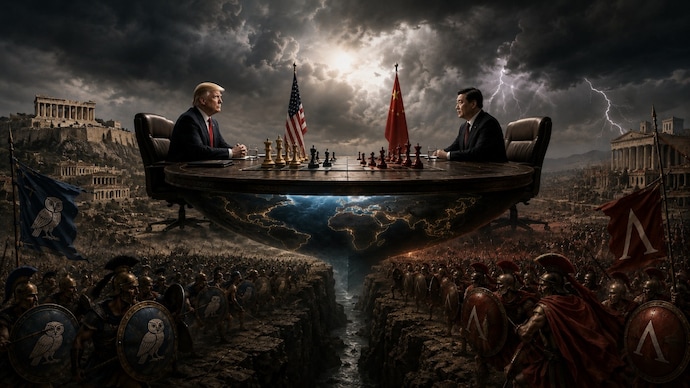
There are some ideas from history that refuse to stay in the past. The “Thucydides Trap” is one of them. It sounds academic, but it is basically about fear, power, and what happens when the world’s balance starts shifting.
It was mentioned again in recent high-level discussions between US and Chinese leadership, where Chinese President Xi Jinping raised the idea while talking about global stability and rising tensions.
Even though it comes from ancient history, it now sits right at the centre of modern geopolitics.
WHY IS IT CALLED A ‘TRAP’?
The term was popularised by Harvard scholar Graham Allison after studying patterns in world history.
He took inspiration from ancient Greek historian Thucydides, who wrote about the war between Athens and Sparta.
Athens was rising fast in wealth, trade, and influence. Sparta was already the dominant military power. As Athens expanded, Sparta started seeing it not as progress, but as a threat.
That fear created pressure, suspicion, and eventually war.
Allison’s argument is simple: when a rising power challenges an established one, fear can grow faster than diplomacy. And fear is dangerous in international politics.
HOW IT CONNECTS TO TODAY’S WORLD
Fast-forward to now, and the same pattern is often used to describe US-China relations.
The United States has been the dominant global power for decades. China’s rapid economic rise, military modernisation, and global influence have shifted that balance.
So when leaders talk about avoiding the “Thucydides Trap,” they are really talking about one question: can two powerful countries adjust to a changing world without sliding into confrontation?
During recent discussions, former US President Donald Trump pushed back on suggestions of US decline, while also agreeing that global competition is intense.
At the same time, Xi’s reference to the concept signalled concern about where that competition might lead if mistrust deepens.
NOT A PREDICTION, BUT A WARNING SIGN
One important thing often gets lost in political headlines. The Thucydides Trap is not a prophecy that war will happen.
It is more like a warning light.
History shows mixed results. Some rising power situations ended in conflict. Others did not. Trade, diplomacy, and mutual dependence have prevented escalation in many cases.
The idea is less about inevitability and more about risk. It asks: what happens when pride, insecurity, and competition collide at the top of the global system?
WHY THE CONVERSATION FEELS MORE RELEVANT NOW
The modern world is more connected than Ancient Greece ever was, but also more competitive in certain areas.
Technology, artificial intelligence, supply chains, defence systems, and global influence are all arenas where the US-China rivalry plays out.
That makes the stakes higher. A misstep in one area can ripple across the entire global economy.
So when leaders bring up the Thucydides Trap, they are not quoting history for style. They are signalling awareness that transitions of power are always delicate.
THE REAL QUESTION BEHIND THE THEORY
Strip away the academic language, and the idea becomes very human.
When someone strong starts feeling challenged, do they respond with cooperation or confrontation? And when someone rising starts gaining confidence, do they push for space or push too far?
History does not give a fixed answer. It only shows patterns.
And that is why this ancient Greek warning still finds its way into modern summit rooms, even when the world looks nothing like Athens or Sparta.
There are some ideas from history that refuse to stay in the past. The “Thucydides Trap” is one of them. It sounds academic, but it is basically about fear, power, and what happens when the world’s balance starts shifting.
It was mentioned again in recent high-level discussions between US and Chinese leadership, where Chinese President Xi Jinping raised the idea while talking about global stability and rising tensions.
Even though it comes from ancient history, it now sits right at the centre of modern geopolitics.
WHY IS IT CALLED A ‘TRAP’?
The term was popularised by Harvard scholar Graham Allison after studying patterns in world history.
He took inspiration from ancient Greek historian Thucydides, who wrote about the war between Athens and Sparta.
Athens was rising fast in wealth, trade, and influence. Sparta was already the dominant military power. As Athens expanded, Sparta started seeing it not as progress, but as a threat.
That fear created pressure, suspicion, and eventually war.
Allison’s argument is simple: when a rising power challenges an established one, fear can grow faster than diplomacy. And fear is dangerous in international politics.
HOW IT CONNECTS TO TODAY’S WORLD
Fast-forward to now, and the same pattern is often used to describe US-China relations.
The United States has been the dominant global power for decades. China’s rapid economic rise, military modernisation, and global influence have shifted that balance.
So when leaders talk about avoiding the “Thucydides Trap,” they are really talking about one question: can two powerful countries adjust to a changing world without sliding into confrontation?
During recent discussions, former US President Donald Trump pushed back on suggestions of US decline, while also agreeing that global competition is intense.
At the same time, Xi’s reference to the concept signalled concern about where that competition might lead if mistrust deepens.
NOT A PREDICTION, BUT A WARNING SIGN
One important thing often gets lost in political headlines. The Thucydides Trap is not a prophecy that war will happen.
It is more like a warning light.
History shows mixed results. Some rising power situations ended in conflict. Others did not. Trade, diplomacy, and mutual dependence have prevented escalation in many cases.
The idea is less about inevitability and more about risk. It asks: what happens when pride, insecurity, and competition collide at the top of the global system?
WHY THE CONVERSATION FEELS MORE RELEVANT NOW
The modern world is more connected than Ancient Greece ever was, but also more competitive in certain areas.
Technology, artificial intelligence, supply chains, defence systems, and global influence are all arenas where the US-China rivalry plays out.
That makes the stakes higher. A misstep in one area can ripple across the entire global economy.
So when leaders bring up the Thucydides Trap, they are not quoting history for style. They are signalling awareness that transitions of power are always delicate.
THE REAL QUESTION BEHIND THE THEORY
Strip away the academic language, and the idea becomes very human.
When someone strong starts feeling challenged, do they respond with cooperation or confrontation? And when someone rising starts gaining confidence, do they push for space or push too far?
History does not give a fixed answer. It only shows patterns.
And that is why this ancient Greek warning still finds its way into modern summit rooms, even when the world looks nothing like Athens or Sparta.

