What the inauguration of Noida International Airport means for Uttar Pradesh
The state government says the new airport is another step in making the state an aviation and logistic hub that will spur industry and make travel easier. The facility is also expected to reduce dependence on Delhi's Indira Gandhi International Airport.
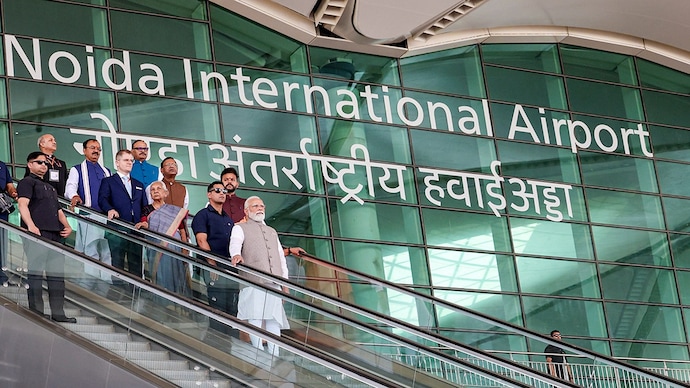
UP Governor Anandiben Patel, chief minister Yogi Adityanath, Union aviation minister Ram Mohan Naidu and several state ministers were present at the inauguration event.
If developed as planned, the Noida International Airport could reshape both regional mobility and the economics of air travel in north India. For UP, the biggest shift would be geographic. Large parts of western UP and parts of Rajasthan and Uttarakhand currently depend on Delhi for international flights. A functional hub at Jewar can shorten travel time, reduce congestion at Delhi airport, and distribute aviation demand across two major nodes.
Over time, this can also influence where industries choose to locate, especially logistics, warehousing, electronics and export-oriented manufacturing that depend on quick cargo movement. For passengers, the impact will depend on airline participation and connectivity, but increased capacity usually leads to more routes and competitive fares. If cargo operations scale up as projected, it could also lower logistics costs for exporters in the region.
Speaking at the event, the Prime Minister described the airport as a “symbol of the development of Uttar Pradesh” and expressed optimism that it would contribute to regional growth in districts such as Agra, Mathura, Aligarh, Ghaziabad and Meerut. CM Adityanath said the airport would strengthen connectivity and support employment generation. He also linked it to other infrastructure projects in the region, including expressways and proposed rail corridors, and said it would help expand economic opportunities.
The airport project, which received in-principle approval from the Centre in 2018, is being developed in four phases at an estimated total cost of Rs 29,560 crore. The first phase involves an investment of around Rs 11,282 crore. Of this, about Rs 6,876 crore is the share of the concessionaire, Yamuna International Airport Private Limited, a
100% subsidiary of Zurich Airport International AG, while the state government spent over Rs 4,400 crore on land acquisition.
In its initial phase, the airport is expected to handle around 1.2 crore passengers annually. The cargo terminal, inaugurated on Saturday, has a starting capacity of 2.5 lakh metric tonnes per year, which can be expanded significantly in later phases. The planned 40-acre MRO facility is aimed at enabling aircraft maintenance within the country.
The project is part of a broader push to expand aviation infrastructure in UP. Once fully operational, the state government has said the airport will contribute to making Uttar Pradesh the only state with five international airports. According to the state government, the airport has been developed using modern and energy-efficient technologies and is designed as a multi-modal transport hub that is expected to integrate road, rail, metro and regional transit systems to improve connectivity for both passengers and cargo. Officials hope this will help reduce travel time and logistics costs, although the actual impact will depend on how quickly these linkages are completed.
The project has been in the works for several years. Initial clearances were granted in 2017, followed by the formation of Noida International Airport Limited in 2018. Zurich Airport International AG was selected as the concessionaire in 2020. Construction began in 2022 after financial closure and approvals, with Tata Projects as the EPC contractor. A trial calibration flight was conducted in 2025, and the aerodrome licence was granted in March this year.
The government has also highlighted plans for last-mile connectivity, including electric buses and cab services. Agreements have been signed for bus operations connecting the airport to nearby states, and private operators are expected to provide app-based transport services. These measures, officials say, are aimed at improving accessibility, though their rollout will determine how effective they are in practice.
The UP government presents the airport as a major step towards positioning the state as an aviation and logistics hub. It has said the project will eventually be linked to a wider network of expressways and transport systems, including the Yamuna Expressway, Delhi-Mumbai Expressway, Eastern Peripheral Expressway and the proposed Ganga Expressway. Rail connectivity plans are also part of the larger vision. Proposals include linking the airport to the Regional Rapid Transit System (RRTS) linking with Delhi and the Delhi-Varanasi high-speed rail corridor, although these remain at different stages of planning and approval.
In addition, the airport is expected to support industrial and commercial activity in the surrounding region, particularly along the Yamuna Expressway. The state government has pointed to ongoing and proposed investments, including electronics manufacturing and other industrial projects, as part of a larger economic cluster developing around the airport. It also projects the airport as a way to reduce dependence on Delhi’s Indira Gandhi International Airport, particularly for travellers from western UP and
surrounding regions. Whether this shift happens at scale will depend on flight operations, airline participation and connectivity.
While the inauguration marks the completion of the first phase, much of the project’s long-term impact will depend on the pace of future expansion and the development of supporting infrastructure. For now, the airport adds to the state’s growing list of large infrastructure projects, with the government positioning it as a key driver of connectivity and investment in the coming years.
Subscribe to India Today Magazine
UP Governor Anandiben Patel, chief minister Yogi Adityanath, Union aviation minister Ram Mohan Naidu and several state ministers were present at the inauguration event.
If developed as planned, the Noida International Airport could reshape both regional mobility and the economics of air travel in north India. For UP, the biggest shift would be geographic. Large parts of western UP and parts of Rajasthan and Uttarakhand currently depend on Delhi for international flights. A functional hub at Jewar can shorten travel time, reduce congestion at Delhi airport, and distribute aviation demand across two major nodes.
Over time, this can also influence where industries choose to locate, especially logistics, warehousing, electronics and export-oriented manufacturing that depend on quick cargo movement. For passengers, the impact will depend on airline participation and connectivity, but increased capacity usually leads to more routes and competitive fares. If cargo operations scale up as projected, it could also lower logistics costs for exporters in the region.
Speaking at the event, the Prime Minister described the airport as a “symbol of the development of Uttar Pradesh” and expressed optimism that it would contribute to regional growth in districts such as Agra, Mathura, Aligarh, Ghaziabad and Meerut. CM Adityanath said the airport would strengthen connectivity and support employment generation. He also linked it to other infrastructure projects in the region, including expressways and proposed rail corridors, and said it would help expand economic opportunities.
The airport project, which received in-principle approval from the Centre in 2018, is being developed in four phases at an estimated total cost of Rs 29,560 crore. The first phase involves an investment of around Rs 11,282 crore. Of this, about Rs 6,876 crore is the share of the concessionaire, Yamuna International Airport Private Limited, a
100% subsidiary of Zurich Airport International AG, while the state government spent over Rs 4,400 crore on land acquisition.
In its initial phase, the airport is expected to handle around 1.2 crore passengers annually. The cargo terminal, inaugurated on Saturday, has a starting capacity of 2.5 lakh metric tonnes per year, which can be expanded significantly in later phases. The planned 40-acre MRO facility is aimed at enabling aircraft maintenance within the country.
The project is part of a broader push to expand aviation infrastructure in UP. Once fully operational, the state government has said the airport will contribute to making Uttar Pradesh the only state with five international airports. According to the state government, the airport has been developed using modern and energy-efficient technologies and is designed as a multi-modal transport hub that is expected to integrate road, rail, metro and regional transit systems to improve connectivity for both passengers and cargo. Officials hope this will help reduce travel time and logistics costs, although the actual impact will depend on how quickly these linkages are completed.
The project has been in the works for several years. Initial clearances were granted in 2017, followed by the formation of Noida International Airport Limited in 2018. Zurich Airport International AG was selected as the concessionaire in 2020. Construction began in 2022 after financial closure and approvals, with Tata Projects as the EPC contractor. A trial calibration flight was conducted in 2025, and the aerodrome licence was granted in March this year.
The government has also highlighted plans for last-mile connectivity, including electric buses and cab services. Agreements have been signed for bus operations connecting the airport to nearby states, and private operators are expected to provide app-based transport services. These measures, officials say, are aimed at improving accessibility, though their rollout will determine how effective they are in practice.
The UP government presents the airport as a major step towards positioning the state as an aviation and logistics hub. It has said the project will eventually be linked to a wider network of expressways and transport systems, including the Yamuna Expressway, Delhi-Mumbai Expressway, Eastern Peripheral Expressway and the proposed Ganga Expressway. Rail connectivity plans are also part of the larger vision. Proposals include linking the airport to the Regional Rapid Transit System (RRTS) linking with Delhi and the Delhi-Varanasi high-speed rail corridor, although these remain at different stages of planning and approval.
In addition, the airport is expected to support industrial and commercial activity in the surrounding region, particularly along the Yamuna Expressway. The state government has pointed to ongoing and proposed investments, including electronics manufacturing and other industrial projects, as part of a larger economic cluster developing around the airport. It also projects the airport as a way to reduce dependence on Delhi’s Indira Gandhi International Airport, particularly for travellers from western UP and
surrounding regions. Whether this shift happens at scale will depend on flight operations, airline participation and connectivity.
While the inauguration marks the completion of the first phase, much of the project’s long-term impact will depend on the pace of future expansion and the development of supporting infrastructure. For now, the airport adds to the state’s growing list of large infrastructure projects, with the government positioning it as a key driver of connectivity and investment in the coming years.
Subscribe to India Today Magazine

