Annamalai writes rare note of dissent on three-language policy. Here's why
The BJP leader urged the Union Education Ministry to withdraw the notification, which has come under criticism in Tamil Nadu for alleged Hindi imposition.
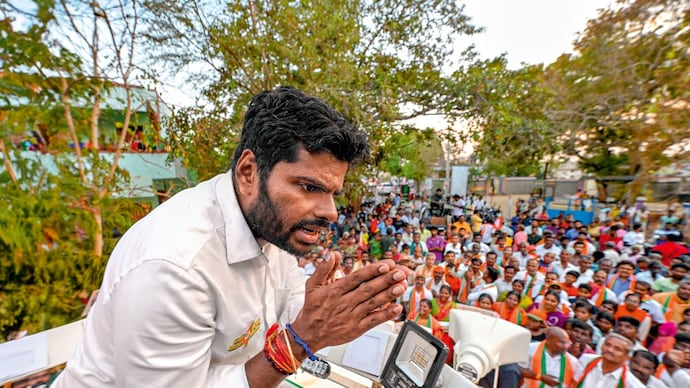
Tamil Nadu BJP leader K Annamalai on Tuesday criticised the recent Central Board of Secondary Education (CBSE) notification making a third language compulsory for Class 9 students in schools affiliated with the board, saying the move would place an undue academic burden on students. He urged the Union Education Ministry to withdraw the notification, which has come under criticism in Tamil Nadu as an alleged attempt at Hindi imposition.
The circular, issued by the CBSE on May 15, announced a major shift in its language policy for Classes 9 and 10. According to the notification, starting July 1 this year, Class 9 students in the 2026-27 academic session will have to study three languages as part of their curriculum in all CBSE-affiliated schools. However, there will be no Class 10 board exam for the third language.
In a post on X, Annamalai noted that while he was one of the initial proponents of the three-language rule for Class 6, the CBSE's attempt to implement the same subject framework for Class 9 students three years earlier than expected is in direct contravention of its own "commitment."
"In April 2026, when the CBSE announced that three languages for Class VI students shall be made compulsory and 2 of the three languages shall be native to India, I was one amongst many who welcomed this decision that allows Children to learn multiple languages from a young age, which would help them to broaden their understanding of India’s diverse literary landscape. In the very same notification released in April 2026, it was explicitly mentioned that the Third language for Class IX children studying in CBSE schools will be made compulsory only from the Academic year 2029-30, which is 3 years from now. However, on 15th May 2026, the CBSE sent a notification to all affiliated schools introducing the third compulsory language for Class IX students from this academic year, rolling back its previous commitment to make it compulsory only from the academic year 2029-30," Annamalai said in his tweet.
He added that the revised system has come as a shock to parents of several students, especially in Tamil Nadu. "This has come as a shock to many parents, especially those from TN, as their Children have already selected a language of choice in Class VI, and now the revised notification mandates that Class IX students learn 3 languages, 2 of which are native to India, with effect from 1st July 2026. Expecting a Class IX student to learn a new language in a short time will only pressurise children and affect their overall learning outcomes."
According to the May 15 CBSE notification, students will study three languages labelled as R1, R2 and R3. The board has made it clear that at least two of these must be native Indian languages. Students can still opt for a foreign language, but only if the other two choices are Indian languages. Foreign languages may also be taken as an additional fourth subject.
The BJP-led Centre's three-language policy has faced fierce opposition in Tamil Nadu. The issue figured prominently as a recurring flashpoint in the run-up to the Assembly election held in the state last month.
Tamil Nadu BJP leader K Annamalai on Tuesday criticised the recent Central Board of Secondary Education (CBSE) notification making a third language compulsory for Class 9 students in schools affiliated with the board, saying the move would place an undue academic burden on students. He urged the Union Education Ministry to withdraw the notification, which has come under criticism in Tamil Nadu as an alleged attempt at Hindi imposition.
The circular, issued by the CBSE on May 15, announced a major shift in its language policy for Classes 9 and 10. According to the notification, starting July 1 this year, Class 9 students in the 2026-27 academic session will have to study three languages as part of their curriculum in all CBSE-affiliated schools. However, there will be no Class 10 board exam for the third language.
In a post on X, Annamalai noted that while he was one of the initial proponents of the three-language rule for Class 6, the CBSE's attempt to implement the same subject framework for Class 9 students three years earlier than expected is in direct contravention of its own "commitment."
"In April 2026, when the CBSE announced that three languages for Class VI students shall be made compulsory and 2 of the three languages shall be native to India, I was one amongst many who welcomed this decision that allows Children to learn multiple languages from a young age, which would help them to broaden their understanding of India’s diverse literary landscape. In the very same notification released in April 2026, it was explicitly mentioned that the Third language for Class IX children studying in CBSE schools will be made compulsory only from the Academic year 2029-30, which is 3 years from now. However, on 15th May 2026, the CBSE sent a notification to all affiliated schools introducing the third compulsory language for Class IX students from this academic year, rolling back its previous commitment to make it compulsory only from the academic year 2029-30," Annamalai said in his tweet.
He added that the revised system has come as a shock to parents of several students, especially in Tamil Nadu. "This has come as a shock to many parents, especially those from TN, as their Children have already selected a language of choice in Class VI, and now the revised notification mandates that Class IX students learn 3 languages, 2 of which are native to India, with effect from 1st July 2026. Expecting a Class IX student to learn a new language in a short time will only pressurise children and affect their overall learning outcomes."
According to the May 15 CBSE notification, students will study three languages labelled as R1, R2 and R3. The board has made it clear that at least two of these must be native Indian languages. Students can still opt for a foreign language, but only if the other two choices are Indian languages. Foreign languages may also be taken as an additional fourth subject.
The BJP-led Centre's three-language policy has faced fierce opposition in Tamil Nadu. The issue figured prominently as a recurring flashpoint in the run-up to the Assembly election held in the state last month.

