
CBSE makes 3 languages compulsory in Class 9 from July 1 for 2026-27 batch
CBSE has made three languages compulsory for Class 9 students of the 2026-27 academic year from July 1, 2026, as per a latest notification. Students must study at least two Indian languages. Class 10 students will not need to appear for R3 in their board exams. The board has also introduced a transition plan, textbook support, and flexible teaching arrangements for schools implementing the change.
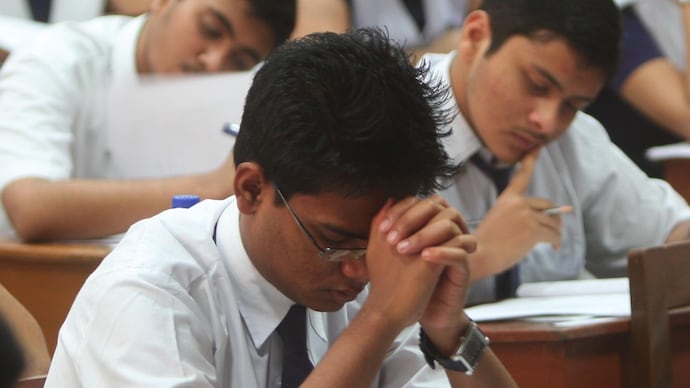
CBSE has made three languages compulsory for Classes 9 and 10 from July 1, 2026, under a new NEP-aligned policy. Students must study at least two Indian languages. (Photo: Getty images)

New Delhi,UPDATED: May 16, 2026 18:35 IST
The Central Board of Secondary Education has announced a major shift in its language policy for Classes 9 and 10. In a circular issued on May 15, 2026, the board confirmed that from July 1, 2026, Class 9 students in the 2026-27 academic session will have to study three languages as part of their curriculum in all CBSE-affiliated schools. However, there will be no Class 10 board exam for the third language.
Earlier CBSE-aligned curriculum reports had said the three-language formula would be implemented from Class 6 upwards, reaching Class 10 by 2030–31. While the new May 15, 2026 circular doesn’t change that basic framework, it formalises the timeline and enforcement for Classes 9 and 10, making three languages compulsory in the Class 9 syllabus from July 1, 2026.
Since the change will apply to the 2026–27 academic session, which has already begun in April, "CBSE has decided to adopt a transitional approach to align its Scheme of Studies with the NCERT syllabus" while implementing the new structure.
TWO INDIAN LANGUAGES NOW COMPULSORY
Under the revised system, students will study three languages labelled as R1, R2 and R3. CBSE has made it clear that at least two of these must be native Indian languages.
Students can still opt for a foreign language, but only if the other two choices are Indian languages. Foreign languages may also be taken as an additional fourth subject.
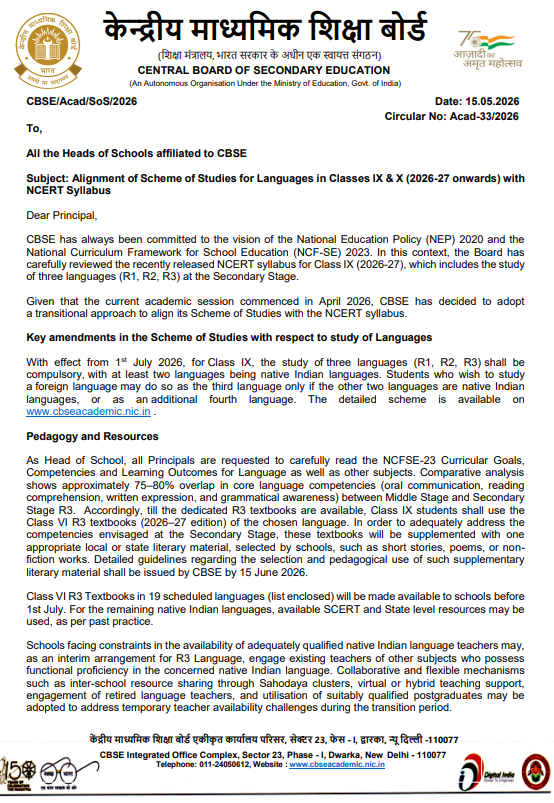
"With effect from 1 July 2026, for Class IX, the study of three languages (R1, R2, R3) shall be compulsory, with at least two languages being native Indian languages," the CBSE notification from May 15 noted.
"Students who wish to study a foreign language may do so as the third language only if the other two languages are native Indian languages, or as an additional fourth language. The detailed scheme is available on www.cbseacademic.nic.in," the notification added.
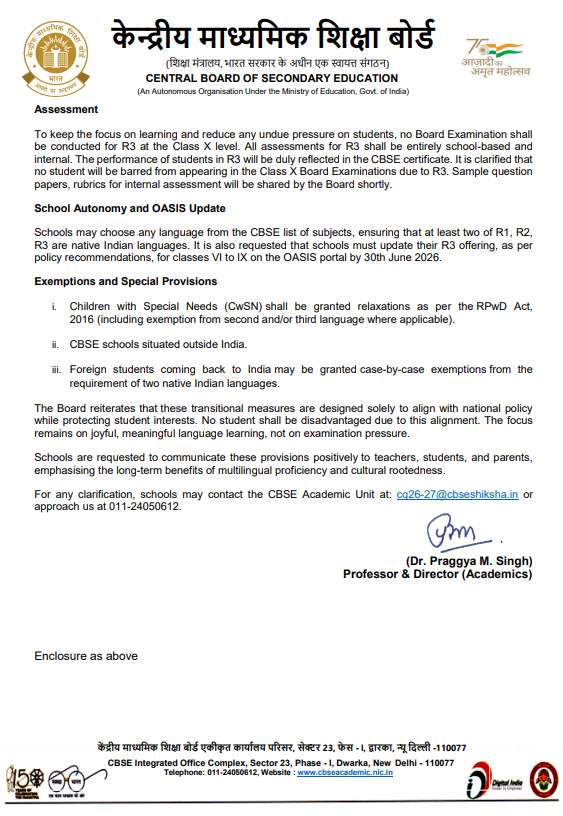
Check out the CBSE notification as posted by ANI here:
NO BOARD EXAM PRESSURE FOR THIRD LANGUAGE
CBSE has clearly stated that there will be no board examination for the third language in Class 10.
All assessment for R3 will be conducted internally by schools. The marks will still be reflected in the final certificate, but students will not be stopped from appearing in the Class 10 board exams because of this subject.
"To keep the focus on learning and reduce any undue pressure on students, no Board Examination shall be conducted for R3 at the Class X level. All assessments for R3 shall be entirely school-based and internal. The performance of students in R3 will be duly reflected in the CBSE certificate," the CBSE notification stated.
"It is clarified that no student will be barred from appearing in the Class X Board Examinations due to R3," it added.
TRANSITION YEAR, NOT A SUDDEN SHIFT
CBSE has taken a transitional approach for the 2026-27 academic session. Since the academic year has already begun in April, schools are being given flexibility to adapt gradually.
The board has emphasised that no student will be disadvantaged during this alignment phase, making it clear that the focus remains on learning rather than strict enforcement.
"CBSE has decided to adopt a transitional approach to align its Scheme of Studies with the NCERT syllabus," the notification stated.
HOW SCHOOLS WILL MANAGE THE CHANGE
The rollout comes with practical challenges, especially around teaching resources. CBSE has allowed multiple flexible options for schools facing teacher shortages.
Schools can use hybrid teaching, share resources through Sahodaya school clusters, hire retired teachers, or even assign teachers from other subjects who are proficient in the language.
"Schools facing constraints in the availability of adequately qualified native Indian language teachers may. as an interim arrangement for R3 Language, engage existing teachers of other subjects who possess functional proficiency in the concerned native Indian language," the CBSE notification stated.
They can also choose any language from the CBSE-approved list, as long as the two-Indian-language rule is followed. Schools must update their language offerings on the OASIS portal by June 30, 2026.
WHAT STUDENTS WILL STUDY FOR NOW
Until new textbooks are introduced, students will use Class 6 level textbooks for the third language.
To bridge the gap, schools will add local or regional literature such as poems, short stories and non-fiction texts. CBSE is expected to release detailed teaching guidelines by June 15.
"Comparative analysis shows approximately 75-80% overlap in core language competencies (oral communication, reading comprehension, written expression, and grammatical awareness) between Middle Stage and Secondary Stage R3. Accordingly, till the dedicated R3 textbooks are available, Class IX students shall use the Class VI R3 textbooks (2026-27 edition) of the chosen language," the CBSE notification stated.
"Class VI R3 Textbooks in 19 scheduled languages (list enclosed) will be made available to schools before 1st July. For the remaining native Indian languages, available SCERT and State level resources may be used, as per past practice," it added.
EXEMPTIONS AND SPECIAL CASES
CBSE has included important relaxations to ensure inclusivity.
Children with Special Needs may receive exemptions from studying a second or third language under the RPWD Act 2016.
Foreign students returning to India can also be given case-by-case exemptions. Schools outside India may follow flexible provisions as well.
WHY THIS CHANGE MATTERS
This is one of the biggest curriculum shifts in recent years, and it signals a push towards multilingual education rooted in Indian languages.
At the same time, CBSE has tried to balance policy with practicality. By removing board exam pressure for the third language and allowing flexibility in implementation, the board is attempting to make the transition smoother for both students and schools.
- Ends