North to South, no bias: PM Modi's guarantee on delimitation process
Prime Minister Narendra Modi addressed a special Parliament session on Thursday, assuring that the delimitation process will not be biased or unfair. His remarks referenced concerns and fierce objections by Opposition MPs, who have raised that the process would significantly impact non-BJP states, especially those in the South.
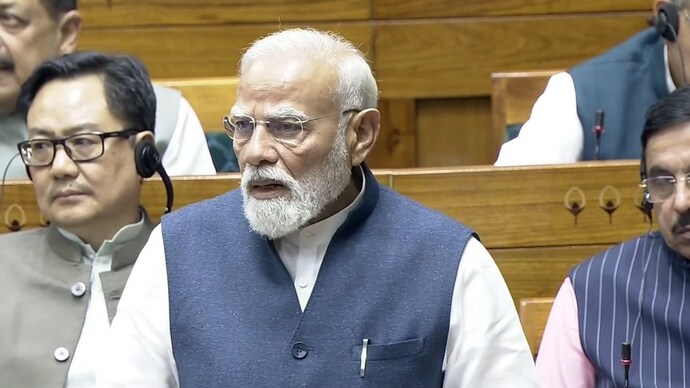
Prime Minister Narendra Modi on Thursday assured that the delimitation process, which has been a long flashpoint between the ruling NDA and the Opposition parties, will not be biased or unfair. "I give guarantee no injustice will be done to any state, from East to West, North to South," PM Modi said in Lok Sabha.
A special Parliament session started earlier in the day to debate on three bills that were introduced in Lok Sabha. These bills are the Constitution (131st Amendment) Bill, aimed at tweaking the women's quota law, and the Union Territories Laws (Amendment) Bill and the Delimitation Bill, to implement the proposed women's quota law in the Union Territories of Puducherry, Delhi and Jammu and Kashmir.
The session began with a fiery 40-minute debate between the NDA and the Opposition, after which the latter insisted on the division of votes before the introduction of the Constitutional (131st Amendment) Bill. In the end, the bill was introduced with as many as 251 members supporting it and 185 MPs voting against the same.
PM Modi also urged the Opposition MPs not to see the women's quota bill from a political lens and cautioned that, in the past, those who had opposed the concept of women's reservations, "the women of the country have not forgiven them".
"I have come to appeal to you that do not see this from a political lens, this is a decision in the national interest," the Prime Minister said, adding that the 33 per cent reservation is not a "gift" but a woman's right.
Under the Constitution (131st Amendment) Bill, the Centre has proposed to increase the strength of Lok Sabha from 543 to 850 seats, with a total of 815 set aside for states and 35 for Union Territories. This will pave the way for the Delimitation Bill and the Union Territories Laws (Amendment) Bill to implement the women's quota law. However, the southern states – mostly ruled by Opposition parties – have vehemently opposed it, arguing that the delimitation exercise would significantly advantage the Hindi heartland, BJP's stronghold.
To break down in simple terms, delimitation is the process of redrawing constituencies to accurately capture the changes in population. Its primary objective is to ensure that each region and the issues of the residents are represented by leaders and put forth properly.
The South Chief Ministers – MK Stalin of Tamil Nadu, Pinarayi Vijayan of Kerala, Revanth Reddy of Telangana and Siddaramaiah of Karnataka – have called out the exercise to be unfair to their states that have effectively enacted population control steps. They, along with their INDIA bloc members, have argued that the delimitation is BJP's political tool to ensure they have long-term electoral advantage.
Earlier in the day, Stalin kickstarted a statewide agitation by burning a copy of the delimitation bill and hoisting black flags.
ALL STATES STAND TO GAIN: SHAH BREAKS DOWN NUMBERS
During a heated debate in the Lok Sabha after the PM's speech, Home Minister Amit Shah pushed back against "the narrative" that a population-based delimitation would disproportionately benefit northern states while penalising those in the south.
He presented a state-wise breakdown to argue that the Centre’s approach aims to increase parliamentary seats across all states proportionally, with a cap of up to 50 per cent growth, rather than strictly following population data from the 2011 Census.
In Tamil Nadu, which currently has 39 Lok Sabha seats, a delimitation exercise based purely on the 2011 Census would raise the tally to 49. However, under the Centre’s formula, the number would go up further to 59 seats.
Telangana’s representation would increase from 17 seats at present to 24 under a strict population-based formula, but reach 25 under the government’s model.
Kerala, which currently has 20 seats, would see a substantial jump -- from 23 seats based on 2011 Census figures to 30 seats under the proposed formula.
Similarly, Andhra Pradesh’s seat count would rise from 25 to 33 based on population data, but increase further to 37 seats under the Centre’s plan.
Odisha, which currently sends 21 members to the Lok Sabha, would see its representation go up to 28 seats under a population-only approach and 31 seats under the government’s formula.
Prime Minister Narendra Modi on Thursday assured that the delimitation process, which has been a long flashpoint between the ruling NDA and the Opposition parties, will not be biased or unfair. "I give guarantee no injustice will be done to any state, from East to West, North to South," PM Modi said in Lok Sabha.
A special Parliament session started earlier in the day to debate on three bills that were introduced in Lok Sabha. These bills are the Constitution (131st Amendment) Bill, aimed at tweaking the women's quota law, and the Union Territories Laws (Amendment) Bill and the Delimitation Bill, to implement the proposed women's quota law in the Union Territories of Puducherry, Delhi and Jammu and Kashmir.
The session began with a fiery 40-minute debate between the NDA and the Opposition, after which the latter insisted on the division of votes before the introduction of the Constitutional (131st Amendment) Bill. In the end, the bill was introduced with as many as 251 members supporting it and 185 MPs voting against the same.
PM Modi also urged the Opposition MPs not to see the women's quota bill from a political lens and cautioned that, in the past, those who had opposed the concept of women's reservations, "the women of the country have not forgiven them".
"I have come to appeal to you that do not see this from a political lens, this is a decision in the national interest," the Prime Minister said, adding that the 33 per cent reservation is not a "gift" but a woman's right.
Under the Constitution (131st Amendment) Bill, the Centre has proposed to increase the strength of Lok Sabha from 543 to 850 seats, with a total of 815 set aside for states and 35 for Union Territories. This will pave the way for the Delimitation Bill and the Union Territories Laws (Amendment) Bill to implement the women's quota law. However, the southern states – mostly ruled by Opposition parties – have vehemently opposed it, arguing that the delimitation exercise would significantly advantage the Hindi heartland, BJP's stronghold.
To break down in simple terms, delimitation is the process of redrawing constituencies to accurately capture the changes in population. Its primary objective is to ensure that each region and the issues of the residents are represented by leaders and put forth properly.
The South Chief Ministers – MK Stalin of Tamil Nadu, Pinarayi Vijayan of Kerala, Revanth Reddy of Telangana and Siddaramaiah of Karnataka – have called out the exercise to be unfair to their states that have effectively enacted population control steps. They, along with their INDIA bloc members, have argued that the delimitation is BJP's political tool to ensure they have long-term electoral advantage.
Earlier in the day, Stalin kickstarted a statewide agitation by burning a copy of the delimitation bill and hoisting black flags.
ALL STATES STAND TO GAIN: SHAH BREAKS DOWN NUMBERS
During a heated debate in the Lok Sabha after the PM's speech, Home Minister Amit Shah pushed back against "the narrative" that a population-based delimitation would disproportionately benefit northern states while penalising those in the south.
He presented a state-wise breakdown to argue that the Centre’s approach aims to increase parliamentary seats across all states proportionally, with a cap of up to 50 per cent growth, rather than strictly following population data from the 2011 Census.
In Tamil Nadu, which currently has 39 Lok Sabha seats, a delimitation exercise based purely on the 2011 Census would raise the tally to 49. However, under the Centre’s formula, the number would go up further to 59 seats.
Telangana’s representation would increase from 17 seats at present to 24 under a strict population-based formula, but reach 25 under the government’s model.
Kerala, which currently has 20 seats, would see a substantial jump -- from 23 seats based on 2011 Census figures to 30 seats under the proposed formula.
Similarly, Andhra Pradesh’s seat count would rise from 25 to 33 based on population data, but increase further to 37 seats under the Centre’s plan.
Odisha, which currently sends 21 members to the Lok Sabha, would see its representation go up to 28 seats under a population-only approach and 31 seats under the government’s formula.

