The rise of AI politicians in India: How avatars are gaming political content
AI-generated avatars delivering Parliament-style speeches are rapidly gaining traction on Instagram, with accounts jumping from under 2K views to reels crossing 2 million and 5 million. Blending real issues with exaggerated claims, this content is reshaping political discourse and amplifying synthetic influence.
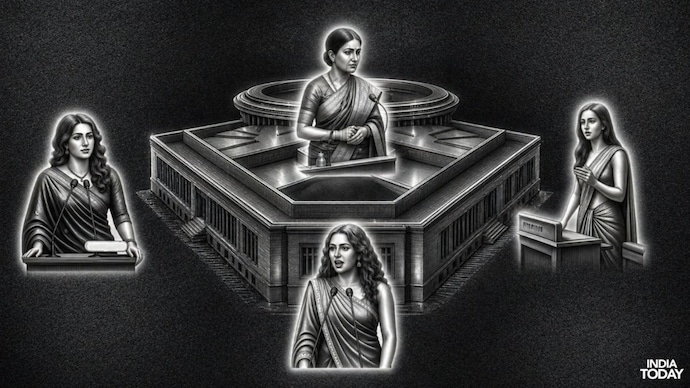


In what appears to be the Parliament, most likely the Lok Sabha, an MP rises to speak. With both Prime Minister Narendra Modi and LoP Rahul Gandhi in frame, she says: “India must have a law preventing any individual from holding political office more than twice, whether as MP or Prime Minister. The chair does not belong to one person.” Applause follows. But this is not Parliament. It only feels like it. Nothing here is real. This is the world of AI.
The tone is assertive, and the delivery mimics the cadence of real political debate. They speak on public policy, governance failures, and political accountability in a way that sounds convincing and appears authentic, yet often push beyond the restraint expected of real politicians. And perhaps that is precisely why it works: it captures attention, holds it, and above all, drives traction.
India Today’s Open Source Intelligence (OSINT) team tracked several such Instagram and Facebook handles and analysed 10 of them, about the content they are posting and how a switch in genres has gained them views.
For instance, an Instagram handle, “srishtijaininspires”, with 265K followers, had average views of under 2K in January but has now scaled to the millions, with some reels crossing 5 million and 2 million views. The obvious question is what changed in between. The answer is clear: the handle has turned “political”.
THE 'VIRAL' CONTENT
Once creators decode what drives visibility and traction, they lean into the same genre with consistency and begin selecting issues that appear organic. One such account, Ira Devyani, with over 60K followers on Instagram, has posted just 36 reels but shows a sharp rise in viewership.
In one reel, the account calls for a “fingerprint-based” voting system in India to prevent what it describes as “vote chori”, a claim that has circulated in political narratives for some time, and the post has crossed over 8 million views.
In another reel, it targets Rahul Gandhi over his religious identity, claiming that the Leader of Opposition in the Lok Sabha hides his religious identity because he is not a Hindu, a video that has garnered over 2 million views. Yet another reel targeting a section of people it labels as “andhbhakts” has also crossed 2 million views.
Most of these accounts began with completely different genres, from public speaking and podcast-style content to other formats. What appears to have worked for them, however, is this Parliament speech theme.
Behind this “engagement farming” and aggressive tone lies a bigger issue: a mix of facts, distortions, and unchecked claims reaching new audiences who remain largely unaware of how to differentiate between original and AI-generated content.
Advocate (Dr.) Prashant Mali, Cyber, Privacy and AI Law expert, notes that, “What we are witnessing is not merely misinformation, but the industrialisation of synthetic political influence. These AI-generated videos blur the line between satire, manipulation, and outright deception, particularly in a country where digital literacy remains uneven.”
In our analysis, another Instagram handle, Chandan Hindustani, with around 142K followers, stands out as a clear example. It is a unique case where the creator uses his own face, paired with an AI-generated version of himself speaking in the House, addressing the Chair while raising issues and questioning government policies like demonetisation.
In several reels, an AI-generated version of Akhilesh Yadav, chief of the Samajwadi Party, appears in the background, seemingly clapping while expressing support for the University Grants Commission (Promotion of Equity in Higher Educational Institutions) Regulations, 2026, popularly called the UGC Equity Rules.
The regulations were introduced by the University Grants Commission but were later stayed by the Supreme Court of India after becoming controversial, with contested claims emerging soon after entering public discourse. The account has also openly criticised the ruling BJP, with several posts alleging links between the party and industrialists gaining relatively higher traction.
The “UGC Bill”, however, was never tabled in any House of Parliament, nor does any such Bill exist. Yet, it exists in the AI world, and opinions are being shaped by it. This has created a challenging scenario: how do we protect the sanctity of Parliament, where proceedings follow procedure rather than randomness, where every statement carries value and must remain within the law?
In contrast, with access to AI tools and social media, anyone can seemingly stage discussions on issues that were never actually debated and say things that cannot otherwise be said. It may seem harmless if one knows it is not real, but in a society with uneven digital literacy, many begin to assume these debates are real, making the situation far more concerning.
Another account, The Jeni Show, with over 113K followers, offers a clear example of this trend. A reel featuring Raghav Chadha has crossed 13 million views, claiming he was removed as Deputy Leader of the Aam Aadmi Party in the Rajya Sabha for raising public interest issues rather than engaging in Hindu-Muslim rhetoric. A discussion that never occurred in either House has, nevertheless, gained traction here, likely explaining why the account has since posted several similar videos that consistently frame the Rajya Sabha MP, who has recently left the AAP and joined the BJP, in a favourable light.
While other topics like the education system and religious harmony also gain traction, a pattern common across such creators is the more concerning appeal to take the law into one’s own hands, framing it as a way to achieve “justice.” One such reel crossing over 2 million views raises serious concerns about the scale and impact of this messaging.
There are several budding accounts posting reels on similar themes, often reusing scripts and narratives that have already performed well. To gain traction, many are resorting to fabricated and, at times, exaggerated numbers and claims to create appeal. As viewership rises, the incentive to lean into such content only grows, turning engagement chasing into a feedback loop that poses a serious risk to information integrity.
However, Mr Mali explains, “the IT (Intermediary Guidelines and Digital Media Ethics Code) Rules 2021, updated in 2023 and 2026, place clear compliance expectations on intermediaries to exercise due diligence, including the removal of unlawful content upon actual knowledge.”
But, to mitigate this risk, India needs “mandatory disclosure of AI-generated political content, stronger platform accountability, and a dedicated legal framework under the Digital India Act. The battle is not just legal, it is epistemic. When reality and fabrication blur, democracy and trust are at risk,” says Prashant Mali.
HOW HAVE THE ACCOUNTS EVOLVED?
Many began with podcast-style reels, public speaking clips, trading explainers, and other generic content, while some also experimented with patriotic or nationalistic themes, but most of these formats failed to gain meaningful traction.
A clear and consistent shift across the accounts analysed is the move toward the Indian Parliament setting and speech format. While the messaging and political leaning vary, the method remains similar. They lift already viral narratives from mainstream discourse and amplify them by raising the tone, using sharper language, and presenting opinions more bluntly than traditional platforms would typically allow, making the content more emotionally charged and shareable.
The data reflects this evolution. The account “srishtijaininspires” initially posted AI-generated content across formats, with videos of AI avatars in trader roles drawing around 1.6K views, speaker content about 1.7K, and podcast-style reels roughly 1.3K. A shift to lawyer-style role play increased views to about 18.1K; however, the real surge came with Parliament-style speech videos reaching nearly 243K early on and later crossing 5 million in similar reels, driven by strong authority cues and amplification through mainstream narratives.
It is essentially a cycle of trial and error. These accounts experiment with formats that do not work, shift to new ones, and continue iterating until something clicks. Many of these handles position themselves as voices of the people, yet without a clear legal framework, such content opens the door to targeted disinformation campaigns capable of influencing public opinion, electoral behaviour, and even social harmony.
In what appears to be the Parliament, most likely the Lok Sabha, an MP rises to speak. With both Prime Minister Narendra Modi and LoP Rahul Gandhi in frame, she says: “India must have a law preventing any individual from holding political office more than twice, whether as MP or Prime Minister. The chair does not belong to one person.” Applause follows. But this is not Parliament. It only feels like it. Nothing here is real. This is the world of AI.
The tone is assertive, and the delivery mimics the cadence of real political debate. They speak on public policy, governance failures, and political accountability in a way that sounds convincing and appears authentic, yet often push beyond the restraint expected of real politicians. And perhaps that is precisely why it works: it captures attention, holds it, and above all, drives traction.
India Today’s Open Source Intelligence (OSINT) team tracked several such Instagram and Facebook handles and analysed 10 of them, about the content they are posting and how a switch in genres has gained them views.
For instance, an Instagram handle, “srishtijaininspires”, with 265K followers, had average views of under 2K in January but has now scaled to the millions, with some reels crossing 5 million and 2 million views. The obvious question is what changed in between. The answer is clear: the handle has turned “political”.
THE 'VIRAL' CONTENT
Once creators decode what drives visibility and traction, they lean into the same genre with consistency and begin selecting issues that appear organic. One such account, Ira Devyani, with over 60K followers on Instagram, has posted just 36 reels but shows a sharp rise in viewership.
In one reel, the account calls for a “fingerprint-based” voting system in India to prevent what it describes as “vote chori”, a claim that has circulated in political narratives for some time, and the post has crossed over 8 million views.
In another reel, it targets Rahul Gandhi over his religious identity, claiming that the Leader of Opposition in the Lok Sabha hides his religious identity because he is not a Hindu, a video that has garnered over 2 million views. Yet another reel targeting a section of people it labels as “andhbhakts” has also crossed 2 million views.
Most of these accounts began with completely different genres, from public speaking and podcast-style content to other formats. What appears to have worked for them, however, is this Parliament speech theme.
Behind this “engagement farming” and aggressive tone lies a bigger issue: a mix of facts, distortions, and unchecked claims reaching new audiences who remain largely unaware of how to differentiate between original and AI-generated content.
Advocate (Dr.) Prashant Mali, Cyber, Privacy and AI Law expert, notes that, “What we are witnessing is not merely misinformation, but the industrialisation of synthetic political influence. These AI-generated videos blur the line between satire, manipulation, and outright deception, particularly in a country where digital literacy remains uneven.”
In our analysis, another Instagram handle, Chandan Hindustani, with around 142K followers, stands out as a clear example. It is a unique case where the creator uses his own face, paired with an AI-generated version of himself speaking in the House, addressing the Chair while raising issues and questioning government policies like demonetisation.
In several reels, an AI-generated version of Akhilesh Yadav, chief of the Samajwadi Party, appears in the background, seemingly clapping while expressing support for the University Grants Commission (Promotion of Equity in Higher Educational Institutions) Regulations, 2026, popularly called the UGC Equity Rules.
The regulations were introduced by the University Grants Commission but were later stayed by the Supreme Court of India after becoming controversial, with contested claims emerging soon after entering public discourse. The account has also openly criticised the ruling BJP, with several posts alleging links between the party and industrialists gaining relatively higher traction.
The “UGC Bill”, however, was never tabled in any House of Parliament, nor does any such Bill exist. Yet, it exists in the AI world, and opinions are being shaped by it. This has created a challenging scenario: how do we protect the sanctity of Parliament, where proceedings follow procedure rather than randomness, where every statement carries value and must remain within the law?
In contrast, with access to AI tools and social media, anyone can seemingly stage discussions on issues that were never actually debated and say things that cannot otherwise be said. It may seem harmless if one knows it is not real, but in a society with uneven digital literacy, many begin to assume these debates are real, making the situation far more concerning.
Another account, The Jeni Show, with over 113K followers, offers a clear example of this trend. A reel featuring Raghav Chadha has crossed 13 million views, claiming he was removed as Deputy Leader of the Aam Aadmi Party in the Rajya Sabha for raising public interest issues rather than engaging in Hindu-Muslim rhetoric. A discussion that never occurred in either House has, nevertheless, gained traction here, likely explaining why the account has since posted several similar videos that consistently frame the Rajya Sabha MP, who has recently left the AAP and joined the BJP, in a favourable light.
While other topics like the education system and religious harmony also gain traction, a pattern common across such creators is the more concerning appeal to take the law into one’s own hands, framing it as a way to achieve “justice.” One such reel crossing over 2 million views raises serious concerns about the scale and impact of this messaging.
There are several budding accounts posting reels on similar themes, often reusing scripts and narratives that have already performed well. To gain traction, many are resorting to fabricated and, at times, exaggerated numbers and claims to create appeal. As viewership rises, the incentive to lean into such content only grows, turning engagement chasing into a feedback loop that poses a serious risk to information integrity.
However, Mr Mali explains, “the IT (Intermediary Guidelines and Digital Media Ethics Code) Rules 2021, updated in 2023 and 2026, place clear compliance expectations on intermediaries to exercise due diligence, including the removal of unlawful content upon actual knowledge.”
But, to mitigate this risk, India needs “mandatory disclosure of AI-generated political content, stronger platform accountability, and a dedicated legal framework under the Digital India Act. The battle is not just legal, it is epistemic. When reality and fabrication blur, democracy and trust are at risk,” says Prashant Mali.
HOW HAVE THE ACCOUNTS EVOLVED?
Many began with podcast-style reels, public speaking clips, trading explainers, and other generic content, while some also experimented with patriotic or nationalistic themes, but most of these formats failed to gain meaningful traction.
A clear and consistent shift across the accounts analysed is the move toward the Indian Parliament setting and speech format. While the messaging and political leaning vary, the method remains similar. They lift already viral narratives from mainstream discourse and amplify them by raising the tone, using sharper language, and presenting opinions more bluntly than traditional platforms would typically allow, making the content more emotionally charged and shareable.
The data reflects this evolution. The account “srishtijaininspires” initially posted AI-generated content across formats, with videos of AI avatars in trader roles drawing around 1.6K views, speaker content about 1.7K, and podcast-style reels roughly 1.3K. A shift to lawyer-style role play increased views to about 18.1K; however, the real surge came with Parliament-style speech videos reaching nearly 243K early on and later crossing 5 million in similar reels, driven by strong authority cues and amplification through mainstream narratives.
It is essentially a cycle of trial and error. These accounts experiment with formats that do not work, shift to new ones, and continue iterating until something clicks. Many of these handles position themselves as voices of the people, yet without a clear legal framework, such content opens the door to targeted disinformation campaigns capable of influencing public opinion, electoral behaviour, and even social harmony.

