Doctors are breaking too: The hidden toll of burnout, grief and sleepless nights
In a country where doctors are often placed on a pedestal, very little attention is paid to what constantly witnessing suffering does to them. On a recent podcast with Health Wealth, Dr. Cyriac Abby Philips, better known as 'The Liver Doc', spoke candidly about the emotional toll of the profession.
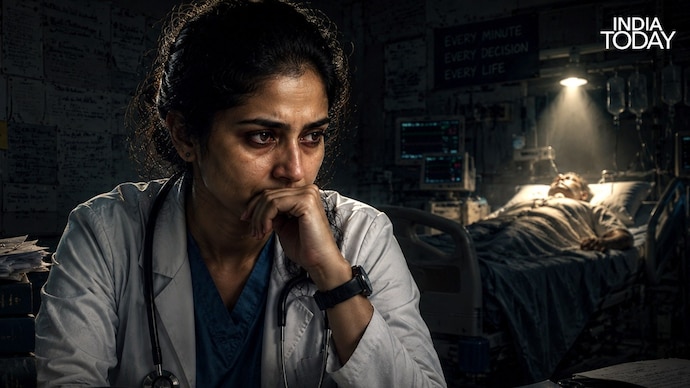
“Aap humare liye bhagwaan ho. Aap hi inko bacha sakte ho.”
(You are like god to us. Only you can save our loved one.)
Few professions in India carry the emotional weight that medicine does. Doctors are expected to remain calm while delivering devastating diagnoses, absorb the grief of anxious families, work through sleepless nights, and somehow still walk into the next patient’s room with composure and hope.
In a country where doctors are often placed on a pedestal, very little attention is paid to what constantly witnessing suffering does to them. The emotional cost of being a doctor in India remains one of the least discussed realities of healthcare.
On a recent podcast with India Today, hepatologist Dr. Cyriac Abby Philips, better known as 'The Liver Doc', spoke about the psychological burden of medical practice, particularly in fields where death and terminal illness are routine. In his book too, he has spoken about experiencing nightmares, sleeplessness, and even seeing the faces of his patients in his children.
“The biggest role as a clinical doctor in hepatology for me is palliative hepatology,” he said. “I take care of a lot of patients who are definitely going to die and I cannot do anything about it except give them a good, dignified, comfortable whatever time is left and a good death.”
He pointed out that medicine is not just about diagnosing and treating disease. “It’s also about caring,” he said, stressing that empathetic care is one of the most overlooked aspects of modern medicine.
Watch the podcast here:
The Liver Doc admitted that while medical training prepares doctors to treat illness, it rarely prepares them for the emotional toll of constantly witnessing death and suffering.
“This is something they don’t teach you in medicine,” he said. “You’re going to be exposed to these patients and they’re going to die and you’re going to get affected by it.”
He spoke about the culture within medicine that normalises emotional suppression, the unspoken expectation that doctors must stay logical, detached, and unaffected.
“Doctors don’t cry. Keep a straight face. Deal with it,” he said, describing the conditioning many doctors undergo. At one point, he admitted, “Writing this book, if I did not write this book, I think decades later I would have killed myself. It’s so depressing, medical practice.”
Burnout is no longer rare
His words resonated with many within the profession because beneath the stereotype of the emotionally invincible doctor lies a reality of chronic stress, burnout, emotional fatigue, sleep deprivation, and silent mental health struggles.
A recent nationwide survey found that nearly 91 per cent of Indian doctors would discourage their children from pursuing medicine as a career. Conducted over six months across metros and smaller cities, and involving more than 1,200 physicians from both public and private healthcare systems, the study highlighted burnout, fear of violence, mounting legal pressure, and emotional stress as major concerns.
The crisis is also reflected in emerging research. A 2024 PubMed-indexed study on Indian doctors found that more than half of surveyed doctors showed significant levels of depression and anxiety, while only 25% reported achieving work-life balance.
For many doctors, the emotional exhaustion builds slowly.
Dr. Saurabh Mehrotra, Director of Neurosciences and psychiatrist at Medanta, says stress and burnout are now deeply embedded within the profession. “The most common issue doctors experience is stress. Over time, many doctors may develop burnout, which has both psychological and physical consequences,” he said.
The triggers are everywhere: emotionally distressing cases, irregular work schedules, sleep disruption, emergency calls in the middle of the night, chronic overwork, and the inability to maintain a healthy work-life balance.
“Many departments are understaffed, which means doctors are overworked and unable to find enough time for relaxation, family, or social life,” he explained.
The consequences are not merely emotional. Burnout can manifest as anxiety, irritability, sleep disturbances, depression, weakened immunity, and even cardiovascular issues.
Inside emergency medicine
Emergency medicine doctors perhaps experience this emotional intensity most acutely.
Dr. Kiran Kumar Varma K, Associate Clinical Director and Zonal HOD of Emergency Medicine at CARE Hospitals, describes emergency departments as emotionally relentless spaces.
“In a single shift, you may handle a major accident, a cardiac arrest, or a family suddenly losing someone unexpectedly,” he said. “Even if you become clinically efficient over time, you do not become emotionally unaffected.”
He admitted that certain cases stay with doctors long after their shifts end.
“Sometimes it shows up quietly as poor sleep, irritability, exhaustion, or emotional numbness,” he said. “Many doctors continue functioning despite that because the profession trains us to prioritise patients first.”
One of the biggest challenges, he says, is the constant pressure of responsibility.
“You are expected to make critical decisions very quickly, often before the full picture is clear, while anxious families are waiting outside,” he said. “There is hardly any time to recover emotionally before the next patient arrives.”
That emotional overload becomes cumulative. “Burnout usually does not happen because of one major event,” he explained. “It is more often the result of sustained emotional and physical exhaustion.”
Young doctors under pressure
For younger doctors and resident physicians, the pressures are often compounded by hierarchy, long hours, academic demands, and unsafe working environments.
Dr. Aviral Mathur, consultant at Sir Ganga Ram Hospital and former president of FORDA and MAMC RDA, says medicine has long glorified endurance and self-sacrifice.
“Most doctors learn to carry these experiences quietly because the system expects you to move on quickly,” he said. “That emotional load is real and cumulative.”
He points out that doctors today are not only dealing with emotional distress, but also fear. “Violence against doctors has become another major source of stress,” he said.
In many hospitals, especially government institutions, doctors work amidst overcrowding, manpower shortages, and infrastructure gaps while dealing with life-and-death situations every day.
“Young mothers in medicine face an especially difficult balancing act between training, duty hours and family responsibilities,” he added.
The silence around mental health
The culture around mental health within medicine itself often prevents doctors from seeking help.
“Many doctors worry that admitting emotional distress may be seen as weakness or inability to cope,” Dr. Mathur said. That stigma exists across seniority levels and specialties.
“Doctors often struggle with the idea that someone who helps others might themselves need psychological support,” Dr. Mehrotra explained.
Even when awareness around mental health has improved in society, medicine continues to reward stoicism.
“Medical training traditionally emphasises endurance,” said Dr. Kiran Kumar Varma. “Exhaustion becomes so normalised that many doctors stop recognising burnout in themselves.”
For some, coping mechanisms become essential survival tools.
Dr. Pradeep Gadugesh from HOSMAT Hospitals says exercise, hobbies, and time with family help him mentally disconnect from hospital life.
“I follow what I call the ‘Ghajini rule’ - forget work at home and forget home at work,” he said.
Others rely heavily on peer support. “Sometimes speaking to colleagues who understand the emotional weight of the job helps more than formal advice,” said Dr. Kiran Kumar Varma.
Humour, too, often becomes a coping mechanism inside emergency departments, a reality outsiders may misunderstand, but one doctors say helps them survive emotionally intense shifts.
What needs to change
Doctors also repeatedly emphasised the need for structural change. Adequate staffing, humane working hours, recovery time after intense duties, confidential mental health support, and healthier workplace cultures emerged as recurring demands.
Many countries now treat physician burnout as a systems issue, not an individual weakness. The UK has a national confidential treatment service for doctors. In the United States, the American Medical Association tracks physician burnout annually, and many institutions increasingly offer wellness support and counselling.
Many doctors believe the problem begins during training itself.
Medical education teaches future doctors how to diagnose illness and save lives, but rarely teaches them how to process grief, trauma, guilt, or emotional exhaustion.
As The Liver Doc pointed out in the podcast, doctors are trained to remain professional in front of patients. The emotions are often buried elsewhere. “You can’t let emotions come in the way,” he said. “I don’t get emotional with my patients. Never. I always keep a professional tone. But I am empathetic towards them.”
The burden, however, does not disappear simply because it is hidden.
Perhaps that is the paradox of medicine in India. Society sees doctors as healers, protectors, even gods. But behind the white coats are people repeatedly exposed to suffering, death, impossible expectations, and emotional isolation, often without enough support systems of their own.
“Aap humare liye bhagwaan ho. Aap hi inko bacha sakte ho.”
(You are like god to us. Only you can save our loved one.)
Few professions in India carry the emotional weight that medicine does. Doctors are expected to remain calm while delivering devastating diagnoses, absorb the grief of anxious families, work through sleepless nights, and somehow still walk into the next patient’s room with composure and hope.
In a country where doctors are often placed on a pedestal, very little attention is paid to what constantly witnessing suffering does to them. The emotional cost of being a doctor in India remains one of the least discussed realities of healthcare.
On a recent podcast with India Today, hepatologist Dr. Cyriac Abby Philips, better known as 'The Liver Doc', spoke about the psychological burden of medical practice, particularly in fields where death and terminal illness are routine. In his book too, he has spoken about experiencing nightmares, sleeplessness, and even seeing the faces of his patients in his children.
“The biggest role as a clinical doctor in hepatology for me is palliative hepatology,” he said. “I take care of a lot of patients who are definitely going to die and I cannot do anything about it except give them a good, dignified, comfortable whatever time is left and a good death.”
He pointed out that medicine is not just about diagnosing and treating disease. “It’s also about caring,” he said, stressing that empathetic care is one of the most overlooked aspects of modern medicine.
Watch the podcast here:
The Liver Doc admitted that while medical training prepares doctors to treat illness, it rarely prepares them for the emotional toll of constantly witnessing death and suffering.
“This is something they don’t teach you in medicine,” he said. “You’re going to be exposed to these patients and they’re going to die and you’re going to get affected by it.”
He spoke about the culture within medicine that normalises emotional suppression, the unspoken expectation that doctors must stay logical, detached, and unaffected.
“Doctors don’t cry. Keep a straight face. Deal with it,” he said, describing the conditioning many doctors undergo. At one point, he admitted, “Writing this book, if I did not write this book, I think decades later I would have killed myself. It’s so depressing, medical practice.”
Burnout is no longer rare
His words resonated with many within the profession because beneath the stereotype of the emotionally invincible doctor lies a reality of chronic stress, burnout, emotional fatigue, sleep deprivation, and silent mental health struggles.
A recent nationwide survey found that nearly 91 per cent of Indian doctors would discourage their children from pursuing medicine as a career. Conducted over six months across metros and smaller cities, and involving more than 1,200 physicians from both public and private healthcare systems, the study highlighted burnout, fear of violence, mounting legal pressure, and emotional stress as major concerns.
The crisis is also reflected in emerging research. A 2024 PubMed-indexed study on Indian doctors found that more than half of surveyed doctors showed significant levels of depression and anxiety, while only 25% reported achieving work-life balance.
For many doctors, the emotional exhaustion builds slowly.
Dr. Saurabh Mehrotra, Director of Neurosciences and psychiatrist at Medanta, says stress and burnout are now deeply embedded within the profession. “The most common issue doctors experience is stress. Over time, many doctors may develop burnout, which has both psychological and physical consequences,” he said.
The triggers are everywhere: emotionally distressing cases, irregular work schedules, sleep disruption, emergency calls in the middle of the night, chronic overwork, and the inability to maintain a healthy work-life balance.
“Many departments are understaffed, which means doctors are overworked and unable to find enough time for relaxation, family, or social life,” he explained.
The consequences are not merely emotional. Burnout can manifest as anxiety, irritability, sleep disturbances, depression, weakened immunity, and even cardiovascular issues.
Inside emergency medicine
Emergency medicine doctors perhaps experience this emotional intensity most acutely.
Dr. Kiran Kumar Varma K, Associate Clinical Director and Zonal HOD of Emergency Medicine at CARE Hospitals, describes emergency departments as emotionally relentless spaces.
“In a single shift, you may handle a major accident, a cardiac arrest, or a family suddenly losing someone unexpectedly,” he said. “Even if you become clinically efficient over time, you do not become emotionally unaffected.”
He admitted that certain cases stay with doctors long after their shifts end.
“Sometimes it shows up quietly as poor sleep, irritability, exhaustion, or emotional numbness,” he said. “Many doctors continue functioning despite that because the profession trains us to prioritise patients first.”
One of the biggest challenges, he says, is the constant pressure of responsibility.
“You are expected to make critical decisions very quickly, often before the full picture is clear, while anxious families are waiting outside,” he said. “There is hardly any time to recover emotionally before the next patient arrives.”
That emotional overload becomes cumulative. “Burnout usually does not happen because of one major event,” he explained. “It is more often the result of sustained emotional and physical exhaustion.”
Young doctors under pressure
For younger doctors and resident physicians, the pressures are often compounded by hierarchy, long hours, academic demands, and unsafe working environments.
Dr. Aviral Mathur, consultant at Sir Ganga Ram Hospital and former president of FORDA and MAMC RDA, says medicine has long glorified endurance and self-sacrifice.
“Most doctors learn to carry these experiences quietly because the system expects you to move on quickly,” he said. “That emotional load is real and cumulative.”
He points out that doctors today are not only dealing with emotional distress, but also fear. “Violence against doctors has become another major source of stress,” he said.
In many hospitals, especially government institutions, doctors work amidst overcrowding, manpower shortages, and infrastructure gaps while dealing with life-and-death situations every day.
“Young mothers in medicine face an especially difficult balancing act between training, duty hours and family responsibilities,” he added.
The silence around mental health
The culture around mental health within medicine itself often prevents doctors from seeking help.
“Many doctors worry that admitting emotional distress may be seen as weakness or inability to cope,” Dr. Mathur said. That stigma exists across seniority levels and specialties.
“Doctors often struggle with the idea that someone who helps others might themselves need psychological support,” Dr. Mehrotra explained.
Even when awareness around mental health has improved in society, medicine continues to reward stoicism.
“Medical training traditionally emphasises endurance,” said Dr. Kiran Kumar Varma. “Exhaustion becomes so normalised that many doctors stop recognising burnout in themselves.”
For some, coping mechanisms become essential survival tools.
Dr. Pradeep Gadugesh from HOSMAT Hospitals says exercise, hobbies, and time with family help him mentally disconnect from hospital life.
“I follow what I call the ‘Ghajini rule’ - forget work at home and forget home at work,” he said.
Others rely heavily on peer support. “Sometimes speaking to colleagues who understand the emotional weight of the job helps more than formal advice,” said Dr. Kiran Kumar Varma.
Humour, too, often becomes a coping mechanism inside emergency departments, a reality outsiders may misunderstand, but one doctors say helps them survive emotionally intense shifts.
What needs to change
Doctors also repeatedly emphasised the need for structural change. Adequate staffing, humane working hours, recovery time after intense duties, confidential mental health support, and healthier workplace cultures emerged as recurring demands.
Many countries now treat physician burnout as a systems issue, not an individual weakness. The UK has a national confidential treatment service for doctors. In the United States, the American Medical Association tracks physician burnout annually, and many institutions increasingly offer wellness support and counselling.
Many doctors believe the problem begins during training itself.
Medical education teaches future doctors how to diagnose illness and save lives, but rarely teaches them how to process grief, trauma, guilt, or emotional exhaustion.
As The Liver Doc pointed out in the podcast, doctors are trained to remain professional in front of patients. The emotions are often buried elsewhere. “You can’t let emotions come in the way,” he said. “I don’t get emotional with my patients. Never. I always keep a professional tone. But I am empathetic towards them.”
The burden, however, does not disappear simply because it is hidden.
Perhaps that is the paradox of medicine in India. Society sees doctors as healers, protectors, even gods. But behind the white coats are people repeatedly exposed to suffering, death, impossible expectations, and emotional isolation, often without enough support systems of their own.

