Nari Shakti Act | Breaking the deadlock
After the opposition blocks the speedy implementation of the historic women's reservation legislation, a roadmap to break the impasse
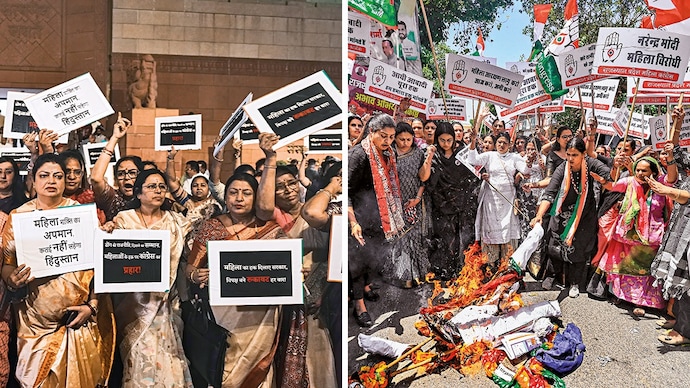


On the evening of April 17, a division bell rang through the new Lok Sabha, the same vaulted, peacock-themed chamber in which, 31 months earlier, amidst a thunderous ovation, the Narendra Modi government had passed the Nari Shakti Vandan Adhiniyam that reserved 33 per cent of seats in the Lok Sabha and state assemblies for women. This time, though, the mood was hostile. When the Speaker announced the count—298 ayes, 230 nays—the Constitution (One Hundred and Thirty-first Amendment) Bill had fallen short of the requisite two-thirds majority by more than 60 votes. It was the first time a Modi-era constitutional amendment had been defeated in a floor test, and the reverberations echoed well beyond the chamber.
On the evening of April 17, a division bell rang through the new Lok Sabha, the same vaulted, peacock-themed chamber in which, 31 months earlier, amidst a thunderous ovation, the Narendra Modi government had passed the Nari Shakti Vandan Adhiniyam that reserved 33 per cent of seats in the Lok Sabha and state assemblies for women. This time, though, the mood was hostile. When the Speaker announced the count—298 ayes, 230 nays—the Constitution (One Hundred and Thirty-first Amendment) Bill had fallen short of the requisite two-thirds majority by more than 60 votes. It was the first time a Modi-era constitutional amendment had been defeated in a floor test, and the reverberations echoed well beyond the chamber.
So, why did the Modi government go out on a limb knowing the odds were stacked against it? The ruling party appears to have wanted to strike several birds with one stone. One of them was to fast-track the Nari Shakti Vandan Adhiniyam, 2023, as left to its normal course, the law would kick in no earlier than 2034. That is because the 2023 Act specifies that women’s reservation will take effect only after a delimitation exercise was carried out on the basis of the first Census conducted after the Act was passed. The new amendment bill sought to compress that timeline by delinking implementation from any future Census. A separate bill was introduced to push through delimitation of constituencies, ostensibly to chalk out an expansion of the Lok Sabha to create extra room to accommodate a one-third quota painlessly.
The wager, observers concluded, was perceived as a win-win for the ruling BJP. It was betting that the Opposition would find it politically awkward to reject a bill tied to women’s reservation. With women constituting nearly half the Indian electorate, a victory would give the BJP the edge needed for a fourth consecutive term in 2029. BJP sources say that Union home minister Amit Shah from February onwards had sought support from each of the key Opposition leaders to push through the bill and informed them that the government was sensitive about ensuring that southern states would not be impacted. The party believed that many of the Opposition parties were amenable and therefore it moved the amendment bill.
But, in Parliament, Opposition parties changed tack and opposed the amendment, charging the government with using women’s reservation as a faade to hoodwink the nation. The real aim, the Congress claimed, was to complete delimitation before 2029, allowing the ruling party to redraw constituencies to its electoral advantage and avoid factoring in the outcome of a caste census. Its members pointed to the April 2025 decision of the Cabinet Committee on Political Affairs which would ensure that the 2027 Census will, for the first time since 1931, enumerate caste.
The BJP’s calculation was that if the Opposition voted down the Bill, as it did, the blame could then be pinned on it for rejecting gender empowerment. Indeed, in a nationally televised address on April 18, Prime Minister Modi accused the Congress and other major Opposition parties, like the Samajwadi Party and the Trinamool Congress, of blocking women’s entry into legislatures. But the Opposition has ensured that the fight is no longer merely over when women should get 33 per cent reservation. It has now seemingly linked it to a larger and far more volatile struggle over delimitation, Census, caste enumeration, claims of the Other Backward Classes (OBCs), the anxieties of the southern states—in short, the basic arithmetic of power in any future Lok Sabha.
Meanwhile, every party agrees that reserving 33 per cent of Lok Sabha seats for women is an imperative that needs speedy implementation. The bigger problem is how to break the impasse over women’s representation in Parliament without allowing it to get derailed by other contentious issues. Here, we attempt some answers to the big questions:
WHY DID AN EXPANDED LOK SABHA OF 850 SEATS NOT PASS MUSTER?
Experts say the infirmity in the constitutional amendment bill was not that it chose 850 seats for the expanded Lok Sabha, but that there was no written justification in the bill on how it arrived at the number. On the floor, Shah tried to settle the southern states’ nerves with a formula the bill did not contain. Every state’s current Lok Sabha allocation, he said, would rise uniformly by 50 per cent, preserving the share of each state. The southern bloc’s 24 per cent would thus stay 24 per cent. The home minister also pointed out that the five southern states stood to gain 19 more seats under the 50 per cent formula when compared to applying the 2011 Census as the basis. When Opposition MPs pointed out that the bill itself lacked any such assurance, Shah took the unusual step of offering an hour’s adjournment to insert the formula into the text.
Rajya Sabha MP Kapil Sibal put his finger on the problem that the Opposition found with Shah’s formula. A 50 per cent uniform hike, he argued, would in fact widen the absolute gap between the northern and southern states rather than narrow it. The 80 seats in Uttar Pradesh, for instance, would rise to 120; Tamil Nadu’s 39 would rise to only 59. The difference between UP and Tamil Nadu, which is 41 seats today, would grow to 61. Sibal did not stop at the arithmetic, he also connected it to the electoral map: in the northern belt, the BJP had won 127 out of 238 Lok Sabha seats in 2024; in the five southern states and the Union territories below the Vindhyas, it won 29 out of 130. The absolute expansion of the Hindi heartland’s numerical weight, Sibal said, was exactly the structural advantage the current bill was designed to lock in.
Not everyone, though, felt that the 50 per cent hike deserved to be rejected outright. Sandeep Shastri, vice-president of the NITTE Education Trust, says the uniform-hike proposal, had it been written into the bill rather than offered as a verbal assurance, was a procedurally sensible way to neutralise the anxiety of the southern states. Contrary to popular perception, in terms of population, all south Indian states are currently over-represented in the Lok Sabha. A uniform 50 per cent hike would make that over-representation steeper, while 11 under-represented states from the North and West would continue to lose out (see The North vs South Battle). Yet southern politicians maintain that any delimitation exercise must reward their states’ success in population control and their higher contribution to national GDP.
The Opposition’s distrust of the delimitation engineering stems from two recent experiences. The 2022 delimitation in Jammu and Kashmir, conducted by the Justice Ranjana Prakash Desai commission under the 2019 Reorganisation Act, added six seats to Jammu (raising its share from 37 to 43) and one to Kashmir (from 46 to 47), even though the Valley’s 2011 population of 6.89 million exceeded Jammu’s 5.38 million. The Assam delimitation of 2023, conducted by the Election Commission, attracted similar allegations: seats with Muslim influence fell from 35 to 22. These are the most visible recent precedents, but then the Congress and other parties have done the same in some states in the past.
IS 33 PER CENT RESERVATION FOR WOMEN IN THE 543-SEAT LOK SABHA A REALALTERNATIVE?
The Opposition’s counter-argument to the charge that they have deliberately delayed the implementation of women’s reservation was blunt and politically potent: if the objective is to speed up the reservation of one-third of Lok Sabha seats for women, why not do it within the existing 543 seats and stop holding the reform hostage to delimitation? One-third of 543 works out to 181 seats. In principle, those 181 constituencies could be reserved for women, with the built-in requirement that one-third each be earmarked in the 84 seats reserved for Scheduled Castes and the 47 seats reserved for Scheduled Tribes for women from the respective categories. They pointed to the several advantages this offers. One, it allows women’s reservation to take effect immediately instead of waiting for the Census-delimitation cycle to grind its way forward. Two, it prevents the gender justice agenda from being hijacked by the North-South, caste and federal battles currently surrounding delimitation.
The core arithmetic is not difficult to understand. The problem, say experts, lies in the constitutional design. The current women’s reservation law does not provide for immediate implementation inside the current Lok Sabha map. It explicitly links the quota to a future delimitation exercise following the next relevant Census. That means if Parliament now wants to reserve 181 seats for women within the existing House, it will almost certainly require another constitutional amendment. Experts point out that the notion that one-third of the existing 543 cannot be set aside without a fresh Census or delimitation is a policy preference, not a constitutional necessity. “The reservation for women does not need to be tied to delimitation at all. The amendment to enable it within 543 seats is legally available and has always been so,” says Sanjeer Alam of the Centre for the Study of Developing Societies (CSDS).
The Congress pointed out that the 73rd and 74th Amendments of 1992-93, passed when it ruled the Centre, installed one-third reservation for women in panchayats and municipalities without any fresh delimitation by states. Over a dozen states have since raised that figure to 50 per cent, producing over a million elected women representatives at the local level. Earlier bills in Parliament seeking 33 per cent reservation for women had no delimitation clause either. Gaurav Gogoi put the Congress stance bluntly in the lower House: “If you had listened to us in 2023, women’s reservation would have been implemented in 2024. We are urging not to link women’s reservation with delimitation. If you do that, we will support it.”
The government’s counter-argument ran thus; if you apply one-third quota to the current 543, whose seats do you reserve? By what criterion is a sitting MP displaced? Also, as a BJP leader points out, political parties would find it hard to sell the idea as male MPs will have to vacate their seats to make way for their women counterparts.
Then, there is the question of rotation. With 181 seats reserved, constituencies would need to rotate every election cycle. As a senior BJP leader explained, “You will effectively reset one-third of the political map every five years. That has consequences for governance and accountability.” Amit Shah, in his reply to the parliamentary debate, offered another counter-argument: expanding the House to 850 would allow 283 women to enter Parliament— in absolute numbers, over 100 more than the 181 derived from the present strength of 543. And it can do so while still keeping a higher pool of unreserved seats for everyone.
WHAT IS THE BEST WAY TO CRACK THE DELIMITATION CONUNDRUM?
Delimitation is the process of redrawing the boundaries of parliamentary and assembly constituencies after every Census, so that representation remains fair as the population changes. Governed by Articles 81, 82 and 170 of the Constitution, it is meant to uphold a simple democratic principle: one person, one vote, one value. India has redrawn its constituencies four times—in 1952, 1963, 1973 and 2002. Each of the first three exercises enlarged the Lok Sabha: from 494 seats after the 1951 census to 522 after 1961, and 543 after 1971. Then came the freeze. Indira Gandhi’s 42nd Amendment suspended further reallocation in 1976, the Emergency year that saw her National Population Policy. The point was to reassure the South, which had curbed its population growth more effectively than the North. Since seats follow population, a fresh Census would have hardened an already uncomfortable North-South gap into a structural one.
The 84th amendment in 2001, under A.B. Vajpayee, which effectively extended the delimitation time-frame by another 30 years, acted on the same principle: states that flattened their fertility curves would not pay for it in Parliament. The need for the incentive was real—and still is. The Hindi belt’s total fertility rate remains well above the southern average—Bihar at 3.0 and UP at 2.4, against 1.8 in Tamil Nadu and Kerala, and 1.7 in Karnataka and Andhra Pradesh. The 84th Amendment altered Article 82 and froze seat shares derived from the 1971 figures until the first Census after 2026 was published. That Census after 2026 would have been 2031. But India missed conducting the exercise in 2021 because of the COVID-19 pandemic, which is why it has rolled into 2026. Being a digital exercise, the numbers are expected next year, setting the stage for delimitation. But since the process typically takes two to three years to be completed, it leaves a slim window before the 2029 Lok Sabha election.
Another anxiety stems from the fact that the Indian scheme places too much discretion in the hands of a Delimitation Commission that, according to its critics, is “bipartisan in appearance and unilateral in function”. The 2026 Bill stipulated that the commission would be headed by a sitting or retired Supreme Court judge chosen by the government, as in the past. The other two permanent members would be the Chief Election Commissioner, or an Election Commissioner nominated by him, and the State Election Commissioner concerned. Ten associate members were envisaged for every state—five MPs chosen by the Lok Sabha Speaker and five MLAs chosen by his counterpart in the assembly. None would have the right to vote or sign.
Since the decisions of a Delimitation Commission cannot be questioned in court, experts point out the opacity of the process. “The real deficit at the heart of all this is not the absence of technical solutions but the absence of trust in the process. That trust can be rebuilt only if the composition of the Delimitation Commission is settled through a broad-based political agreement before the commission is constituted, not afterwards,” says former cabinet secretary K.M. Chandrasekhar. As a trust-building measure, experts suggest providing statutory guidance for the Speaker’s nomination of associate members and creating formal institutional spaces for expert and civil-society collaboration.
WAS THE DEMAND FOR A CENSUS A NECESSITY OR A DELAYING TACTIC?
To accelerate women’s reservation in the Lok Sabha by 2029, the Union government had introduced a triad of legislations: the Delimitation Bill, the 131st Amendment and the Union Territories Laws (Amendment) Bill, which together completed the formal revision of legal mechanisms needed to expand the House to 850 seats. These amendments would have rewritten Articles 82 and 170 to let Parliament choose which Census to use for delimitation—in effect, the 2011 figures rather than the 2026 enumeration. In doing so, it would have cut the constitutional umbilical cord tying women’s reservation to a future Census, allowing the quota to take effect as early as the 2029 general election.
The Opposition, though, saw in the attempt a nefarious design to thwart their demand for adequate representation for OBCs in Parliament. The current Lok Sabha reserves 84 seats for SCs and 47 for STs under Article 330—about 24 per cent of the House. There is no reservation for OBCs. The 138 OBC MPs in the 18th Lok Sabha account for roughly 25 per cent, while the 141 upper-caste MPs constitute roughly 26 per cent, the first time in India’s history that OBC representation in the Lok Sabha matches that of the upper castes.
Once the 2027 enumeration produces authentic OBC numbers for the first time in nearly a century, the parties that extracted the caste census from a reluctant ruling dispensation will not let the matter rest at job quotas. They will demand proportionate reservation in legislatures too, the way SCs and STs already have. “It will turn the debate from gender to social justice arithmetic,” says Ashutosh Kumar of Panjab University, who has worked extensively on caste politics. Samajwadi Party chief Akhilesh Yadav put the demand forcefully: no women’s reservation without OBC representation within it. If OBCs turn out to be more than half the population, a plausible outcome, proportional reservation will become a political migraine the BJP will find impossible to finesse: upper-caste pushback on one side, an OBC vote bank the party cannot afford to alienate on the other. Fast-tracking delimitation before the OBC numbers are out would have closed the window, at least for a generation, on the most explosive demand.
But the difficulty in implementation is even more acute. There is no current constitutional framework for OBC reservation in the Lok Sabha. The last full caste count widely relied upon for backward class estimates is from 1931. The Mandal Commission, working from older data and extrapolations, estimated OBCs to be around 52 per cent of the population. The 2011 Socio-Economic and Caste Census did collect caste information, but those caste-wise figures were never fully published in a manner that produced a settled national denominator for representation. This is why the Opposition and social justice parties are eagerly awaiting the outcome of the 2027 Census, for it would be the first time in almost 100 years that they would get material evidence.
Experts say that if the familiar 27 per cent OBC formula used in public employment is applied in Parliament, the figure would be about 147 seats in the current House. Since 131 seats are already reserved for SCs/ STs, it would mean half the seats in Parliament would fall in the reserved category. The moment one accepts the principle of OBC reservation in Parliament, the next demand becomes inevitable: one-third of those OBC-reserved seats must also go to OBC women. That would create a layered reservation matrix—general women, SC women, ST women, OBC women—requiring an entirely new constitutional architecture. What appears to be a simple one-third women’s quota will thus become a highly complex redistribution mechanism across both gender and caste lines.
IS THE SOUTHERN FORMULA OF GDP GROWTH FOR SEAT SHARE VIABLE?
Telangana chief minister A. Revanth Reddy has proposed a 50-50 hybrid model: half of any new Lok Sabha seats allocated by population, half by contribution to gross domestic product. K.T. Rama Rao of the Bharat Rashtra Samithi has advanced a harder variant—delimit on “fiscal contributions to the nation”. Kerala Congress (M) leader Jose K. Mani has argued for a broader, more calibrated version of the same idea: a multi-factor matrix that blends demographic weight with success at population control, economic contribution, human development outcomes and social progress. Mani’s formula is, in effect, a translation into political vocabulary of the Finance Commission’s devolution criteria and is thus a sophisticated import into the delimitation debate. The 16th Finance Commission, whose report under Arvind Panagariya was submitted to the President on November 17, 2025, and awaits tabling in Parliament, has raised the demographic-performance weight and introduced a GDP-contribution criterion in the revenue devolution formula (see graphic: Can delimitation use the revenue sharing formula?).
Yet that argument may not hold much water, for in GDP terms, the gap between the North and South is narrowing. The five biggest north Indian states account for 29 per cent of India’s GDP. The five biggest south Indian states contribute 31 per cent. Shastri is sceptical of layering delimitation with economic variables like GDP, which he believes can be politicised in ways that may destabilise rather than help settle the issue. Experts point out that, as a principle, for the Lok Sabha, GDP-weightage is deeply problematic. It is meant to be the House of the People that represents citizens, not tax-paying units or productive capacity. If GDP becomes a determinant of seats, richer states will enjoy greater parliamentary weight not because they have more people, but because they produce more output. Also, as BJP MP Tejashwi Surya pointed out during the debate in Parliament, GDP is more volatile. “Does that mean we would have to reduce or increase the representation of the state every year?” he asked.
No major democracy, be it the United States, the United Kingdom, Germany, Canada or Australia, allocates seats in the lower house by fiscal contribution. The closest international analogue that meets the South’s concern is the American solution: the House has representatives by state population, but the Senate has two seats for every state. The Rajya Sabha, by design, does not currently play that role. Its allocation roughly tracks Lok Sabha strength, a fact the 131st Amendment would have distorted further by shifting the Lok Sabha-Rajya Sabha ratio from 2.2 to 3.3. The real answer, therefore, is not to convert the Lok Sabha into a partly GDP-weighted chamber but evolve a larger expansion formula for both Houses that addresses the key concerns raised during the debate.
WHAT’S THE BEST WAY FORWARD?
BJP leaders in private conversations argue that the Opposition parties will have to be engaged more at the highest level as these changes will have to be eventually implemented and will require constitutional and legislative work. As one of them put it, “The purpose of the bill that collapsed was to prepone the discussions and implement both the reservation for women and the most complex delimitation process in independent India’s history. It still has to be done, and we need the Opposition on board.”
Experts say the fastest, fairest way out of this imbroglio is to stop pretending that all representation questions in India can be solved in one constitutional stroke. That is what doomed the 2026 attempt. It tried to deliver women’s reservation, redefine the timing of delimitation, use a particular Census base, expand the House, and quieten southern fears in one package. It was too much, too soon, and too politically loaded.
A workable path would proceed in stages. First, political parties should reach a consensus on how the core reform of providing women reservation without dragging it through the quicksand of delimitation politics. Delimitation, in fact, should be negotiated separately, with safeguards to ensure that the Commission appointed is insulated from political influence. Also, that parliamentary reservation for OBCs, or even a sub-quota for OBC women within women’s reservation, would require its own constitutional debate and data foundation. Trying to settle that issue in the middle of women’s reservation implementation could cause the entire project to collapse again.
Meanwhile, Census 2027 should be completed as India cannot keep redesigning representation based on demographic assumptions through national sample surveys. Before the delimitation process begins, Parliament and the states need a clear and public framework: what Census will be used, how much the House will be expanded and why, whether existing regional shares will be broadly protected, and what safeguards will exist against gerrymandering. The terms of the exercise should be politically settled before the lines are drawn. The impasse must be broken at the earliest for Indian women to claim their rightful place in the edifice of parliamentary democracy.

