Aviation / Travel | Chaos in the skies
Airspace closures and war-risk costs disrupt India's busiest international routes, triggering cancellations, fare shocks and mounting financial stress for airlines
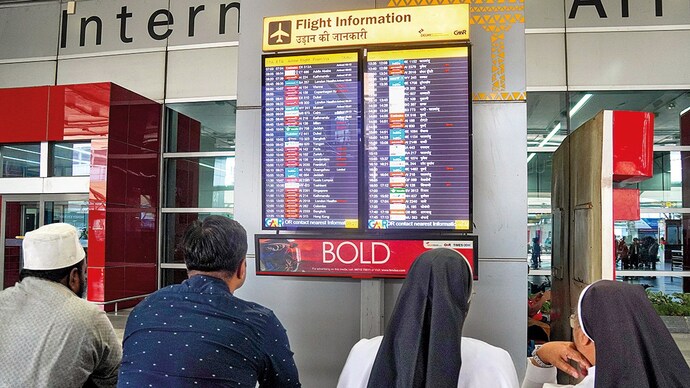
Delhi-based surgeon Dr Vijay S. Pandey just wanted to return home from vacation. He was in Abu Dhabi with his wife, two daughters and a relative when the airspace closed. On March 5, he booked what SpiceJet was referring to as a ‘special distress flight’ from Fujairah to Delhi, for the next day. Five tickets, each costing around Rs 1 lakh. The money was gone instantly from his account. No PNR was ever generated. On March 6, the flight was cancelled. As of March 22, the refund was still not in. “Paid five times the fare for the Gulf evacuation flight amid scary situation,” says Pandey, now back home. “Airlines are profiting from our sufferings.”
Delhi-based surgeon Dr Vijay S. Pandey just wanted to return home from vacation. He was in Abu Dhabi with his wife, two daughters and a relative when the airspace closed. On March 5, he booked what SpiceJet was referring to as a ‘special distress flight’ from Fujairah to Delhi, for the next day. Five tickets, each costing around Rs 1 lakh. The money was gone instantly from his account. No PNR was ever generated. On March 6, the flight was cancelled. As of March 22, the refund was still not in. “Paid five times the fare for the Gulf evacuation flight amid scary situation,” says Pandey, now back home. “Airlines are profiting from our sufferings.”
SpiceJet said since no PNR was generated, the matter was between the user and the bank. But Rs 5 lakh is a serious sum. Pandey’s story—a panic booking, money deducted without a ticket, a cancellation without consequence—captures what is now the worst disruption to Indian aviation since the COVID pandemic. The government says some 426,000 Indians have returned from the Gulf since the war began on February 28. The implications for India-Gulf aviation: fares up 300-460 per cent, longer flight times and abrupt cancellations, turning a key corridor into an expensive, unpredictable route.
A wall of closed airspace stretching from the eastern Mediterranean to the Persian Gulf is the reason. Iraq, Kuwait and Syria are completely closed to civil aviation. Only limited prior-permission flights are allowed into Israel, Bahrain and Qatar. Access from the UAE narrows to a single western corridor, vulnerable to sudden overnight closures. Since Operation Sindoor in April 2025, Pakistani airspace is closed for Indian-registered aircraft. With the Middle East now fenced off as well, both westbound corridors have been snuffed out.
India-Gulf flights are adding 45-120 minutes to total time. Air India flights from Newark and New York now stop to refuel in Rome. IndiGo, which operates an all-narrowbody fleet, cancelled new long-haul routes to London, Amsterdam and Manchester after crew-duty limits were exceeded following network reshuffling. It cancelled 162 Middle East services in a single day on March 2. Its international cancellation rate has hit 75.9 per cent.
By mid-March, airfares had surged. One-way tickets from Abu Dhabi to Delhi, typically priced at Rs 10,000-21,500, were selling for Rs 39,285-69,678. On the Dubai-Delhi corridor, fares rose to Rs 50,000–60,000, with last-minute tickets even higher. On the Dubai-Kochi route—the lifeline for the 2.2-million-strong Kerala diaspora—one-way fares reached Rs 62,000. Return fares on long-haul routes such as India-US, usually in the Rs 45,000-Rs 1 lakh range, climbed to Rs 1.3 lakh-2.25 lakh. Bengaluru-Frankfurt return fares rose from about Rs 80,000 to Rs 1.9 lakh.
What’s fuelling the surge isn’t just supply constraints. War-risk insurance premiums have risen 10-20 times, adding Rs 30-40 lakh per narrowbody and up to Rs 1 crore for widebody return trips. India-Gulf flights often depart nearly empty, with insurance costs recouped from passengers on packed return legs. Jet fuel prices jumped 58.4 per cent in a week from February 28, from $99.40 to $157.41 per barrel; domestic Aviation Turbine Fuel (ATF) has reached Rs 96,638 per kilolitre in Delhi. Every diverted long-haul flight burns four additional tonnes of fuel on average, costing $6,000-7,500 more per additional hour aloft. Fuel accounts for roughly 40 per cent of airline operating costs in India. “The crisis is worse than COVID. If this continues for weeks, airlines may find it impossible to operate,” says Kapil Kaul, CEO of aviation consulting CAPA India. “Indian airlines have already lost some $2.5 billion [Rs 23,500 crore] till date. As the war continues and the rupee touches 100 to a dollar, things will get worse.”
WHAT IS BEING DONE
With several airlines facing “unsustainable financial conditions”, the government has lifted the fare caps that had been imposed during the December 2025 IndiGo-led disruptions—following lobbying by the Federation of Indian Airlines. At the same time, airlines levy a modest fuel surcharge, though full cost recovery would require steeper fare hikes.
The ministry of external affairs is operating an inter-ministerial mechanism for clearance of additional flights and prioritisation of students, workers and medical-emergency cases. Where direct routes are still blocked, India helped open up transit corridors through Turkey, Armenia, Azerbaijan and Jordan. Regular commercial flights have started operating in a phased mode, too.
WHAT MORE NEEDS TO BE DONE
D.P. Hemanth, CEO of Asia Pacific Flight Training Academy, says there are two levers: rationalisation of state VAT on ATF and nudging oil marketing companies (OMCs) to moderate margins, wherever possible. The government is examining if the OMCs’ price revision, due in April, could be staggered over a few months to cushion fares and freight rates from an immediate shock.
Hemanth also flags lease rentals. IndiGo pays upwards of Rs 10,000 crore a year for the leasing of planes; Air India’s outgo is running into several thousand crores. And they owe this money even for grounded flights. “The government should present a rescue package. We have an operator-starved, under-serviced aviation market. Any hit to aviation impacts the economy a lot,” says Hemanth.

