BJP | Game plan to break new ground
The BJP is confident of retaining Assam and getting big gains in Bengal while also making inroads into the southern states
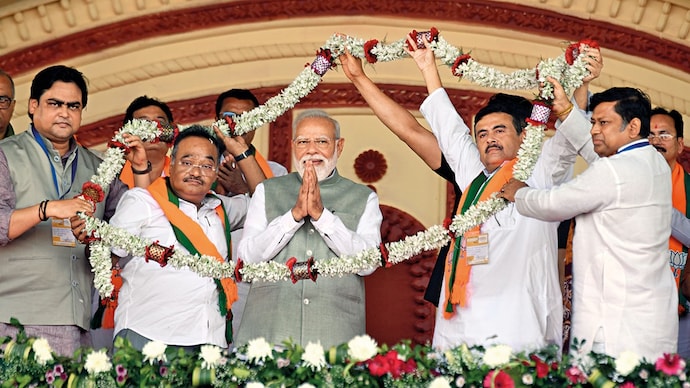
For the BJP, West Bengal remains the top prize among the five states going to the polls in April. And while it is confident of retaining power in Assam, and has largely wrested the Northeast states from the Congress, ‘Bangla’ remains the missing crown jewel in the party’s eastern push. For Prime Minister Narendra Modi and his home minister Amit Shah, the state represents a huge challenge, a theatre where their untiring electoral machinery must perform with clockwork precision. Electoral setbacks in the state in the 2024 Lok Sabha polls, where the BJP tally went down to 11 seats out of the total 42, have not deterred them. Since then, the party has honed a far more clinical playbook by marrying data-driven, booth-level targeting with early candidate announcements and finely tuned community alliances. The post-2024 approach, including dialling down the Hindutva rhetoric where needed, tightening coordination with partners, and enforcing disciplined execution has already paid rich dividends in state polls in Maharashtra, Haryana and Delhi. Now it’s time for the big challenge: how Bengal votes this year could set the trajectory for the party as it begins planning for the 2029 general election.
For the BJP, West Bengal remains the top prize among the five states going to the polls in April. And while it is confident of retaining power in Assam, and has largely wrested the Northeast states from the Congress, ‘Bangla’ remains the missing crown jewel in the party’s eastern push. For Prime Minister Narendra Modi and his home minister Amit Shah, the state represents a huge challenge, a theatre where their untiring electoral machinery must perform with clockwork precision. Electoral setbacks in the state in the 2024 Lok Sabha polls, where the BJP tally went down to 11 seats out of the total 42, have not deterred them. Since then, the party has honed a far more clinical playbook by marrying data-driven, booth-level targeting with early candidate announcements and finely tuned community alliances. The post-2024 approach, including dialling down the Hindutva rhetoric where needed, tightening coordination with partners, and enforcing disciplined execution has already paid rich dividends in state polls in Maharashtra, Haryana and Delhi. Now it’s time for the big challenge: how Bengal votes this year could set the trajectory for the party as it begins planning for the 2029 general election.
Meanwhile, next-door Assam is a study in contrast: with CM Himanta Biswa Sarma himself leading the charge, the BJP is expected to sail through. As for the southern push in Kerala, Tamil Nadu and Puducherry, the party still lacks the dominant leaders and organisational roots to call the shots. Here, it’s a more nuanced strategy amid the hard realities of local politics—of positional advantage and incremental gains, where every election takes it closer to the top prize.
ONWARDS AND UPWARDS
The BJP has a controlled and state-specific strategy, whether it is Bengal’s fine-tuned poll machine, Assam’s leader-driven model, or the progressive wins in the south
WEST BENGAL
At the BJP headquarters in Kolkata, the buzz is all about ground reports, caste and booth-level data, and, of course, ‘winnability metrics’. The party has already announced 255 candidates and is finalising the remaining 39, the early rollout aimed at maximising mobilisation time. In a clear shift from its earlier reliance on turncoats and celebrity candidates, the emphasis this time is on leaders with local networks, claims the party. But then there have also been protests against the ‘centrally imposed nominations’. From Alipurduar to Hooghly and North 24 Parganas to Kolkata, sections of the local cadre are up in arms against outsiders being parachuted in.
Meanwhile, the party has recognised the limits of a hyper-Hindutva narrative. In West Bengal, Muslims account for 27 per cent of the population and have influence in some one-third of the total 294 assembly seats. Keeping the campaign low-decibel is also one way to broaden the party’s appeal. Internal assessments suggest that even a 4-6 per cent fragmentation within the minority vote can be decisive in 40-50 constituencies.
That said, the BJP is also relying on the Sangh’s grassroots networks to amplify the narratives around alleged violence against Hindus in Bangladesh, concerns over demographic shifts, illegal infiltration, and perceived local security threats. Late last year, the Sangh and their affiliates had already ramped up the door-to-door outreach programmes in the state. Insiders say some 94,000 local ‘mohalla meetings’ have been organised across Bengal in the past few months. The Sangh’s centenary programme, Ghar Ghar Sampark Abhiyan, provided the perfect occasion, with RSS swayamsevaks putting every effort into covering the Dalit and Adivasiconcentrated blocks. Massive Ramnavami mobilisation, reportedly across some 1,000 locations in Bengal, was all part of the preelection drum roll.
The Sangh network, too, has grown. Sources say that in south Bengal alone, the number of RSS shakhas has doubled to some 12,000 right now. Motivation levels are high, they say, buoyed by the visits of “high-level leaders”. RSS sarsanghchalak Mohan Bhagwat was in Bengal on a 10day visit in February.
The BJP has also consciously avoided personal attacks on chief minister Mamata Banerjee, recognising that any aggressive rhetoric could alienate the women voters and the bhadralok middle class. The party has fielded leader of the Opposition, Suvendu Adhikari, against her in Bhabanipur constituency (last time around, he had defeated Mamata when she took him on in his lair, Nandigram). It’s also focusing on issues like women’s safety, corruption and law and order. High-profile incidents like the RG Kar Medical College rape-murder case, which sparked large-scale protests in 2024, are being used to highlight the TMC regime’s failures. There are reports that the party may field the RG Kar victim’s mother from Panihati in North 24 Parganas.
The saffron side has also got a boost from the Election Commission, both through the SIR process—successive revisions have flagged 2-4 per cent of the electorate (700,000-1.5 million voters) for deletion, while also adding new voters—and the removal of officials perceived to be close to the TMC. Some 60 senior officials have been shunted out, including the chief secretary, DGP, home secretary and even the Kolkata police commissioner.
ASSAM
Unlike in any other BJP-ruled state, chief minister Himanta Biswa Sarma, whose personal network, administrative authority and regional credibility are critical to the party, is the face of the campaign here. He is not just expected to retain Assam but to deliver a decisive mandate as well. The CM’s influence extends across constituencies, communities and alliance configurations, allowing the BJP to navigate the state’s complex demographic realities.
Sarma has also been able to neutralise the Muslim vote (they account for roughly 34 per cent of the population, but are concentrated in 35-40 constituencies). This has been done through a sharp campaign around alleged illegal infiltration from Bangladesh, eviction drives in districts such as Darrang, Nagaon and Barpeta, tightened land laws in tribal belts, and invoking mechanisms against doubtful voters. Sarma has also sought to draw a distinction between indigenous Assamese Muslims and ‘Miya infiltrators’, helping the party avoid a complete consolidation of minorities against it.
The party has also firmed up alliances. It is contesting only 89 of the total 126 seats, with the Asom Gana Parishad and the Bodoland People’s Front (BPF) being allocated 26 and 11 seats respectively. The BPF’s return to the NDA is significant as it has influence in 12-15 seats in the Bodoland Territorial Council belt.
TAMIL NADU
The BJP has returned to its alliance with the All India Anna Dravida Munnetra Kazhagam (AIADMK), acknowledging the limits of its post-2021 attempt to go solo. A new conciliatory state president, Nainar Nagendran, and some shrewd bargaining, has got it 27 seats, seven more than last time. That said, there is some grumbling over the choice of seats. The party is also trying to broaden its reach beyond the BJP’s traditional support base of the Tamil Brahmin and Nadar communities. New state chief Nagendran is from the Thevar community (an OBC caste), which is quite influential in the southern and central districts. The state unit is also going through a political and organisational reset. Ex-state chief K. Annamalai, whose confrontational line had led to the break-up with the AIADMK earlier, has been asked to dial it down.
The numbers explain the compulsion. In the 2021 assembly poll, the BJP, in alliance with the AIADMK, managed four seats with a 2.6 per cent vote share. In the 2024 Lok Sabha election, the BJP contested largely on its own, pushed its vote share to 11 per cent, but failed to win a single seat. The message was clear: vote share does not translate into seats without alliance backing.
KERALA
Kerala remains an outlier for the BJP, with the party unable to break the tightly structured bipolar contest between the CPI(M)-led Left Democratic Front (LDF) and the Congress-led United Democratic Front (UDF). In 2021, the BJP got 11.4 per cent vote share, but failed to win a single seat. The breakthrough came in 2024, when actor Suresh Gopi won Thrissur, the party’s first Lok Sabha victory in the state. Recently, the party also captured the corporation in capital Thiruvananthapuram in the local body polls.
For 2026, the BJP is targeting 15 ‘winnable’ seats in the 140-seat house. It also has some big-ticket candidates, such as ex-Union ministers Rajeev Chandrasekhar and V. Muraleedharan, and former DGP R. Sreelekha. The focus is on constituencies where it polls 15-25 per cent, mostly concentrated in Thiruvananthapuram, Thrissur and Palakkad districts. A key part of this push has been the outreach to the 18 per cent Christian population through engagement with the Syro-Malabar Church and bodies like the Kerala Catholic Bishops’ Council. This outreach has backing at the highest level, with PM Modi himself meeting Church leaders in November last and again recently.
Yet, the returns remain limited. Christian voters continue to be anchored within the LDF-UDF framework, reinforced by parish networks and long-standing political alignments. The BJP’s booth-level machinery also lags behind the grassroots organisation of both fronts. In a state with 75 per cent-plus voter turnout and entrenched voting patterns, the organisational gap becomes decisive.
PUDUCHERRY
The former French colony has an outsize influence in the saffron scheme of things, thanks to the NDA government in the Union Territory. The administration here was led by the All India N.R. Congress (AINRC), with the BJP the other major partner. The alliance continues, with the AINRC contesting 16 seats, and the BJP 10—one more than last time—for the 30-seat assembly. The other four seats have been divided between the AIADMK and the Lakshia Jananayaga Katchi.
Here, too, it’s all about incremental gains for the party. It became a serious player after winning six of the nine seats it contested in 2021, and has now relegated the AIADMK to a marginal role in the NDA. There seems to be no downside in Puducherry for a party that established a mainstream presence here just a few years ago, and that too with a clutch of turncoats from the other parties.

