Bihar | Will he be the samrat?
Nitish Kumar is said to favour old foe and deputy CM Samrat Choudhary for the CM's post, but he is not the BJP's only choice
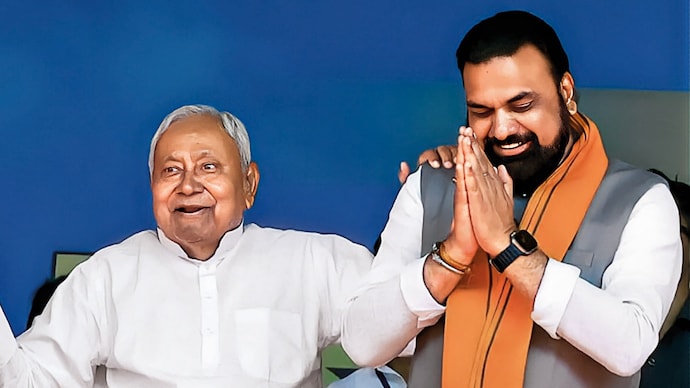
For about 22 months beginning in 2022, Samrat Choudhary wore a saffron turban as a symbol of a project unfinished, publicly vowing not to remove it until he had “dethroned” Nitish Kumar from the chief minister’s post. That was after Nitish ditched the National Democratic Alliance to form the Mahagathbandhan government with the Rashtriya Janata Dal (RJD). The antagonist turban did not vanish even after Nitish pivoted back to the BJP in January 2024, with Choudhary enlisted as No. 2.
For about 22 months beginning in 2022, Samrat Choudhary wore a saffron turban as a symbol of a project unfinished, publicly vowing not to remove it until he had “dethroned” Nitish Kumar from the chief minister’s post. That was after Nitish ditched the National Democratic Alliance to form the Mahagathbandhan government with the Rashtriya Janata Dal (RJD). The antagonist turban did not vanish even after Nitish pivoted back to the BJP in January 2024, with Choudhary enlisted as No. 2.
Two years on, the picture has emphatically reversed. Choudhary is within striking distance of Bihar’s throne. And his best asset is that he has Nitish’s backing. The Janata Dal (United) supremo is moving to the Rajya Sabha, and will be formally stepping down as CM. By April 15, Bihar is likely to get a new face at the helm. Only one eventuality is certain: the CM will be a BJP face. The party leadership thrives on springing last-minute surprises, and names like Nityanand Rai and Vijay Kumar Sinha are being discussed too, alongside leaders from the depressed castes. But Choudhary’s hat—or his turban—is very much in the ring. While weighing his pros and cons, his enthusiastic articulation of the Hindutva governance as deputy CM will count. But that does not entirely erase a built-in deficit: he is not a product of the BJP, being an eclectic party-hopper originally groomed within the RJD.
So, why is Nitish plumbing for the man who was once sworn to his ouster? And why might the BJP fall for that line of reasoning? It’s about caste arithmetic, the bedrock of Bihar politics, and here Choudhary begins with a structural advantage. He belongs to the Kushwaha (Koeri) community, approximately 4.2 per cent of the state’s population, and more importantly, the second-largest bloc among the OBCs (the largest are the Yadavs, the RJD’s core base). The Kushwahas occupy a more fluid political space: numerically significant enough to matter, yet not so consolidated that they are permanently anchored to a single party. In this sense, Choudhary represents an opportunity: the consolidation of a key OBC bloc.
This is where Nitish’s calculations also flow from. Choudhary could represent the other part of a duality that has been one of his most enduring political innovations—the ‘Luv-Kush’ social coalition. Nitish, a Kurmi, built a durable political identity by pairing his caste with the Koeris (Kushwahas), creating a non-Yadav OBC axis to counterbalance the Yadav-Muslim alliance. This ‘Luv-Kush’ formula was a vital bridge that also greatly empowered the BJP. It is not incognisant of that fact.
THE RIGHT PAIRING
With Nitish’s departure, the BJP-JD(U) coalition has to survive the absence of its architect while retaining his reach and durability. Choudhary offers a plausible answer. As a Kushwaha leader, he can anchor the Koeri side of the equation. If paired, as some in the JD(U) suggest, with Nitish’s son Nishant Kumar, it can articulate the same social base in an undisturbed way.
Choudhary’s candidacy also rests on a related logic. Nitish, despite stepping aside, is unlikely to retreat from Bihar’s political landscape. Any successor, then, would do well to be acceptable to him and his party. The BJP’s challenge will be to assert leadership without alienating its ally. Choudhary could be that consensus figure—one who can bridge the NDA’s internal dynamics. It’s telling that, within the JD(U), the transition is being described not as a change of guard but as a “transfer of legacy”. The question is, will the BJP repose full trust in a non-cadre face at such a decisive moment?

