Vijay cannot stop Tamil Nadu's blockbuster freebies film. So, what must he do?
With his pre-election promise of liberal give-aways—on top of massive existing ones—Tamil Nadu Chief Minister Vijay has shown that the freebie culture is not episodic, it is chronic. Every promise that he made carries a massive recurring price tag that must be paid in hard cash, not cinema tickets. How can he foot the bill?
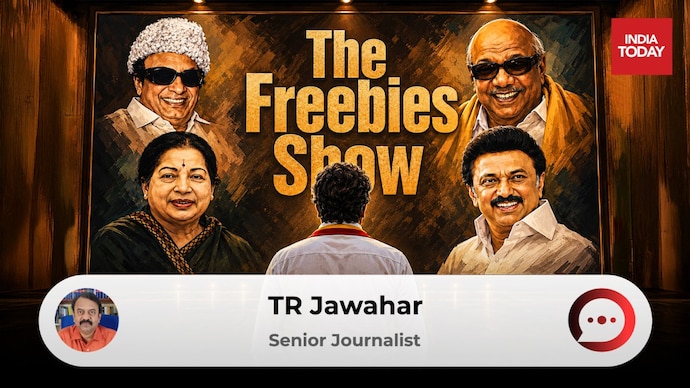
The confetti has barely settled on the Marina, and the pristine hero has successfully taken his oath at the Nehru Stadium. The cinematic climax is over, the credits have rolled, and the lights in the theatre have been switched on. But as the new dispensation takes its seat at Fort St. George, the celebratory buzz of the Thooya Sakthi (pure force) is meeting the cold, unblinking glare of a ledger that contains no poetry, no punchlines, and absolutely no liquidity.
Welcome, Chief Minister Vijay, to the real world of peninsular public finance, where the expectation clock doesn't just tick—it tolls.
For months, the campaign trail of Tamil Nadu Assembly Election 2026 resembled a high-octane auction of state-sponsored benevolence. The promise matrix was wide, lavish, and designed to cater specifically to a generation that thinks money grows on digital trees. We were treated to a grand buffet of targeted cash transfers, monthly allowances for women that outbid the previous Kalaignar Magalir Urimai Thogai, unemployment stipends for the Gen Z cohorts, and massive freebie doles that assumed the treasury was a bottomless well of plenty.
But as the new Chief Minister opens the royal iron safe, he is confronting a mathematical nightmare. The state’s outstanding public borrowing has officially touched a staggering Rs 10.71 lakh crore for the financial year. The inheritance is not a treasury; it is a towering mountain of IOUs. The Dravidian duopoly did not just vacate the palace; they left behind a state where every single infant is born with a debt certificate of over one lakh rupees wrapped around its wrist.
THE WHITE PAPER INTERMISSION
Realising that the script cannot outrun the spreadsheet forever, the new administration has already whispered its first defensive play: a comprehensive white paper on state finances. This is the mandatory political intermission—a tactical pause where the director steps in front of the screen, adjusts his spectacles, and asks the audience for a bit of time and understanding to check reality first. By initiating a forensic look into the books, Vijay is essentially telling the eager crowds that the projection room needs a quick technical alignment before the freebie feature film can resume.
It is a lucid and logical progression of facts designed to temper the frantic multiplex expectations. Even the absurd needs an audit. Before the electronic transfer machines can start spitting out the promised cash handouts, the state needs to reconcile its data with the Reserve Bank of India and calculate the true depth of its overdraft limitations. The white paper is a clever cushion; it allows the movie messiah to maintain his Thooya Sakthi aura while letting the dry, bureaucratic numbers do the unpleasant work of saying, "please stand by."
THE CHRONICLE OF CHRONIC PROFLIGACY
The move to issue a white paper carries a profound sense of political dj vu. In 2021, the incoming DMK administration similarly brought out a scathing, data-heavy white paper, loudly complaining that the preceding AIADMK regimes had completely emptied the vault. Yet, having diagnosed the disease, they set about continuing the exact same spendthrift trend, proving that in Tamil Nadu, the freebie culture is not episodic but chronic. It is a genealogy of addiction in which the State and society are comrades in alms.
Tamil Nadu's revenue deficit has hovered precariously around Rs 49,279 crore in recent budget estimates, while the final deficits revealed in Comptroller and Auditor General (CAG) audit reports consistently exceed the initial medium-term fiscal plans by 71.5%. The CAG has repeatedly passed structural strictures, noting that the state has routinely violated its own Fiscal Responsibility and Budget Management (FRBM) targets by borrowing heavily not to build revenue-generating assets, but simply to fund its day-to-day consumption.
A CAROUSEL OF CONCESSIONS: THE GRAND DELIVERY MATRIX
But while the white paper buys time, the manifesto remains an active contract in the minds of the masses. The sheer volume of the promised payouts is enough to give any financial secretary an immediate fit. Vijay’s campaign did not stop at competing with the old guard; it literally sought to out-dole them at every turn.
In addition to the enhanced monthly allowance for women, the TVK script threw in a completely free bus ride for men on state transport utilities—effectively turning the entire fleet into a complimentary public chariot parade. Then came the promise of subsidized gold sovereigns for weddings, ceremonial silk sarees for festive distribution, and an immediate, headline-grabbing announcement on a domestic electricity concession aimed at erasing the recent tariff hikes.
Every single one of these promises carries a massive, recurring price tag that must be paid in hard cash, not cinema tickets. The electricity concession alone requires the state to pump additional thousands of crores into a power grid that is already on life support, turning a popular applause-line into an immediate budgetary drain.
COMMITTED TO THE CASH CRUNCH
To understand the sheer magnitude of the fiscal dilemma Vijay must now walk, one needs to peel back the layers of Tamil Nadu's expenditure budget, which hovers around a massive Rs 4,39,293 crore.
The fundamental structural trap of the state's economy lies in what economists politely term committed expenditure. In plain Tamil, this is the Mudhal Thedhi: money that must be paid out on the first of every month before a single rupee can be spent on new roads, schools, or multiplex-style welfare schemes.
Currently, the state spends an astonishing 62% of its total estimated revenue receipts (which stand at Rs 3,31,569 crore) on just three immovable legacy obligations, and the specific arithmetic of this stranglehold is devastating. Out of this total structural trap, 28%—amounting to a whopping Rs 93,423 crore—is swallowed in whole by salaries and wages to keep the massive, multi-layered bureaucratic apparatus moving. Another 14%—translating to a hefty Rs 46,290 crore—is automatically funnelled into pensions to sustain the retired legions of the state's workforce. The remaining 21%—a crushing Rs 69,341 crore—goes entirely toward servicing the interest payments on the past sins of public borrowing, essentially paying the premium on yesteryear’s political profligacy.
When a cumulative total of Rs 2,07,054 crore, representing more than sixty paise out of every single rupee collected, is automatically sucked into this engine of state maintenance, the room for revolutionary transformation shrinks to a tiny, suffocating window. Every grand cinematic vision for the state's future is instantly hemmed in by the reality that the bureaucracy, the retirees, and the lenders must be fed before the new Chief Minister can buy a single bag of popcorn for his eager audience.
The fiscal deficit is already pushed to the absolute legal brim at 3.4% of the Gross State Domestic Product (GSDP), leaving zero margin for error. Under the stringent guidelines of the central monitoring grid, the tap on off-budget borrowings has been firmly shut. The old trick of hiding debt in the balance sheets of state power corporations or transport undertakings has been clinically outlawed. The financial regulators are watching, and any attempt to run an unauthorized overdraft will meet with an immediate, automatic freeze.
THE FEDERAL FRICTION: LANGUAGE, GST & METRO RAIL MYSTERY
The fiscal narrative cannot be fully understood without looking at the permanent background noise of the Centre-State equation: the bitter battle over GST sharing and infrastructural accounting. The federal friction has directly choked the state's welfare pipelines, most notably through the central withholding of over Rs 2,291 crore in annual education funds under the Samagra Shiksha scheme. This fiscal freeze is the direct fallout of a high-stakes ideological gridlock, where Delhi has squeezed the cash flow as leverage to enforce the National Education Policy's three-language formula, while Chennai firmly stands its ground on its historical two-language policy.
Nowhere is this accounting battle more visible than in the Chennai Metro Rail Phase-II project. A massive sum of Rs 9,523 crore remains trapped in a bureaucratic limbo between Chennai and Delhi. The state maintains that this expenditure should be classified under a Central Sector Project, meaning it should reflect entirely in the Union government’s accounts. Because Delhi has consistently sat on the book adjustment entries, the multi-thousand-crore burden has been dumped directly onto the state’s balance sheet, inflating the debt-to-GSDP ratio to an elevated 26.12%.
Vijay inherits not just an empty vault, but a long-standing, unresolved shouting match over central tax devolution, where the peninsular state is consistently asked to generate maximum revenue while receiving a diminished share in return.
THE LEGACY PARADOX: STRONG ECONOMY, STRANGLED TREASURY
This brings us to the grand economic paradox of modern Tamil Nadu: a remarkably strong state economy wrapped around a completely strangled public treasury. For many preceding decades, the state’s welfare model has been a phenomenal success on paper. It has yielded some of the highest human development and social indices in the entire country, outpacing the national average in per capita income, maternal health, and gross educational enrolment.
But this stellar social progress has come at an unsustainable financial cost. A decade of consistent, structural deficits has proven that you cannot run a first-world welfare state on a third-world tax base without eventually hitting a financial wall. The state's nominal growth rate suggests that a trillion-dollar economy is achievable by 2031, but that wealth resides in the private industrial clusters of Coimbatore and Sriperumbudur, aggravating intra-State income and wealth disparities, while the government’s own tax buoyancy has hovered below par for years. The preceding regimes spent eons treating the state budget as an endless round of electoral charity, and the bills for that decade-long party have all matured exactly at the moment Vijay took the oath.
THE REVENUE DUOPOLY: SIN AND SOIL
The irony gets even thicker when you look at how this highly moral, rational, and now wholly cinematic state earns its bread. Tamil Nadu boasts of being a hub for automobile manufacturing, software, textile and leather export. But when it comes to stuffing cash into the state's own pocket, the entire structure relies on a twin-engine system of absolute vice and basic shelter: TASMAC and Property Registrations.
Together, these two departments contributed more than Rs 75,000 crore to the exchequer in the last fiscal year. State-run liquor sales alone pumped in a massive Rs 50,000 crore in excise and tax, while the stamp duty from property transactions brought in Rs 25,910 crore.
Here lies the ultimate political and moral pretzel for the Good Samaritan CM. The TVK, in its quest for social purity, has loudly toyed with populist anti-liquor rhetoric. The closure of taverns near temples and schools has secured the blessings of mothers and the devout but also brings a blight on the exchequer – read my other article: Vijay separates the temple from the tavern here. Every time a liquor shop is shut down in the name of public interest, the treasury instantly loses hundreds of crores, wobbling like a tippler.
To compensate for a full-scale shutdown, the state would have to increase property guideline values by an impossible margin or raise value-added taxes on fuel to levels that would trigger mass rebellion. It is tough luck that diesel and gas prices are already heading north. The hero who promised to vanquish the evil force is finding that the evil force’s primary revenue generator is the only thing keeping the state's schools and hospitals from running completely out of cash. A dicey dilemma that gives Hamlet an inferiority complex.
THE DUPLICATION TRAP AND THE POWER DRAG
The administrative challenges are further compounded by a phenomenon known as the layer-cake of populism. Over the last two decades, consecutive governments have layered new cash transfer schemes directly on top of existing ones without ever rationalizing or restructuring the old ones.
We have matching freebie schemes for laptops, cycles, breakfast, and bus passes, often distributed through overlapping departments with zero data synchronization. If Vijay attempts to layer his own grand election promises on top of this existing grid without a ruthless, microscopic audit, the budget will collapse into absolute insolvency within the first two quarters.
Then there are the structural anchors dragging the state down into the red: the public sector undertakings. The state power distribution giant, TANGEDCO, and the various state transport corporations are operating as structural black holes. The budget must allocate over Rs 15,877 crore just to fund the losses of the electricity board, which suffers from chronic inefficiency, transmission leakages, and a complete refusal to modernize its tariff structure out of pure electoral fear.
The transport buses are running on flat tyres, charging fares that are artificially depressed while the fuel bills are paid out of borrowed funds. It is an economy running on a treadmill—plenty of motion, massive noise, but zero forward movement on the fiscal track.
REGIONAL BALANCING & THE EXPECTATION GRID
Beyond the spreadsheet lies the complex regional geography of the mandate. The eight districts where the TVK drew a total blank—primarily across the deep southern belts and traditional delta pockets—represent a crucial administrative expectation that must be handled with care. This spatial gap should not be viewed just as a political threat, but rather as a weak link that may lead to administrative alienation and therefore requires targeted, constructive development.
After all, governance follows in the footsteps of the party.
These regions cannot be left out of the state’s investment map. To win over these sceptical zones, the new administration must ensure that infrastructure spending, agricultural subsidies for the delta, and industrial corridors for the south are distributed with absolute parity, proving that the Thooya Sakthi governs for the entire soil, not just for the booths that blew the whistle.
THE ACTIONABLE BLUEPRINT: SHORT-TERM SURVIVAL TACTICS
Since the new Chief Minister has shown commendable caution by asking for time to understand the state's financial reality, it is only proper to offer a realistic, politically sound balancing act to stabilize the treasury without triggering an audience mutiny. In the short term, the administration must pivot from universal populism to targeted rationalization.
Data-Driven Targeting: By deploying a unified data registry, the state can instantly eliminate the duplication trap. Richer income brackets must be micro-targeted out of the free bus ride and electricity subsidy grids via an opt-out mechanism like the central LPG subsidy model. This preserves the political promise for the vulnerable while cutting down budgetary bleed by an estimated 15%.
The Asset Monetization Reel: Rather than raising taxes or taking fresh loans, the government can unlock non-tax revenues by monetizing underutilized state assets, leasing urban land parcels owned by transport undertakings, and introducing commercial advertising models across public infrastructure. Vijay's assurance of transparency should do overtime here.
The Escrow Guarantee: For high-visibility promises like the gold sovereign wedding scheme, the state can create independent, corporate-backed social responsibility (CSR) trusts, keeping the financial liability off the sovereign balance sheet.
THE LONG-TERM SCRIPT: STRUCTURAL ECONOMIC RE-ENGINEERING
For long-term systemic health, the matinee megastar must transition roles from a manager of doles to a builder of wealth. Charisma must be converted into capital through deep structural reforms.
TANGEDCO Tariff Restructuring: The power giant must be unbundled and commercialized. Introducing time-of-day metering for high-end consumers and solar-grid integration for agriculture can arrest the Rs 15,877 crore annual drain without penalizing domestic users.
Tax Buoyancy via Digital Compliance: Tamil Nadu’s own tax-to-GSDP ratio has dropped from 7.92% to nearly 6.2%. By fully automating commercial tax audits and leveraging AI to track GST leakages in major industrial hubs, the state can naturally increase its tax revenue by Rs 20,000 crore annually without increasing tax rates.
Federal Realignment via the SC: The state must pursue its Supreme Court suit on the Samagra Shiksha funds with clinical rigor, arguing that educational funding cannot be held hostage to cultural conditions, thereby unlocking the trapped Rs 2,291 crore through judicial mandate.
THE FINAL REEL
MGR had the image but lacked the imagination; Jayalalithaa possessed intelligence but was also possessed by insidious resident evils. The new star on the firmament can learn from them: what to do and most importantly, what not to. Some history need not necessarily be repeated.
For now, the whistle has been heeded, the throne has been claimed, but the real test is now unfolding in the boring corridors of the state finance department. Vijay is no longer dealing with a friendly scriptwriter who can manipulate the plot to ensure the hero wins against all odds. He is dealing with a ledger where the numbers must balance, where the debt is real, and where the vault is completely, hilariously bare.
The multiplex mandate has met the reality of the market. By showing fiscal discipline in the boardroom while maintaining his populist empathy on the screen, the new Chief Minister has a rare opportunity to rewrite the economic history of the soil. The audience has given him a long rope; it is now up to him whether he ties up the loose ends or ties himself up in knots of imprudent profligacy.
(TR Jawahar is a senior Chennai-based journalist and author of the book Why TN Is Forbidden Land: The State And Its State Of Affair Explained. His just-concluded exclusive 50-part series for indiatoday.tech is a must-read for any student looking for a civilisational understanding of Tamil Nadu. Access his series, Time, Tide & Tamil, here.)
The confetti has barely settled on the Marina, and the pristine hero has successfully taken his oath at the Nehru Stadium. The cinematic climax is over, the credits have rolled, and the lights in the theatre have been switched on. But as the new dispensation takes its seat at Fort St. George, the celebratory buzz of the Thooya Sakthi (pure force) is meeting the cold, unblinking glare of a ledger that contains no poetry, no punchlines, and absolutely no liquidity.
Welcome, Chief Minister Vijay, to the real world of peninsular public finance, where the expectation clock doesn't just tick—it tolls.
For months, the campaign trail of Tamil Nadu Assembly Election 2026 resembled a high-octane auction of state-sponsored benevolence. The promise matrix was wide, lavish, and designed to cater specifically to a generation that thinks money grows on digital trees. We were treated to a grand buffet of targeted cash transfers, monthly allowances for women that outbid the previous Kalaignar Magalir Urimai Thogai, unemployment stipends for the Gen Z cohorts, and massive freebie doles that assumed the treasury was a bottomless well of plenty.
But as the new Chief Minister opens the royal iron safe, he is confronting a mathematical nightmare. The state’s outstanding public borrowing has officially touched a staggering Rs 10.71 lakh crore for the financial year. The inheritance is not a treasury; it is a towering mountain of IOUs. The Dravidian duopoly did not just vacate the palace; they left behind a state where every single infant is born with a debt certificate of over one lakh rupees wrapped around its wrist.
THE WHITE PAPER INTERMISSION
Realising that the script cannot outrun the spreadsheet forever, the new administration has already whispered its first defensive play: a comprehensive white paper on state finances. This is the mandatory political intermission—a tactical pause where the director steps in front of the screen, adjusts his spectacles, and asks the audience for a bit of time and understanding to check reality first. By initiating a forensic look into the books, Vijay is essentially telling the eager crowds that the projection room needs a quick technical alignment before the freebie feature film can resume.
It is a lucid and logical progression of facts designed to temper the frantic multiplex expectations. Even the absurd needs an audit. Before the electronic transfer machines can start spitting out the promised cash handouts, the state needs to reconcile its data with the Reserve Bank of India and calculate the true depth of its overdraft limitations. The white paper is a clever cushion; it allows the movie messiah to maintain his Thooya Sakthi aura while letting the dry, bureaucratic numbers do the unpleasant work of saying, "please stand by."
THE CHRONICLE OF CHRONIC PROFLIGACY
The move to issue a white paper carries a profound sense of political dj vu. In 2021, the incoming DMK administration similarly brought out a scathing, data-heavy white paper, loudly complaining that the preceding AIADMK regimes had completely emptied the vault. Yet, having diagnosed the disease, they set about continuing the exact same spendthrift trend, proving that in Tamil Nadu, the freebie culture is not episodic but chronic. It is a genealogy of addiction in which the State and society are comrades in alms.
Tamil Nadu's revenue deficit has hovered precariously around Rs 49,279 crore in recent budget estimates, while the final deficits revealed in Comptroller and Auditor General (CAG) audit reports consistently exceed the initial medium-term fiscal plans by 71.5%. The CAG has repeatedly passed structural strictures, noting that the state has routinely violated its own Fiscal Responsibility and Budget Management (FRBM) targets by borrowing heavily not to build revenue-generating assets, but simply to fund its day-to-day consumption.
A CAROUSEL OF CONCESSIONS: THE GRAND DELIVERY MATRIX
But while the white paper buys time, the manifesto remains an active contract in the minds of the masses. The sheer volume of the promised payouts is enough to give any financial secretary an immediate fit. Vijay’s campaign did not stop at competing with the old guard; it literally sought to out-dole them at every turn.
In addition to the enhanced monthly allowance for women, the TVK script threw in a completely free bus ride for men on state transport utilities—effectively turning the entire fleet into a complimentary public chariot parade. Then came the promise of subsidized gold sovereigns for weddings, ceremonial silk sarees for festive distribution, and an immediate, headline-grabbing announcement on a domestic electricity concession aimed at erasing the recent tariff hikes.
Every single one of these promises carries a massive, recurring price tag that must be paid in hard cash, not cinema tickets. The electricity concession alone requires the state to pump additional thousands of crores into a power grid that is already on life support, turning a popular applause-line into an immediate budgetary drain.
COMMITTED TO THE CASH CRUNCH
To understand the sheer magnitude of the fiscal dilemma Vijay must now walk, one needs to peel back the layers of Tamil Nadu's expenditure budget, which hovers around a massive Rs 4,39,293 crore.
The fundamental structural trap of the state's economy lies in what economists politely term committed expenditure. In plain Tamil, this is the Mudhal Thedhi: money that must be paid out on the first of every month before a single rupee can be spent on new roads, schools, or multiplex-style welfare schemes.
Currently, the state spends an astonishing 62% of its total estimated revenue receipts (which stand at Rs 3,31,569 crore) on just three immovable legacy obligations, and the specific arithmetic of this stranglehold is devastating. Out of this total structural trap, 28%—amounting to a whopping Rs 93,423 crore—is swallowed in whole by salaries and wages to keep the massive, multi-layered bureaucratic apparatus moving. Another 14%—translating to a hefty Rs 46,290 crore—is automatically funnelled into pensions to sustain the retired legions of the state's workforce. The remaining 21%—a crushing Rs 69,341 crore—goes entirely toward servicing the interest payments on the past sins of public borrowing, essentially paying the premium on yesteryear’s political profligacy.
When a cumulative total of Rs 2,07,054 crore, representing more than sixty paise out of every single rupee collected, is automatically sucked into this engine of state maintenance, the room for revolutionary transformation shrinks to a tiny, suffocating window. Every grand cinematic vision for the state's future is instantly hemmed in by the reality that the bureaucracy, the retirees, and the lenders must be fed before the new Chief Minister can buy a single bag of popcorn for his eager audience.
The fiscal deficit is already pushed to the absolute legal brim at 3.4% of the Gross State Domestic Product (GSDP), leaving zero margin for error. Under the stringent guidelines of the central monitoring grid, the tap on off-budget borrowings has been firmly shut. The old trick of hiding debt in the balance sheets of state power corporations or transport undertakings has been clinically outlawed. The financial regulators are watching, and any attempt to run an unauthorized overdraft will meet with an immediate, automatic freeze.
THE FEDERAL FRICTION: LANGUAGE, GST & METRO RAIL MYSTERY
The fiscal narrative cannot be fully understood without looking at the permanent background noise of the Centre-State equation: the bitter battle over GST sharing and infrastructural accounting. The federal friction has directly choked the state's welfare pipelines, most notably through the central withholding of over Rs 2,291 crore in annual education funds under the Samagra Shiksha scheme. This fiscal freeze is the direct fallout of a high-stakes ideological gridlock, where Delhi has squeezed the cash flow as leverage to enforce the National Education Policy's three-language formula, while Chennai firmly stands its ground on its historical two-language policy.
Nowhere is this accounting battle more visible than in the Chennai Metro Rail Phase-II project. A massive sum of Rs 9,523 crore remains trapped in a bureaucratic limbo between Chennai and Delhi. The state maintains that this expenditure should be classified under a Central Sector Project, meaning it should reflect entirely in the Union government’s accounts. Because Delhi has consistently sat on the book adjustment entries, the multi-thousand-crore burden has been dumped directly onto the state’s balance sheet, inflating the debt-to-GSDP ratio to an elevated 26.12%.
Vijay inherits not just an empty vault, but a long-standing, unresolved shouting match over central tax devolution, where the peninsular state is consistently asked to generate maximum revenue while receiving a diminished share in return.
THE LEGACY PARADOX: STRONG ECONOMY, STRANGLED TREASURY
This brings us to the grand economic paradox of modern Tamil Nadu: a remarkably strong state economy wrapped around a completely strangled public treasury. For many preceding decades, the state’s welfare model has been a phenomenal success on paper. It has yielded some of the highest human development and social indices in the entire country, outpacing the national average in per capita income, maternal health, and gross educational enrolment.
But this stellar social progress has come at an unsustainable financial cost. A decade of consistent, structural deficits has proven that you cannot run a first-world welfare state on a third-world tax base without eventually hitting a financial wall. The state's nominal growth rate suggests that a trillion-dollar economy is achievable by 2031, but that wealth resides in the private industrial clusters of Coimbatore and Sriperumbudur, aggravating intra-State income and wealth disparities, while the government’s own tax buoyancy has hovered below par for years. The preceding regimes spent eons treating the state budget as an endless round of electoral charity, and the bills for that decade-long party have all matured exactly at the moment Vijay took the oath.
THE REVENUE DUOPOLY: SIN AND SOIL
The irony gets even thicker when you look at how this highly moral, rational, and now wholly cinematic state earns its bread. Tamil Nadu boasts of being a hub for automobile manufacturing, software, textile and leather export. But when it comes to stuffing cash into the state's own pocket, the entire structure relies on a twin-engine system of absolute vice and basic shelter: TASMAC and Property Registrations.
Together, these two departments contributed more than Rs 75,000 crore to the exchequer in the last fiscal year. State-run liquor sales alone pumped in a massive Rs 50,000 crore in excise and tax, while the stamp duty from property transactions brought in Rs 25,910 crore.
Here lies the ultimate political and moral pretzel for the Good Samaritan CM. The TVK, in its quest for social purity, has loudly toyed with populist anti-liquor rhetoric. The closure of taverns near temples and schools has secured the blessings of mothers and the devout but also brings a blight on the exchequer – read my other article: Vijay separates the temple from the tavern here. Every time a liquor shop is shut down in the name of public interest, the treasury instantly loses hundreds of crores, wobbling like a tippler.
To compensate for a full-scale shutdown, the state would have to increase property guideline values by an impossible margin or raise value-added taxes on fuel to levels that would trigger mass rebellion. It is tough luck that diesel and gas prices are already heading north. The hero who promised to vanquish the evil force is finding that the evil force’s primary revenue generator is the only thing keeping the state's schools and hospitals from running completely out of cash. A dicey dilemma that gives Hamlet an inferiority complex.
THE DUPLICATION TRAP AND THE POWER DRAG
The administrative challenges are further compounded by a phenomenon known as the layer-cake of populism. Over the last two decades, consecutive governments have layered new cash transfer schemes directly on top of existing ones without ever rationalizing or restructuring the old ones.
We have matching freebie schemes for laptops, cycles, breakfast, and bus passes, often distributed through overlapping departments with zero data synchronization. If Vijay attempts to layer his own grand election promises on top of this existing grid without a ruthless, microscopic audit, the budget will collapse into absolute insolvency within the first two quarters.
Then there are the structural anchors dragging the state down into the red: the public sector undertakings. The state power distribution giant, TANGEDCO, and the various state transport corporations are operating as structural black holes. The budget must allocate over Rs 15,877 crore just to fund the losses of the electricity board, which suffers from chronic inefficiency, transmission leakages, and a complete refusal to modernize its tariff structure out of pure electoral fear.
The transport buses are running on flat tyres, charging fares that are artificially depressed while the fuel bills are paid out of borrowed funds. It is an economy running on a treadmill—plenty of motion, massive noise, but zero forward movement on the fiscal track.
REGIONAL BALANCING & THE EXPECTATION GRID
Beyond the spreadsheet lies the complex regional geography of the mandate. The eight districts where the TVK drew a total blank—primarily across the deep southern belts and traditional delta pockets—represent a crucial administrative expectation that must be handled with care. This spatial gap should not be viewed just as a political threat, but rather as a weak link that may lead to administrative alienation and therefore requires targeted, constructive development.
After all, governance follows in the footsteps of the party.
These regions cannot be left out of the state’s investment map. To win over these sceptical zones, the new administration must ensure that infrastructure spending, agricultural subsidies for the delta, and industrial corridors for the south are distributed with absolute parity, proving that the Thooya Sakthi governs for the entire soil, not just for the booths that blew the whistle.
THE ACTIONABLE BLUEPRINT: SHORT-TERM SURVIVAL TACTICS
Since the new Chief Minister has shown commendable caution by asking for time to understand the state's financial reality, it is only proper to offer a realistic, politically sound balancing act to stabilize the treasury without triggering an audience mutiny. In the short term, the administration must pivot from universal populism to targeted rationalization.
Data-Driven Targeting: By deploying a unified data registry, the state can instantly eliminate the duplication trap. Richer income brackets must be micro-targeted out of the free bus ride and electricity subsidy grids via an opt-out mechanism like the central LPG subsidy model. This preserves the political promise for the vulnerable while cutting down budgetary bleed by an estimated 15%.
The Asset Monetization Reel: Rather than raising taxes or taking fresh loans, the government can unlock non-tax revenues by monetizing underutilized state assets, leasing urban land parcels owned by transport undertakings, and introducing commercial advertising models across public infrastructure. Vijay's assurance of transparency should do overtime here.
The Escrow Guarantee: For high-visibility promises like the gold sovereign wedding scheme, the state can create independent, corporate-backed social responsibility (CSR) trusts, keeping the financial liability off the sovereign balance sheet.
THE LONG-TERM SCRIPT: STRUCTURAL ECONOMIC RE-ENGINEERING
For long-term systemic health, the matinee megastar must transition roles from a manager of doles to a builder of wealth. Charisma must be converted into capital through deep structural reforms.
TANGEDCO Tariff Restructuring: The power giant must be unbundled and commercialized. Introducing time-of-day metering for high-end consumers and solar-grid integration for agriculture can arrest the Rs 15,877 crore annual drain without penalizing domestic users.
Tax Buoyancy via Digital Compliance: Tamil Nadu’s own tax-to-GSDP ratio has dropped from 7.92% to nearly 6.2%. By fully automating commercial tax audits and leveraging AI to track GST leakages in major industrial hubs, the state can naturally increase its tax revenue by Rs 20,000 crore annually without increasing tax rates.
Federal Realignment via the SC: The state must pursue its Supreme Court suit on the Samagra Shiksha funds with clinical rigor, arguing that educational funding cannot be held hostage to cultural conditions, thereby unlocking the trapped Rs 2,291 crore through judicial mandate.
THE FINAL REEL
MGR had the image but lacked the imagination; Jayalalithaa possessed intelligence but was also possessed by insidious resident evils. The new star on the firmament can learn from them: what to do and most importantly, what not to. Some history need not necessarily be repeated.
For now, the whistle has been heeded, the throne has been claimed, but the real test is now unfolding in the boring corridors of the state finance department. Vijay is no longer dealing with a friendly scriptwriter who can manipulate the plot to ensure the hero wins against all odds. He is dealing with a ledger where the numbers must balance, where the debt is real, and where the vault is completely, hilariously bare.
The multiplex mandate has met the reality of the market. By showing fiscal discipline in the boardroom while maintaining his populist empathy on the screen, the new Chief Minister has a rare opportunity to rewrite the economic history of the soil. The audience has given him a long rope; it is now up to him whether he ties up the loose ends or ties himself up in knots of imprudent profligacy.
(TR Jawahar is a senior Chennai-based journalist and author of the book Why TN Is Forbidden Land: The State And Its State Of Affair Explained. His just-concluded exclusive 50-part series for indiatoday.tech is a must-read for any student looking for a civilisational understanding of Tamil Nadu. Access his series, Time, Tide & Tamil, here.)

