
Vijay separates temple from tavern; dares to go where no TN CM has gone before
Welfare and whisky are strange bedfellows in Tamil Nadu. The State doles out freebies with one hand and pours poison with the other. So, Vijay has done something bold by shutting liquor vends close to temples, schools and bus stands.
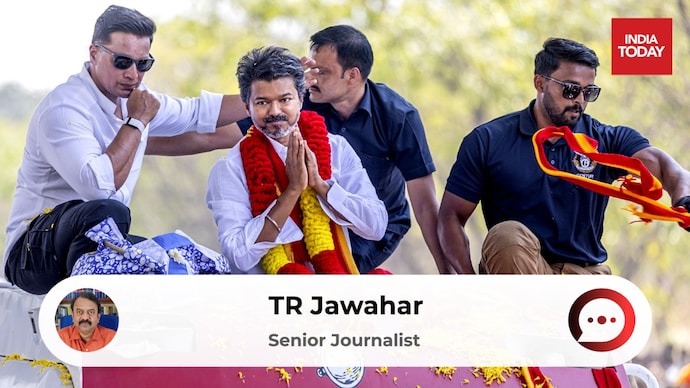

Tamil Nadu is at once Temple Nadu and Tippler Nadu. It is both deeply spiritual and high on spirit, if you get the drift. Both versions overflow with enlightenment: if the deity kindles religious fervour, a drink or two brings out profound rationalist truisms. After all, philosophy happens when the mind ‘floats’ above mundane terra firma. Anyway, let’s now hit the ground.
With just two days in office, Chief Minister Vijay has already swung the first decisive axe. Seven hundred and seventeen TASMAC shops — 276 near temples and places of worship, 186 beside schools and colleges, and 255 hugging bus stands — have been given marching orders within a fortnight. Five hundred metres of breathing space for the faithful, the young and the daily commuter. No more lurching out of a bar straight into a puja, a classroom or a crowded platform. The superstar-turned-CM has drawn a firm line where earlier regimes only made faint pencil marks. Welcome to the newest chapter in Tippler Nadu’s never-ending love-hate saga with booze.
THE PROHIBITION PENDULUM
Flip back the pages and the state’s affair with prohibition reads like a drunkard’s diary — full of good intentions, sudden blackouts and morning-after regrets. Karunanidhi lifted the ban, arguing that Tamil Nadu could not remain an “island of camphor” in a sea of liquor all around. The pious alibi lasted only until politics needed cash. Then prohibition returned, only to be lifted again when the exchequer gasped.
MGR, the silver-screen crusader against arrack, the man who once thundered against the devil drink, ended up laying the foundation of the modern liquor empire in the 1980s. The barman became the benevolent benefactor. He gave out doles with one hand while the other poured the poison. Welfare and whisky became strange bedfellows. The very man who promised to save families from ruin quietly turned the state into a partner in the trade. Irony, that most sober of emotions, must have laughed itself senseless.
Jayalalithaa, on assuming power in 1991, signed the order lifting prohibition on day one. The pattern was set. Successive governments — DMK or AIADMK — played the prohibition game like a dizzying seesaw. Revenue was the eternal excuse, hooch tragedies the convenient villain, welfare the lofty cover. Yet the very money meant to uplift families ended up drowning them. A tragic contradiction: the state elected to protect its people winked at the outrage while the firewater flowed.
Breweries and distilleries were pitted against each other in a parallel duopoly, with rules changing with every regime. One front favoured its benami players, the other tilted the field in the opposite direction. The supply chain became a corrupt pecking order flowing smoothly from the very top down to the last outlet.
Private players, often linked to political families or their proxies, danced around the official trade. Purchase policies were tweaked, licences granted and withdrawn like breaths in a drunken drawl. Corruption did not merely touch liquor — it became liquor. The same fluid that filled bottles filled pockets at every level of the polity and society. A ruthless exploitation of an addicted populace by the very government chosen to protect it.
For a detailed history of prohibition in Tamil Nadu, read my series TIME, TIDE & TAMIL on indiatoday.tech from Part 29 onwards.
TASMAC — FROM BABY TO STATE’S BIGGEST BAR
TASMAC began life modestly under MGR as a regulator. Under Jayalalithaa, it ballooned into the state’s biggest wholesaler and retailer rolled into one. Toddy shops and arrack outlets faded. The corporation took full control of the retail end. What started as an attempt to clean up the business became the state’s most efficient cash-extraction machine. No middlemen on paper, yet the shadows remained.
TASMAC shops, ironically, remain shrouded in mystery while the drinkers out front have stopped covering their faces. Brazen consumption meets opaque operations. Accounts, tenders, supply chains — all wrapped in a haze thicker than yesterday’s hangover.
The supply chain itself breeds its own special brand of rot. From the procurement of spirits at the distillery gate to the pint poured at the counter, every layer offers its own cut. A prosperous entity that rakes in tens of thousands of crores annually, yet sails on with minimal independent oversight. Successive CAG reports have repeatedly flagged serious lapses in procurement rates, inventory mismatches and unexplained price variations, but the corporation continues to function as a law unto itself.
CAG observations gather dust while the liquid keeps flowing and the revenue keeps climbing. This lack of real accountability has turned TASMAC into more than a corporation — it is an institution that quietly sustains an entire ecosystem of influence and undeclared wealth. A state entity that defies normal scrutiny has become the most profitable arm of the government, answerable to none but itself.
Daily footfall across the 4,765 outlets runs into several lakh customers, each seeking a daily dose of liquid courage. The shops may look modest from outside, yet inside they operate like well-oiled temples to Bacchus, complete with their own cocktail of rituals involving hurried pours and shady bargains.
Vijay has promised transparency. He must go deeper into this woozy topic. Let sunlight pierce the opaque corridors of TASMAC — its procurement, pricing and auditing mechanisms. Only when the official trade itself becomes accountable can the larger conversation about reducing dependence on the devil’s brew begin in earnest.
After all, drinkers live in huts. Peddlers, beneficiaries and top-shelf elites build ritzy bungalows. The contrast totters the senses. The socialist welfare state that once railed against private vultures quietly became the biggest vulture of all.
THE CASH COW THAT NEVER SOBERS UP
The figures themselves spin with success. In FY 2024-25, TASMAC raked in Rs 48,344 crore. The previous year it was Rs 45,855.70 crore. The year before that, Rs 44,121.13 crore. Even during the pandemic dip of FY 2021-22, it still managed Rs 36,050.65 crore.
VAT contributes the lion’s share — around Rs 37,323 crore — with excise adding another Rs 11,020 crore. Alcohol for human consumption sits comfortably outside GST. Sarakku may escape GST, but the side dish certainly does not. The state keeps every paisa of its steep levies, which swing from 14.5 per cent to more than 270 per cent depending on the brand. No bill, no breakdown, no questions asked. The customer pays, drinks the sauce and reels home. The government smiles and swaggers all the way to the bank.
Festivals lift the spirits higher. During last Diwali, TASMAC registered a staggering Rs 790 crore in just a few days. Pongal saw Rs 518 crore in the first two days alone — Rs 217 crore on Bhogi and Rs 301 crore on Pongal day. Average daily sales hover around Rs 140-150 crore, spiking wildly during celebrations.
Tamil Nadu consistently ranks among the top liquor-consuming states in India. Adult consumption stands at about 14.2 per cent, but among men it touches 32.8 per cent. Women remain below one per cent — a small mercy in a state otherwise generous with the hard stuff.
The drinkers may be shaky on their feet, yet the numbers remain remarkably steady. The footfall never seems to drop. The cash cow refuses to sober up.
Hooch tragedies continue to punctuate this grim drama. The Kallakurichi tragedy of 2024, where dozens lost their lives after consuming poisonous illicit brew, remains fresh in public memory. Every time such a disaster strikes, politicians out of power scream for total prohibition. Editorials are written, candles lit, compensation announced. Yet the moment the same leaders occupy the seat of power, they find themselves sipping the very juice they once condemned. The cycle repeats with sickening regularity. And clandestine moonshine continues to ensure that many do not see the light of day.
VIJAY’S FIRST BOLD CUT
Vijay has already shown he intends to be different. His first major order carries none of that familiar political duplicity.
He steps into this well-oiled machinery with his order to close 717 outlets. Not total prohibition, not yet, but a clear signal. Five hundred metres of distance is more than tokenism. It is a statement. A stern message, undiluted, on the rocks.
This means thousands of daily tipplers in sensitive zones will have to walk farther for their fix — a small but real inconvenience that could quietly nudge a few toward teetotalling, at least temporarily.
Mothers waiting at bus stops, children near schools and devotees leaving temples will breathe easier without the constant reek of something raw and the sight of swaying figures. These sensitive zones become a little safer, a little saner.
True, the government stands to lose roughly 15 per cent of its retail network — 717 out of 4,765 shops — which will inevitably affect revenue. Yet that very sacrifice carries the promise of fewer broken homes and fewer Bacchus-worshipping mornings after.
Earlier governments made similar noises but rarely followed through with speed or seriousness. This time the deadline is two weeks. The message is unmistakable: the new cartographer of the state wants to redraw the map where temples, schools and bus stands breathe easier.
Mothers and sisters across the state are already whispering blessings. For decades they watched husbands and sons disappear into the snifter while welfare schemes funded by the same drink promised to save them. The contradiction was never lost on them.
LADIES’ HOPE VS EXCHEQUER’S HANGOVER
Here lies the comic tragedy. Drinking is injurious to health, but tax revenue from alcohol sales is a vital elixir for state finances. The exchequer itself is addicted.
Welfare promises — freebies, schemes and doles — need this very revenue to stay afloat. How does a government fund its populism while slowly weaning the populace off the poison that funds it?
Earlier regimes refused real change because entrenched interests ran too deep. Political families, benami breweries and the entire supply chain had become part of the ecosystem. Vijay carries no such baggage. His wide appeal, massive youth following and impressive mandate give him something few career politicians possessed — the muscle and the moral space to snap the link between the ballot and the bottle.
SOME SHOTS FOR THE FUTURE
TASMAC is unique to Tamil Nadu; the local spirit may need a nuanced craft in small nips. Beyond the statutory warning printed on every label — that comic little note which somehow acts more like an invitation than a deterrent — perhaps the government could attempt a few gentle nudges.
Subsidised de-addiction centres near remaining outlets, community counselling vans parked outside high-footfall zones or even a cheeky “Soma-free Saturday” campaign turning the ancient Vedic drink of the gods into a modern joke. Humour with heft, because the topic is heavy enough already.
And since it was the youth brigade — that scrolling, meme-dropping, reel-making army that catapulted Vijay into power — the new Chief Minister would do well to speak their language loud and clear.
Imagine campaign drops like “#NoFilterNoSauce — filter your feed, not your liver”, or “Swipe left on liquid courage, swipe right on real glow-up”. Catchy lines such as “Keep it 100, skip the 60 proof” could flood timelines and turn sobriety into a badge of cool rebellion rather than moral preaching.
Vijay, with his unmatched pull among the young, can turn anti-addiction into the coolest rebellion in town — a digital detox from the bottle, a viral movement that makes saying no to the stimulant the ultimate flex. Policy meets purpose in language that is short, savage and shareable.
When the youth start memeing sobriety and turning “teetotaller” into a badge of honour, Tamil Nadu will not just reduce dependence on the liquid — it will redesign its future. The superstar knows the power of this brigade better than anyone. Now he can harness it to make sobriety not a lecture, but the next big trend.
CAN THE SUPERSTAR PLUG THE TAP?
Tamil Nadu has seen many heroes on screen. Now it watches one in the chief minister’s chair attempting a real-life reset.
The drinkers may sway and swagger for some time yet. The shops may still do brisk business away from sensitive zones. But the direction is right. A small but firm cut in the right place.
The state that perfected the art of floating between temple and tavern now faces a sober question. Can it reduce the spirit without killing the spirit of its people? Can welfare survive without the welfare of arrack? A few more straight walkers in the critical vicinity would be no bad thing at all.
Vijay carries hope. The beginning has been bold. Now comes the difficult part.
The rest, as they say in Tippler Nadu after the last round, remains to be seen — preferably with clearer eyes and steadier feet.