Indian tigers stressed and changing behaviour due to tourists, scientists have proof
A CCMB study across five tiger reserves found higher stress in tigers near safari routes and human activity.
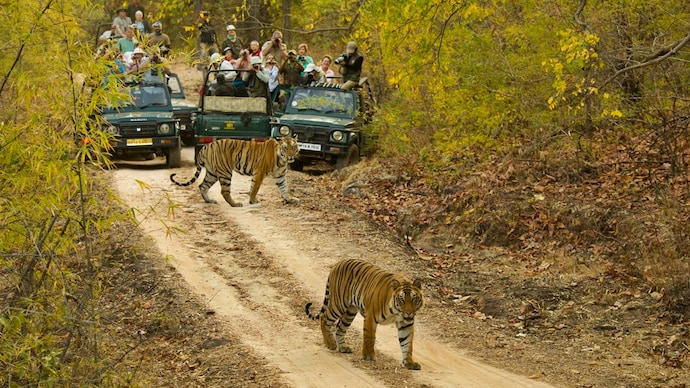
A viral video from Ranthambore National Park, about a month ago, triggered a wave of outrage. It captured safari vehicles encircling a tiger from all sides, leaving the animal with barely any space to move.
Unfortunately, these scenes have become common across most of India's tiger reserves. While the desire to witness a tiger in the wild is understandable, do we realise the stress it places on the animal?
A multi-reserve study by scientists at the CSIR-Centre for Cellular and Molecular Biology (CCMB) has confirmed that tourism and human activity inside these reserves are significantly increasing stress levels among tigers.
The research tracked tigers across five tiger reserves — Corbett, Tadoba-Andhari, Bandhavgarh, Kanha, and Periyar — across two years and four seasons. This makes it one of the largest multi-reserve physiological studies ever conducted on wild tigers in India.
Led by Chief Scientist Dr G Umapathy of the Hyderabad-based CCMB, the team analysed 610 genetically confirmed tiger scat samples- including 291 females and 185 males, collected between 2020 and 2023.
The team measured two key hormone markers: glucocorticoids (stress hormones) and progesterone (reproductive hormones) in female tigers.
Published in the journal Animal Conservation, the study found that stress biomarkers are significantly higher in tigers that roam close to tourism roads or in areas with high human activity. Furthermore, tigers within strictly protected core areas experience sudden, intense spikes in stress when the seasonal tourism gates swing open.
The stress effects were most pronounced in Tadoba-Andhari and Bandhavgarh, two of India's most popular reserves for sightings.
HOW DID SCIENTISTS PROVE THE THEORY?
We asked the study’s lead author, Dr G Umapathy, how his team managed to distinguish natural wildlife stressors from human-induced stress across more than 600 samples.
Dr Umapathy explained that they looked for distinct patterns across time and geography, comparing three specific scenarios to be sure
The "Comparison" Test: They compared tigers living in heavy tourism zones against tigers in core and buffer areas that shared identical food sources, prey bases, and forest cover. The only differing factor between the groups was the presence of safari tourists.
The "Monsoon" Test: They compared the months when the parks are closed during the monsoon to the months they are open. Natural stress, like a failed hunt, happens uniformly all year round, but the stress spikes they recorded strictly aligned with the opening of safari gates.
The "Distance" Test: They mapped exactly how close these tigers were to safari roads and water holes, making sure to account for things like how much prey was available or if the tiger was currently raising cubs.
A 'natural' event, like a fight with another tiger or losing a meal, causes a quick spike in stress that disappears within a few hours or a day, explains Dr Umapathy. "What we found in the busy tourist zones was entirely different. It wasn't just a temporary spike; it was a sustained shift in the stress levels of the entire population mean, far too consistent across different tigers and seasons to be explained away by natural events."
"We see a massive, sudden jump in stress the moment the parks reopen, but the levels in tourist zones never drop back down to the peaceful baseline of the monsoon months. Instead, they plateau at an elevated state throughout the entire safari season. While the monsoon closure gives them a partial break, it is simply not long enough for their bodies to fully recover before the next season begins."
So, what happens physiologically when these stress hormones remain elevated over the long term?
"A short-term rise in cortisol is adaptive," says Dr Umapathy. "It gives a tiger the quick burst of energy and sharp focus needed to hunt or face an immediate threat. However, when that stress never clears, the tiger’s own survival system turns against it."
Constant stress breaks down the immune system, making tigers an easy target for infections and parasitic loads they would normally fight off with ease.
More critically for long-term conservation, high stress messes with the body's reproductive hormones. It delays young tigers from reaching sexual adulthood, prevents females from going into heat (suppressing oestrus), and lowers sperm quality in males. Ultimately, fewer cubs are conceived, and fewer survive.
"A tiger might look perfectly healthy in your camera lens, but on the inside, its body is structurally struggling to survive and reproduce," Umapathy warns. "This is called allostatic load, a heavy physiological tax that only internal hormone monitoring can reveal."
THE HIDDEN BEHAVIOURAL CRISIS IN TIGERS
The study highlights an even deeper issue: breeding conditions for tigresses are becoming incredibly difficult to maintain. Tigresses require completely quiet, undisturbed patches for denning.
Because of the constant noise and vehicle disturbance, mother tigers are now being forced to choose denning and breeding sites situated far away from safari roads.
This is a massive hidden cost. While this spatial struggle might not instantly show up in a hormone test, it means mother tigers are being driven out of the prime, optimal sectors of the forest. When a tigress is pushed into a less-optimal, lower-quality habitat just to find peace, it directly threatens the survival rates of her cubs and severely reduces the total number of litters she can successfully raise in her lifetime. This is how individual stress mutates into a massive population crisis.
THE SOLUTION: UNCOUPLING TOURISM FROM PROTECTION
The researchers clarified that their study does not oppose wildlife tourism, recognising that it plays a vital role in funding conservation and supporting local livelihoods. However, they have recommended clear, scientifically backed policy changes:
- The number of vehicles entering tiger reserves should be reduced to make sure there is no crowding around tigers
- Shortening the daily duration of morning and evening safaris.
- Relocating artificial water bodies away from heavy tourism routes.
Addressing the counter-argument that moving water holes creates dangerous "blind spots" for poachers, Dr Umapathy clarifies, "People often misinterpret our recommendation. They think moving water holes away from safari roads means we are reducing security and monitoring. It is exactly the opposite. What we are proposing is decoupling tourism infrastructure from protection infrastructure, two entirely different functions that are currently wrongly collapsed onto the same road network."
"Forest surveillance does not require water holes to be visible from a tourist vehicle. It simply requires our forest guards and protection teams to follow the resources where the tigers actually go. Security can easily be maintained, and even enhanced, through dynamic patrolling and technology, ensuring tiger welfare and habitat surveillance work hand-in-hand."
A viral video from Ranthambore National Park, about a month ago, triggered a wave of outrage. It captured safari vehicles encircling a tiger from all sides, leaving the animal with barely any space to move.
Unfortunately, these scenes have become common across most of India's tiger reserves. While the desire to witness a tiger in the wild is understandable, do we realise the stress it places on the animal?
A multi-reserve study by scientists at the CSIR-Centre for Cellular and Molecular Biology (CCMB) has confirmed that tourism and human activity inside these reserves are significantly increasing stress levels among tigers.
The research tracked tigers across five tiger reserves — Corbett, Tadoba-Andhari, Bandhavgarh, Kanha, and Periyar — across two years and four seasons. This makes it one of the largest multi-reserve physiological studies ever conducted on wild tigers in India.
Led by Chief Scientist Dr G Umapathy of the Hyderabad-based CCMB, the team analysed 610 genetically confirmed tiger scat samples- including 291 females and 185 males, collected between 2020 and 2023.
The team measured two key hormone markers: glucocorticoids (stress hormones) and progesterone (reproductive hormones) in female tigers.
Published in the journal Animal Conservation, the study found that stress biomarkers are significantly higher in tigers that roam close to tourism roads or in areas with high human activity. Furthermore, tigers within strictly protected core areas experience sudden, intense spikes in stress when the seasonal tourism gates swing open.
The stress effects were most pronounced in Tadoba-Andhari and Bandhavgarh, two of India's most popular reserves for sightings.
HOW DID SCIENTISTS PROVE THE THEORY?
We asked the study’s lead author, Dr G Umapathy, how his team managed to distinguish natural wildlife stressors from human-induced stress across more than 600 samples.
Dr Umapathy explained that they looked for distinct patterns across time and geography, comparing three specific scenarios to be sure
The "Comparison" Test: They compared tigers living in heavy tourism zones against tigers in core and buffer areas that shared identical food sources, prey bases, and forest cover. The only differing factor between the groups was the presence of safari tourists.
The "Monsoon" Test: They compared the months when the parks are closed during the monsoon to the months they are open. Natural stress, like a failed hunt, happens uniformly all year round, but the stress spikes they recorded strictly aligned with the opening of safari gates.
The "Distance" Test: They mapped exactly how close these tigers were to safari roads and water holes, making sure to account for things like how much prey was available or if the tiger was currently raising cubs.
A 'natural' event, like a fight with another tiger or losing a meal, causes a quick spike in stress that disappears within a few hours or a day, explains Dr Umapathy. "What we found in the busy tourist zones was entirely different. It wasn't just a temporary spike; it was a sustained shift in the stress levels of the entire population mean, far too consistent across different tigers and seasons to be explained away by natural events."
"We see a massive, sudden jump in stress the moment the parks reopen, but the levels in tourist zones never drop back down to the peaceful baseline of the monsoon months. Instead, they plateau at an elevated state throughout the entire safari season. While the monsoon closure gives them a partial break, it is simply not long enough for their bodies to fully recover before the next season begins."
So, what happens physiologically when these stress hormones remain elevated over the long term?
"A short-term rise in cortisol is adaptive," says Dr Umapathy. "It gives a tiger the quick burst of energy and sharp focus needed to hunt or face an immediate threat. However, when that stress never clears, the tiger’s own survival system turns against it."
Constant stress breaks down the immune system, making tigers an easy target for infections and parasitic loads they would normally fight off with ease.
More critically for long-term conservation, high stress messes with the body's reproductive hormones. It delays young tigers from reaching sexual adulthood, prevents females from going into heat (suppressing oestrus), and lowers sperm quality in males. Ultimately, fewer cubs are conceived, and fewer survive.
"A tiger might look perfectly healthy in your camera lens, but on the inside, its body is structurally struggling to survive and reproduce," Umapathy warns. "This is called allostatic load, a heavy physiological tax that only internal hormone monitoring can reveal."
THE HIDDEN BEHAVIOURAL CRISIS IN TIGERS
The study highlights an even deeper issue: breeding conditions for tigresses are becoming incredibly difficult to maintain. Tigresses require completely quiet, undisturbed patches for denning.
Because of the constant noise and vehicle disturbance, mother tigers are now being forced to choose denning and breeding sites situated far away from safari roads.
This is a massive hidden cost. While this spatial struggle might not instantly show up in a hormone test, it means mother tigers are being driven out of the prime, optimal sectors of the forest. When a tigress is pushed into a less-optimal, lower-quality habitat just to find peace, it directly threatens the survival rates of her cubs and severely reduces the total number of litters she can successfully raise in her lifetime. This is how individual stress mutates into a massive population crisis.
THE SOLUTION: UNCOUPLING TOURISM FROM PROTECTION
The researchers clarified that their study does not oppose wildlife tourism, recognising that it plays a vital role in funding conservation and supporting local livelihoods. However, they have recommended clear, scientifically backed policy changes:
- The number of vehicles entering tiger reserves should be reduced to make sure there is no crowding around tigers
- Shortening the daily duration of morning and evening safaris.
- Relocating artificial water bodies away from heavy tourism routes.
Addressing the counter-argument that moving water holes creates dangerous "blind spots" for poachers, Dr Umapathy clarifies, "People often misinterpret our recommendation. They think moving water holes away from safari roads means we are reducing security and monitoring. It is exactly the opposite. What we are proposing is decoupling tourism infrastructure from protection infrastructure, two entirely different functions that are currently wrongly collapsed onto the same road network."
"Forest surveillance does not require water holes to be visible from a tourist vehicle. It simply requires our forest guards and protection teams to follow the resources where the tigers actually go. Security can easily be maintained, and even enhanced, through dynamic patrolling and technology, ensuring tiger welfare and habitat surveillance work hand-in-hand."

