Mad rush for data centres, AI can spark fresh tech and job boom in India
Big tech companies are spending hundreds of billions of dollars on creating mega data centres that will fuel AI demand in the coming years. India, say experts, is well poised to benefit from the data centre boom, even if in some areas challenges remain.
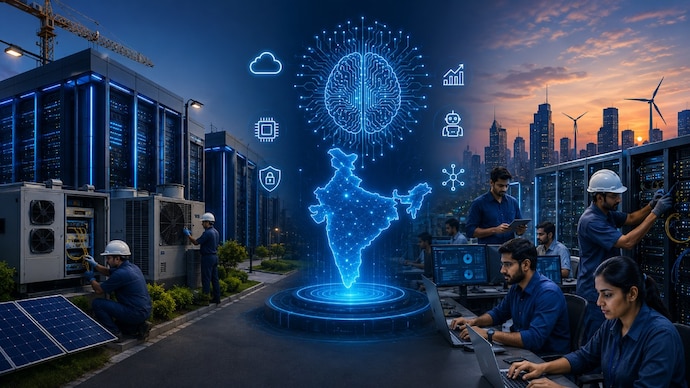
There is a new infrastructure push in India. Not for highways, airports, or factories, but for giant buildings packed with GPUs, cooling systems, fibre cables, and endless rows of servers quietly powering the internet economy.
Until a few years ago, most Indian companies relied on small server rooms tucked inside office buildings. Data centres were largely invisible pieces of infrastructure. But now, India is experiencing an unprecedented demand for data centre capacity.
India’s data centre capacity has exploded from just 375 megawatts (MW) in 2020 to more than 1,500 MW in 2025, according to the Ministry of Electronics & IT. The data centre capacity is measured by power units because it directly correlates to the amount of power used by a data centre. The bigger and more data centres, the higher the usage. And this is only the beginning. Investment bank Morgan Stanley estimates India’s capacity could rise nearly six-fold to 10.5 GW by 2031.
Why the rush?
One big reason why AI data centres could spark the next economic boom in the Indian economy and jobs, similar to how offshoring of IT work did around two decades ago, is the relentless pace at which these data centres are coming up. That pace is in a big way fuelled by India’s push for “data localisation”, the idea that data of Indian users should stay inside India’s borders instead of being stored overseas.
The government has increasingly pushed this through measures such as the Digital Personal Data Protection (DPDP) Act, along with sector-specific rules from regulators like the RBI and SEBI. The aim is to improve digital sovereignty, reduce dependence on foreign infrastructure, and keep sensitive citizen and financial data under Indian jurisdiction.
But regulation for data localisation alone is not driving this boom. The second major trigger is AI.
As businesses and governments rapidly adopt cloud computing and artificial intelligence, demand for high-performance computing infrastructure is soaring. AI systems require massive computing power, specialised chips such as GPUs, ultra-fast storage, and advanced cooling systems that traditional server rooms simply cannot handle. Adding to this demand is the rise of Indian-language AI models, which require enormous amounts of local computing infrastructure to train and operate efficiently.
Madhusudan Bhor, founder & CEO of Vantageo, explains the shift: “Cloud and enterprise digitisation created the base, while AI is now accelerating the need for high-performance compute, GPUs, large memory and fast storage.”
The push made by the government, in turn, has spurred private players into action. This was also on display at the India AI Summit earlier this year. At the summit, the Adani Group announced a $100 billion plan to build renewable-powered, AI-ready data centres by 2035. Similarly, Reliance Industries has committed investments worth $120 billion toward digital and AI infrastructure.
These massive investments highlight how India is trying to position itself not just as a consumer of artificial intelligence, but as a country capable of building and controlling its own next-generation computing infrastructure. Industry experts believe this could help India emerge as a serious global player in the AI economy.
Global giants too bet on India
For global companies, India is no longer just a large internet market. It is becoming a strategic data centre, AI and cloud hub.
India’s geographic location gives companies easier access to users across South Asia, Southeast Asia, and even parts of the Middle East. Building infrastructure here helps reduce delays in digital services while also diversifying global operations away from a handful of concentrated regions. That is why tech giants are rapidly expanding their India footprint.
Google recently broke ground on what is being described as India’s largest AI hub near Visakhapatnam, with infrastructure support from AdaniConneX and Nxtra by Airtel.
Microsoft and Amazon Web Services are also pouring billions into Indian AI and cloud infrastructure.
Microsoft had earlier announced a $3.7 billion investment in Telangana for data centres with around 660 MW IT capacity. AWS, meanwhile, has committed $12.7 billion toward cloud infrastructure in India by 2030. More recently, Microsoft said it is building its largest India data centre in Hyderabad as part of a broader $17.5 billion investment push.
The government is also sweetening the deal.
In the Union Budget 2026-27, India announced a 20-year tax holiday until 2047 for foreign cloud service providers operating workloads from Indian data centres for overseas customers. The policy is expected to attract massive capital inflows, with some estimates projecting up to $200 billion in investments into India’s data centre ecosystem over time.
In addition, India’s draft Data Centre Policy is promising to tech giant to streamline approvals through single-window clearances, dedicated data centre zones, fiscal and non-fiscal incentives including subsidised infrastructure and power support.
India’s next tech jobs wave?
The real impact of this boom may not just be infrastructure — but jobs. Much like the IT-services revolution that created millions of software jobs in the 1990s and 2000s, the AI data-centre race could create an entirely new workforce focused on digital infrastructure.
These are not just coding jobs. The industry now needs experts who can manage massive server facilities, GPU clusters, liquid cooling systems, cybersecurity frameworks, power systems, and AI networking infrastructure. The rapid expansion of data centres is already creating workforce shortages globally. In the United States, companies are facing a shortage of skilled workers such as fibre technicians at data centre construction sites.
To tackle this gap, Meta recently partnered with CBRE to launch a four-week training programme aimed at producing high-paid fibre technicians for the growing data centre industry.
Experts believe India could soon face similar talent shortages as AI and massive infrastructure projects accelerate across the country. That in turn will create demand for a more skilled workforce.
Rahul Takkallapally, co-founder of BharathCloud, says there is already a “growing requirement of professionals proficient in managing AI infrastructure, such as hyperscale infrastructure management, GPU clustering, liquid cooling, cybersecurity, energy-efficient management, and power management techniques.”
As AI workloads become more distributed, experts believe another specialised field will become increasingly important — digital interconnection. Sudhir Kunder, chief business officer at DE-CIX India, says one emerging skill gap is “interconnection architecture itself.”
“Enterprises increasingly need people who understand multi-cloud connectivity, peering, private cloud access, routing resilience, and secure data movement, without relying solely on the public Internet,” he says.
But challenges remain
Despite the rapid expansion and push from the government, experts say India is still in the early stages of its data centre and AI infrastructure journey.
Compared to mature markets such as the United States, Singapore, and several parts of Europe, India remains in what industry leaders describe as an “infrastructure acceleration phase.”
That means while investment announcements are rising rapidly, the country still needs deeper development across electricity grids, fibre connectivity, semiconductor supply chains, cooling systems, and policy coordination to support AI infrastructure at a global scale.
Kunder says India has made significant progress, but the next stage will require far more coordinated planning. “India is moving quickly, but the next phase requires coordinated investments across energy, connectivity, semiconductor supply chains, and policy frameworks to compete at a global scale,” he says.
Still, the direction is becoming increasingly clear. Just as India once became a global IT-services powerhouse, the country is now positioning itself to become a major hub for AI infrastructure — with data centres emerging as the factories of the digital age.
There is a new infrastructure push in India. Not for highways, airports, or factories, but for giant buildings packed with GPUs, cooling systems, fibre cables, and endless rows of servers quietly powering the internet economy.
Until a few years ago, most Indian companies relied on small server rooms tucked inside office buildings. Data centres were largely invisible pieces of infrastructure. But now, India is experiencing an unprecedented demand for data centre capacity.
India’s data centre capacity has exploded from just 375 megawatts (MW) in 2020 to more than 1,500 MW in 2025, according to the Ministry of Electronics & IT. The data centre capacity is measured by power units because it directly correlates to the amount of power used by a data centre. The bigger and more data centres, the higher the usage. And this is only the beginning. Investment bank Morgan Stanley estimates India’s capacity could rise nearly six-fold to 10.5 GW by 2031.
Why the rush?
One big reason why AI data centres could spark the next economic boom in the Indian economy and jobs, similar to how offshoring of IT work did around two decades ago, is the relentless pace at which these data centres are coming up. That pace is in a big way fuelled by India’s push for “data localisation”, the idea that data of Indian users should stay inside India’s borders instead of being stored overseas.
The government has increasingly pushed this through measures such as the Digital Personal Data Protection (DPDP) Act, along with sector-specific rules from regulators like the RBI and SEBI. The aim is to improve digital sovereignty, reduce dependence on foreign infrastructure, and keep sensitive citizen and financial data under Indian jurisdiction.
But regulation for data localisation alone is not driving this boom. The second major trigger is AI.
As businesses and governments rapidly adopt cloud computing and artificial intelligence, demand for high-performance computing infrastructure is soaring. AI systems require massive computing power, specialised chips such as GPUs, ultra-fast storage, and advanced cooling systems that traditional server rooms simply cannot handle. Adding to this demand is the rise of Indian-language AI models, which require enormous amounts of local computing infrastructure to train and operate efficiently.
Madhusudan Bhor, founder & CEO of Vantageo, explains the shift: “Cloud and enterprise digitisation created the base, while AI is now accelerating the need for high-performance compute, GPUs, large memory and fast storage.”
The push made by the government, in turn, has spurred private players into action. This was also on display at the India AI Summit earlier this year. At the summit, the Adani Group announced a $100 billion plan to build renewable-powered, AI-ready data centres by 2035. Similarly, Reliance Industries has committed investments worth $120 billion toward digital and AI infrastructure.
These massive investments highlight how India is trying to position itself not just as a consumer of artificial intelligence, but as a country capable of building and controlling its own next-generation computing infrastructure. Industry experts believe this could help India emerge as a serious global player in the AI economy.
Global giants too bet on India
For global companies, India is no longer just a large internet market. It is becoming a strategic data centre, AI and cloud hub.
India’s geographic location gives companies easier access to users across South Asia, Southeast Asia, and even parts of the Middle East. Building infrastructure here helps reduce delays in digital services while also diversifying global operations away from a handful of concentrated regions. That is why tech giants are rapidly expanding their India footprint.
Google recently broke ground on what is being described as India’s largest AI hub near Visakhapatnam, with infrastructure support from AdaniConneX and Nxtra by Airtel.
Microsoft and Amazon Web Services are also pouring billions into Indian AI and cloud infrastructure.
Microsoft had earlier announced a $3.7 billion investment in Telangana for data centres with around 660 MW IT capacity. AWS, meanwhile, has committed $12.7 billion toward cloud infrastructure in India by 2030. More recently, Microsoft said it is building its largest India data centre in Hyderabad as part of a broader $17.5 billion investment push.
The government is also sweetening the deal.
In the Union Budget 2026-27, India announced a 20-year tax holiday until 2047 for foreign cloud service providers operating workloads from Indian data centres for overseas customers. The policy is expected to attract massive capital inflows, with some estimates projecting up to $200 billion in investments into India’s data centre ecosystem over time.
In addition, India’s draft Data Centre Policy is promising to tech giant to streamline approvals through single-window clearances, dedicated data centre zones, fiscal and non-fiscal incentives including subsidised infrastructure and power support.
India’s next tech jobs wave?
The real impact of this boom may not just be infrastructure — but jobs. Much like the IT-services revolution that created millions of software jobs in the 1990s and 2000s, the AI data-centre race could create an entirely new workforce focused on digital infrastructure.
These are not just coding jobs. The industry now needs experts who can manage massive server facilities, GPU clusters, liquid cooling systems, cybersecurity frameworks, power systems, and AI networking infrastructure. The rapid expansion of data centres is already creating workforce shortages globally. In the United States, companies are facing a shortage of skilled workers such as fibre technicians at data centre construction sites.
To tackle this gap, Meta recently partnered with CBRE to launch a four-week training programme aimed at producing high-paid fibre technicians for the growing data centre industry.
Experts believe India could soon face similar talent shortages as AI and massive infrastructure projects accelerate across the country. That in turn will create demand for a more skilled workforce.
Rahul Takkallapally, co-founder of BharathCloud, says there is already a “growing requirement of professionals proficient in managing AI infrastructure, such as hyperscale infrastructure management, GPU clustering, liquid cooling, cybersecurity, energy-efficient management, and power management techniques.”
As AI workloads become more distributed, experts believe another specialised field will become increasingly important — digital interconnection. Sudhir Kunder, chief business officer at DE-CIX India, says one emerging skill gap is “interconnection architecture itself.”
“Enterprises increasingly need people who understand multi-cloud connectivity, peering, private cloud access, routing resilience, and secure data movement, without relying solely on the public Internet,” he says.
But challenges remain
Despite the rapid expansion and push from the government, experts say India is still in the early stages of its data centre and AI infrastructure journey.
Compared to mature markets such as the United States, Singapore, and several parts of Europe, India remains in what industry leaders describe as an “infrastructure acceleration phase.”
That means while investment announcements are rising rapidly, the country still needs deeper development across electricity grids, fibre connectivity, semiconductor supply chains, cooling systems, and policy coordination to support AI infrastructure at a global scale.
Kunder says India has made significant progress, but the next stage will require far more coordinated planning. “India is moving quickly, but the next phase requires coordinated investments across energy, connectivity, semiconductor supply chains, and policy frameworks to compete at a global scale,” he says.
Still, the direction is becoming increasingly clear. Just as India once became a global IT-services powerhouse, the country is now positioning itself to become a major hub for AI infrastructure — with data centres emerging as the factories of the digital age.

