
8th Pay Commission: The food-cost formula behind salary revision demands
Employee unions have asked the 8th Pay Commission to recalculate minimum pay using updated food-cost and nutrition standards. The push shows how salary revision talks are increasingly centred on inflation, household budgets and daily living costs.
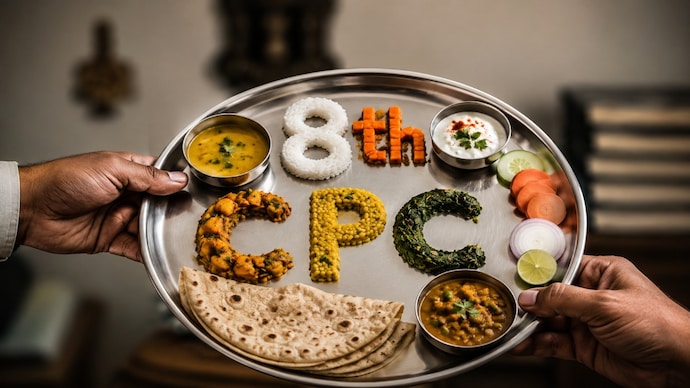

Why are government employee unions suddenly talking about calories, milk, vegetables and food baskets while negotiating salaries under the 8th Pay Commission?
Because the next salary revision for lakhs of central government employees may partly depend on how much food a family is expected to consume every month.
At the centre of the debate is a little-known figure: 3490 calories.
Employee unions have argued before the 8th Pay Commission that this updated nutrition benchmark should now become one of the foundations for calculating minimum salaries, saying older formulas no longer reflect present-day living costs.
The issue has emerged as one of the most detailed and closely watched aspects of the ongoing 8th Pay Commission consultations, where employee bodies are trying to show that rising food prices and household expenses have fundamentally changed how government salaries should be calculated.
HOW FOOD COST IS LINKED TO 8TH PAY COMMISSION SALARY CALCULATIONS
Every Pay Commission first tries to estimate the minimum amount of money required for a government employee’s family to maintain a basic standard of living.
To calculate this, expenses related to food, housing, healthcare, fuel, clothing, education and transportation are taken into account.
Food expenditure becomes one of the most important parts of the calculation because it forms the base of the minimum wage formula.
The underlying logic used by Pay Commissions is simple: if the cost of maintaining proper nutrition rises, the salary needed to maintain that standard of living must also rise.
This is why employee unions are now pushing the 8th Pay Commission to use updated nutritional standards and current food prices while calculating minimum salaries.
WHY 3490 CALORIES HAS BECOME KEY NUMBER IN 8TH PAY COMMISSION TALKS
The Staff Side of the National Council-Joint Consultative Machinery (NC-JCM), in its memorandum submitted to the 8th Pay Commission, argued that earlier salary calculations were based on outdated nutritional assumptions of around 2700 calories.
The memorandum instead referred to updated Indian Council of Medical Research (ICMR) standards and argued that the calorie requirement for a working adult engaged in heavy activity should now be considered at around 3490 calories.
“The Dr. Wallace Aykroyd formula adopted by earlier Pay Commissions based on 2700 calories is outdated,” the memorandum argued, while calling for adoption of updated ICMR nutritional norms.
The latest calorie requirements released by the ICMR and National Institute of Nutrition (NIN) classify energy needs according to activity levels.
For adults aged 19–39 years, the recommended daily calorie intake is:
- Sedentary: Men 2110 kcal, Women 1660 kcal
- Moderate activity: Men 2710 kcal, Women 2130 kcal
- Heavy activity: Men 3470 kcal, Women 2720 kcal
Employee unions have broadly relied on the heavy-work benchmark while arguing that many government jobs involve long hours, physical movement, travel, stress and irregular working conditions.
HOW NC-JCM USED CALORIE INTAKE TO DEMAND RS 69,000 MINIMUM PAY
The NC-JCM memorandum did not just mention calorie intake theoretically. It used detailed expenditure calculations to build its salary demand.
The memorandum attached calculations covering the cost of rice, wheat, pulses, vegetables, milk, fruits, edible oils, fish, eggs, spices, sugar, and fuel across different cities.
Using these food-cost calculations along with housing, healthcare and education expenses, the Staff Side argued that the existing salary structure no longer reflects the actual cost of maintaining a family.
The memorandum then linked these revised expenditure estimates to its demand for:
- a 3.833 fitment factor,
- and a minimum salary of around Rs 69,000 under the 8th Pay Commission.
The calculation logic used by the Staff Side was broadly:
Higher calorie requirement higher food expenditure higher monthly family expenditure higher minimum salary demand.
WHAT AINPSEF HAS SAID ABOUT FOOD COST AND CALORIE-BASED SALARY REVISION
The All India NPS Employees Federation (AINPSEF) also used calorie and food-cost calculations in its memorandum submitted to the 8th Pay Commission.
The federation argued that “the current minimum pay does not adequately compensate employees in view of inflation and rising cost of living”.
The memorandum stated that according to ICMR nutritional standards, a working individual requires around 3490 calories daily and argued that the cost of maintaining this nutritional level has risen sharply due to inflation.
AINPSEF then used this food-cost and inflation logic to build its own salary demand formula.
The federation proposed:
Rs 6,000 per consumption unit 5 family units = Rs 30,000.
The memorandum then added Dearness Allowance of around 58%, taking the figure to nearly Rs 47,400.
After factoring in healthcare expenses, education costs and modern living requirements, the federation argued that the “scientifically derived minimum pay” should range between Rs 55,000 and Rs 60,000.
HOW FOOD PRICES AND FAMILY EXPENSES ARE DRIVING 8TH PAY COMMISSION DEMANDS
Both memorandums repeatedly argue that salary structures fixed years ago no longer match the real-world cost of running a household.
The unions have linked their demands to rising prices of:
- milk,
- vegetables,
- edible oils,
- LPG cylinders,
- healthcare,
- fuel,
- education,
- and urban housing.
The calorie debate is also closely tied to another major demand being raised before the 8th Pay Commission — increasing the “family unit” formula from 3 units to 5 units.
Employee bodies argue that many employees today support spouses, children and elderly parents, making older family assumptions unrealistic.
The discussion around calorie intake and food-cost formulas may sound highly technical, but it directly affects how salaries are calculated for lakhs of central government employees and pensioners.
Any revision in minimum wage calculations eventually impacts:
- basic pay,
- fitment factor,
- dearness allowance,
- pensions,
- house rent allowance,
- and retirement benefits.
The 8th Pay Commission has already started consultations with employee unions and staff representatives across the country. Meetings have already been held in Delhi, while the next rounds of discussions are scheduled in Hyderabad, Srinagar and Ladakh.
For now, one thing is becoming increasingly clear in the 8th Pay Commission discussions: the debate over salaries is no longer just about pay scales. It is also about what it actually costs to run a household in modern India.