
Why India may be taking risky bet with $500 billion US deal
Marco Rubio said in New Delhi that India had committed to buying $500 billion of American goods over five years. The remark has intensified scrutiny of whether the proposed arrangement offers India enough return.
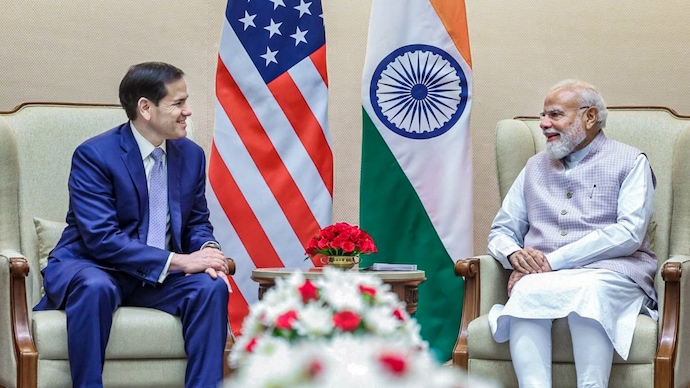

Days after US Secretary of State Marco Rubio left New Delhi, one line from his visit continues to echo across Indian political and business circles. It was not about the Quad meeting, China, or even regional security. Instead, the debate centres on a massive $500 billion investment.
During his visit, Rubio said India had "committed" to purchasing $500 billion worth of American goods over the next five years. The statement did not trigger an immediate reaction from New Delhi at the time. But as global media reports, trade experts and economic commentators began digging deeper into the claim, questions started piling up over what exactly India may have agreed to -- and whether it stands to gain enough in return.
It is significant because India is already battling pressure on its currency, higher oil prices and uncertainty around global trade. Critics are now asking whether New Delhi is walking into an uneven deal with Washington while trying to mend ties with President Donald Trump, whose aggressive tariff policies forced New Delhi on backfoot.
A team of US negotiators, led by Trade Representative Jamieson Greer, is due to visit India from June 1 to June 4 to finalise the details pertaining to the Interim Agreement between the two countries and take forward the negotiations on a broader Bilateral Trade Agreement (BTA).
TRADE TARGET OR TRADE COMMITMENT?
The controversy traces back to February, when India and the US announced an interim trade understanding. At the time, the White House said India "intends" to increase purchases of American products, including energy supplies, coal and technology equipment.
According to the Financial Times, the wording used earlier by both sides sounded more like a future trade target than a binding commitment. India's commerce ministry had also referred to the figure in a press release, though the point appeared near the end of the statement.
The ministry additionally included aircraft and aviation equipment among sectors expected to contribute to the proposed trade volume.
Commerce Minister Piyush Goyal later played down concerns over the figure and argued that India's growing economy could comfortably absorb such imports. He said demand from India's aviation sector alone could contribute nearly $100 billion over five years.
But Rubio's latest remarks have shifted attention back to the issue because he described the arrangement as a firm "commitment".
Speaking in New Delhi after the Quad Foreign Ministers' Meeting, Rubio said India had committed to increasing purchases from the US across sectors including agriculture, energy and technology.
WHY ANALYSTS ARE QUESTIONING THE DEAL
The Financial Times report argued that the timing of such a massive import plan appears unusual because the global trade situation has changed sharply since February.
After the initial trade understanding, the US Supreme Court struck down the legal basis for some of Trump's earlier tariff measures. Washington later imposed a standard 10 per cent tariff on trading partners regardless of separate trade negotiations.
Under those circumstances, analysts are asking why India would still move ahead with plans to purchase such a large volume of American goods without securing bigger concessions from Washington.
The report further questioned why India would narrow supplier choices in sectors like aviation instead of using international competition to negotiate better deals.
Economic experts are also watching the issue because of pressure on India's foreign exchange reserves. The Financial Times newsletter noted that negative net foreign direct investment -- where more money leaves the country than enters it -- is already contributing to weakness in the rupee.
A large-scale import arrangement with the US could add more pressure at a difficult time for the Indian economy.
RUBIO TRIES TO CALM TENSIONS
Rubio's visit itself came during a tense phase in India-US ties.
As reported by The New York Times, Trump's return to the White House has disrupted years of steady diplomatic progress between the two countries. Earlier US administrations from both parties had spent more than two decades building closer strategic ties with India.
But relations have recently faced strain over tariffs, immigration measures and Trump's shifting global alliances.
During his visit, Rubio attempted to reassure India that ties remained strong despite trade disputes.
"The US-India relationship has not lost any momentum," Rubio said at a press conference alongside External Affairs Minister S. Jaishankar.
When asked about Trump's steep tariffs on Indian goods, Rubio said India should not take the move personally and described it as part of Washington's broader effort to fix trade imbalances. Jaishankar responded by saying both countries were following policies centred on national interest. "The US has an America first policy, and India also has an India first policy," he said.
US TARIFFS AND IMMIGRATION MOVES WORRY INDIA
According to the report, many Indians are also worried about Trump's recent outreach towards China and Pakistan.
The report noted that Trump recently praised Pakistani leaders involved in mediation linked to the Iran conflict. Rubio later clarified that Washington's relationship with Islamabad would not come at the cost of its partnership with India.
Indian professionals working in the US are also concerned about stricter immigration rules announced by the Trump administration. The new measures are expected to affect many Indian technology workers waiting for permanent residency.
Against that backdrop, the reported $500 billion purchase arrangement has started looking politically sensitive as well as economically risky.