
Infra push around KBR National Park in Hyderabad faces pushback from citizens
Seven flyovers and as many underpasses, estimated to cost between Rs 930 crore and Rs 1,090 crore overall, have been planned around the KBR National Park stretch. Nearly 1,300 trees are believed to be under threat due to the major infrastructure project.
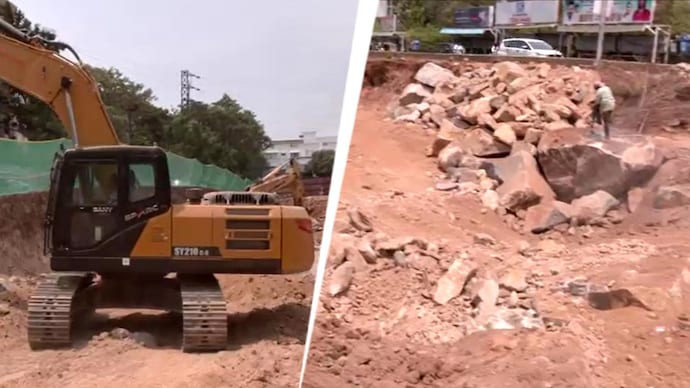

Infrastructure development works around the Kasu Brahmananda Reddy (KBR) National Park in Hyderabad is facing growing public resistance, with residents and environmental activists demanding the Telangana government roll back the decision to build flyovers and underpasses in the area.
They have alleged that the project is threatening the city’s green cover and residential areas. The outcry has grown with the massive excavation work that is underway for the planned construction activities.
The increasingly contentious developmental works are part of the Hyderabad City Innovative and Transformative Infrastructure (H-CITI) project, which proposes a network of flyovers, underpasses and road widening works around key junctions surrounding the national park to facilitate signal-free traffic movement.
Seven flyovers and as many underpasses, estimated to cost between Rs 930 crore and Rs 1,090 crore overall, have been planned around the KBR park stretch.
Earlier this week, on Monday, May 18, a temporary yet major relief came for the environmental activists opposing the project as the Supreme Court restrained authorities from cutting down trees in the eco-sensitive zone of KBR national park.
While hearing a plea, a bench of Justices BV Nagarathna and Ujjal Bhuyan said there should be no tree felling within the 25-35 metre eco-sensitive zone around the park.
HERE IS WHAT AN ACTIVIST SAYS
Speaking to India Today, activist Vijay alleged that nearly 1,300 trees located around the KBR Park eco-sensitive zone were under threat due to the proposed flyovers, underpasses and road expansion works.
He claimed that Telangana government had reduced the eco-sensitive zone limits to between 3 and 28 metres without conducting a proper public hearing.
He further alleged that authorities cited a public hearing conducted during the Covid period, but activists questioned the lack of proper documentation related to the process.
Vijay said the proposed project would not solve Hyderabad’s traffic congestion and instead would only shift traffic bottlenecks from one junction to another. He urged Hyderabad citizens to oppose what he termed as unnecessary expenditure of public funds on large-scale infrastructure projects.
According to the activist, traffic congestion in several parts of Hyderabad continues to persist despite authorities having spent nearly Rs 25,000 crore to Rs 35,000 crore on flyovers and underpasses in the city over the past decade.
Speaking on the issue, Dr Srinivas Reddy, a resident of the area, alleged that he received notices stating that a portion of his house would be demolished for the project. He claimed that several other residents in the vicinity had also received similar notices and had approached the court seeking relief.
Residents and activists demanded that the Revanth Reddy-led state government reconsider the project and instead focus on strengthening Hyderabad’s public transport network and improving last-mile connectivity rather than investing in large-scale flyovers and underpasses.
Environmental groups opposing the project alleged that repeated construction of flyovers and grade separators over the years had failed to permanently resolve Hyderabad’s traffic congestion and warned that the ongoing works could cause irreversible damage to one of the city’s major green spaces.