
BRICS is bigger than the G7, and Russia keeps India running
India hosts a BRICS bigger than the G7. The country's oil still runs on Russian crude, and a US Treasury deadline ticks past on Saturday.

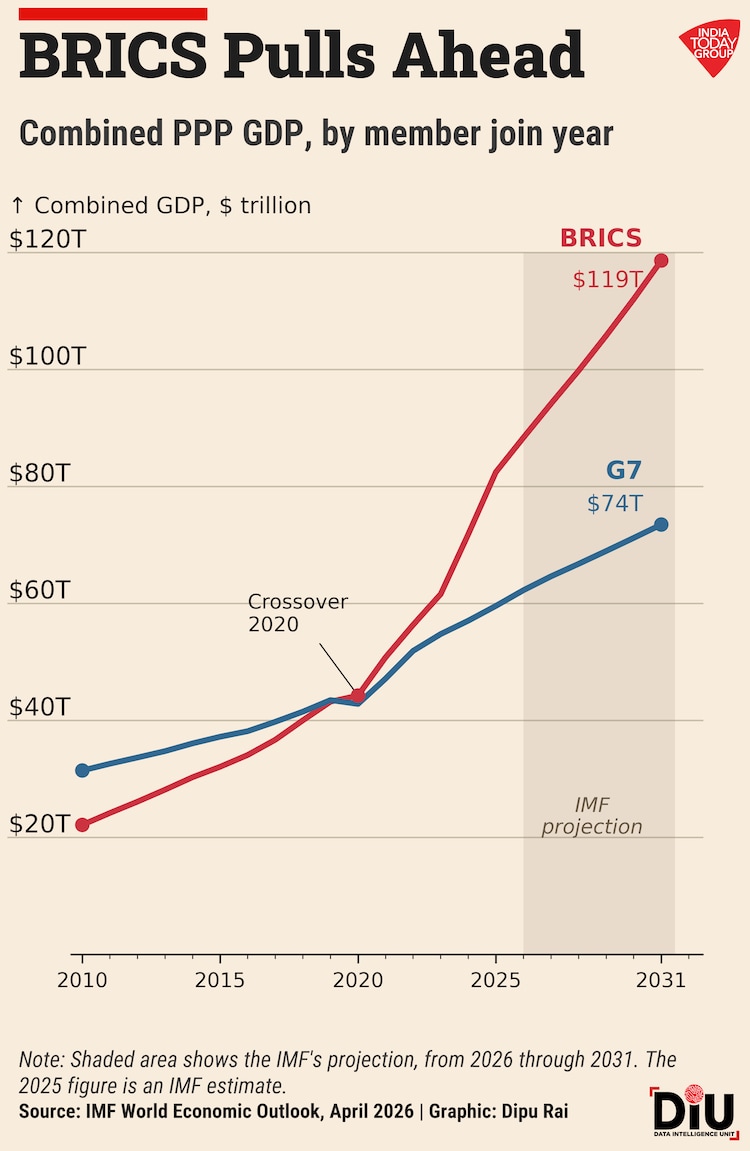
The bloc of ten emerging economies India is hosting in New Delhi this week is, at least by one big-picture measure, already bigger than the West. The combined BRICS economic output, adjusted for what its roughly 4.45 billion people can actually buy in their own countries, sits at $88 trillion against the G7's $62 trillion, according to the International Monetary Fund's April 2026 World Economic Outlook.
Russian Foreign Minister Sergey Lavrov landed in Delhi on Wednesday with that arithmetic at his back, and a different one in his pocket: Russia now accounts for a quarter of India’s oil spend, a share that has grown nearly 14 times since the war in Ukraine began in 2022.
What ‘bigger’ means here
The economic crossover happened in 2020. Brazil, Russia, India, China, and South Africa, the founding five, passed the G7 in combined purchasing-power output for the first time during the pandemic year, $44.3 trillion to $42.8 trillion. When Egypt, Ethiopia, Iran, and the UAE joined in 2024, the bloc added another $11 trillion of PPP-adjusted output on day one. Indonesia, joining in January 2025, brought $5 trillion more.
"Bigger" here means purchasing power parity, which adjusts every country's output for what its rupees, yuan, or rubles actually buy at home. It is the measure the IMF itself uses for global-share comparisons. In current US-dollar terms, the picture flips: the G7 still leads BRICS by about $21 trillion in the IMF's 2031 projection. Both numbers come from the same database; PPP simply removes the exchange-rate distortion.
The other measure that puts BRICS ahead is the people. The bloc's ten members between them house roughly 4.45 billion people, somewhere between 45 and 55 per cent of humanity, depending on how BRICS partner countries are counted. Nine of the world's twenty most populous nations are now in the bloc.
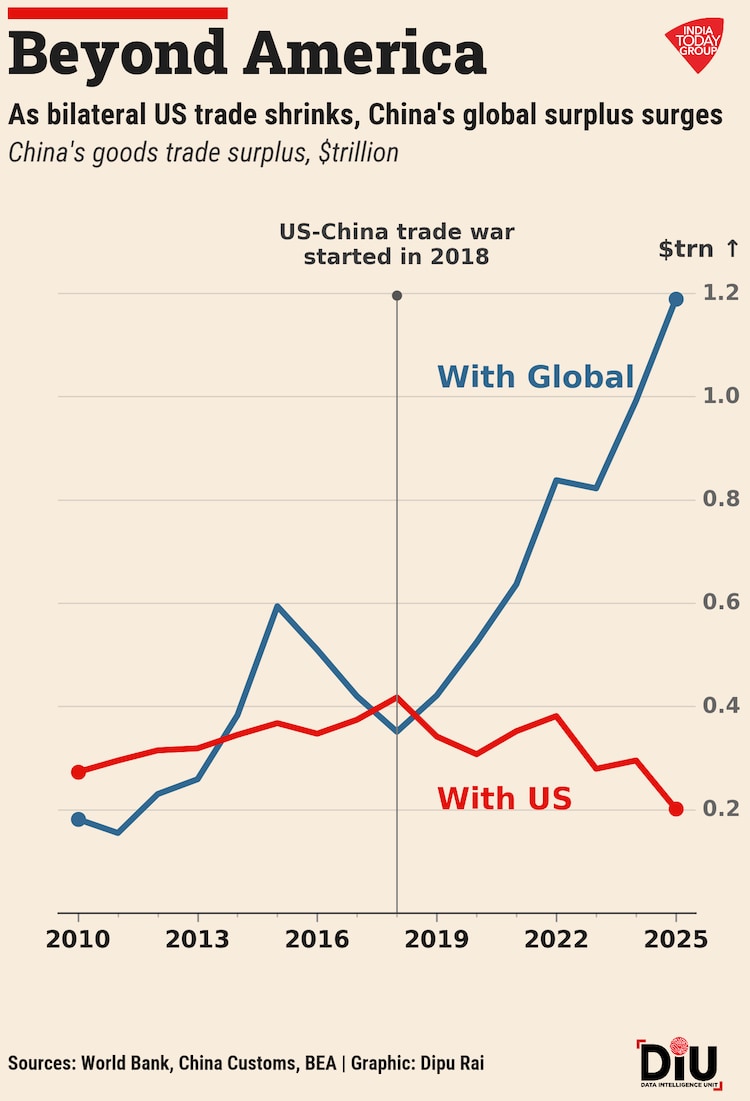
A third dimension favours BRICS, and specifically China. The country's trade surplus with the rest of the world has widened sharply since 2018, while the US continues to run a deep deficit. The gap between them is one more measure where the bloc India hosts this week has pulled away from the West.
Why Russia matters to India this week
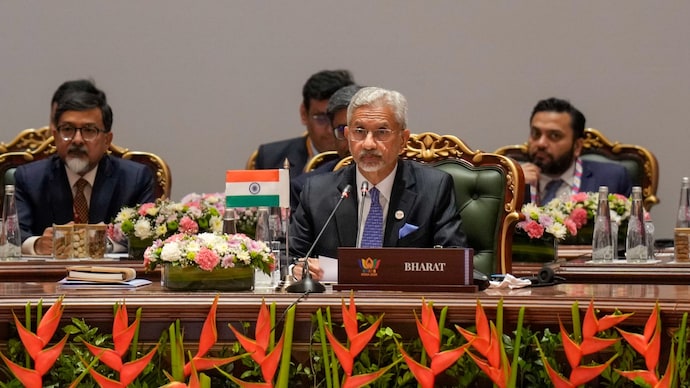
"The conflict in West Asia merits particular attention," External Affairs Minister S Jaishankar told the visiting ministers as the two-day meeting opened at Bharat Mandapam on Thursday. "Continuing tensions, risks to maritime traffic and disruptions to energy infrastructure highlight the fragility of the situation. Safe and unimpeded maritime flows through international waterways, including the Strait of Hormuz and Red Sea, remain vital for global economic well-being."
The line was directed inside the room, but its audience was outside it. Half of India's crude oil and refined-product imports still cross the Strait of Hormuz, which Iran shut to most shipping on March 4. About Rs 7.3 lakh crore of Indian oil money rides on the strait staying open — $86.8 billion in FY26 alone, from Saudi Arabia, Iraq, the United Arab Emirates, Kuwait, Qatar, Iran, and Bahrain combined.
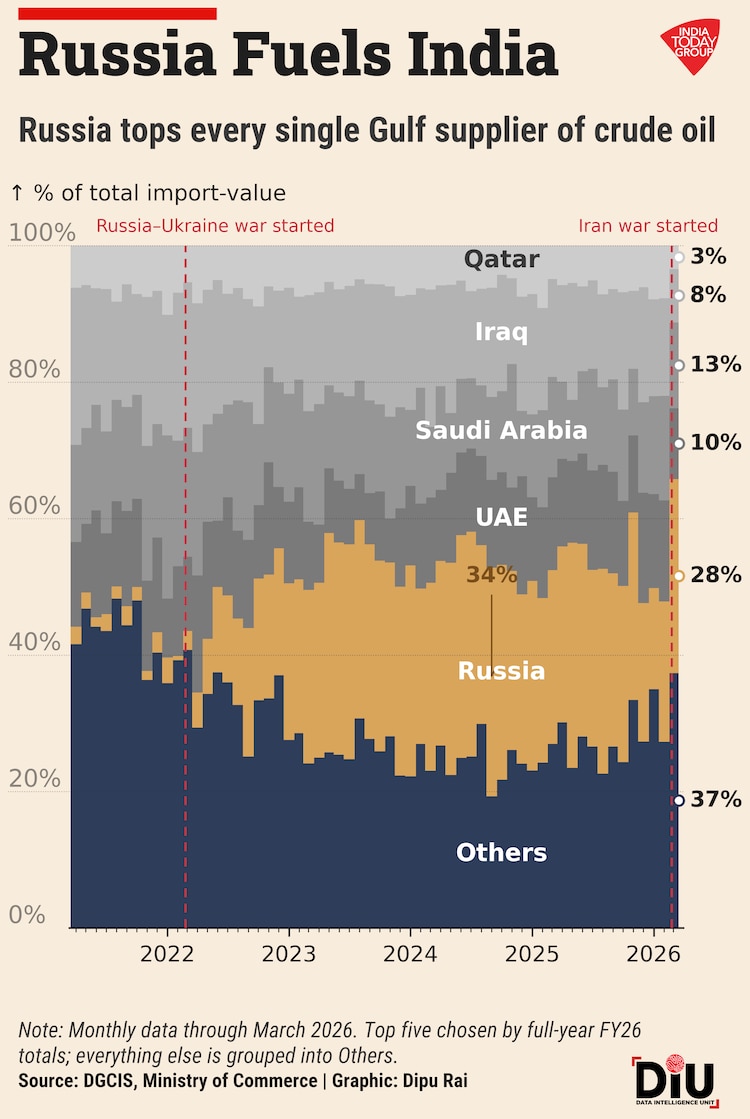
Before the Ukraine war, Russia barely registered on India’s oil bill, just two per cent of the country's $162 billion in petroleum and petroleum-product imports in FY22. In March 2026, Russia earned one in every four oil dollars India spent. The share peaked at 34 per cent in late 2024, according to the Ministry of Commerce.
In rupee terms, India spent about Rs 3.7 lakh crore on Russian crude and products in the year to March 2026, more than it spent on any single Gulf supplier. Saudi Arabia, Iraq, and the UAE, historically India's three biggest Gulf exporters, came in at roughly Rs 1.8 lakh crore and Rs 2 lakh crore each, respectively.
Washington is not thrilled. The US Treasury sanctioned Rosneft and Lukoil, Russia's two biggest exporters, earlier this year and pressed India to wind down purchases. But once the Hormuz blockade tightened the global oil market in March, the Treasury extended a waiver for India and a handful of other importers until May 16. That deadline now sits in the same week as the BRICS foreign ministers' meeting itself.
Lavrov was sharper still. In an interview, he accused the US of "trying to seize all energy routes" and called the Western pressure on India "unfair play, unfair competition." India's interests, he added, "will not be affected. We will do our utmost to ensure that this unfair play does not affect our arrangements."
What India wants
A second piece of diplomatic choreography is unfolding in parallel.
While Jaishankar opened BRICS at Bharat Mandapam, US President Donald Trump and Chinese President Xi Jinping shook hands ahead of bilateral talks in Beijing on Thursday, the first visit by a US president to China since 2017. By the close of their meeting, both leaders had agreed that the Strait of Hormuz "must remain open" and that Iran "can never have a nuclear weapon", according to the White House. Xi separately said China was interested in buying more US oil to reduce its own Hormuz exposure. Two summits, in two capitals, on the same two days, are not a coincidence.
The substantive question is what India gets back from a bloc whose physical sway in this crisis sits with Russia. Two items are on the agenda, according to officials familiar with the discussions.
The first is a coordinated BRICS-wide response to the Hormuz disruption, ideally a price ceiling for member-to-member crude trades, which would shield the bloc's two biggest oil importers, India and China, from spot-market spikes. The second is movement on what officials privately call the "Russia option": rupee-denominated payment for Russian crude, technically operational since 2023 but used sparingly.
If both move at the September summit India will host, the bloc will have something concrete to announce. If neither does, the headline statistic — bigger than the G7 in IMF tables — will look like an abstraction. India will then be back to negotiating its energy security one government at a time.