
Explained: How India weathered El Niño events in recent Years
India has witnessed 16 El Nino years since 1950, with seven resulting in deficient monsoons.


The latest update from the World Meteorological Organisation indicates an 80 per cent probability of an El Nino event between June and August this year. The likelihood of the phenomenon persisting through November is even higher at 90 per cent.
The June 2 update warns that the event may cause drought in some areas and heavy rainfall in others. It also heightens concerns about heatwaves, given that the previous El Nino episode in 2023–24 coincided with global temperatures reaching a record high in 2024.
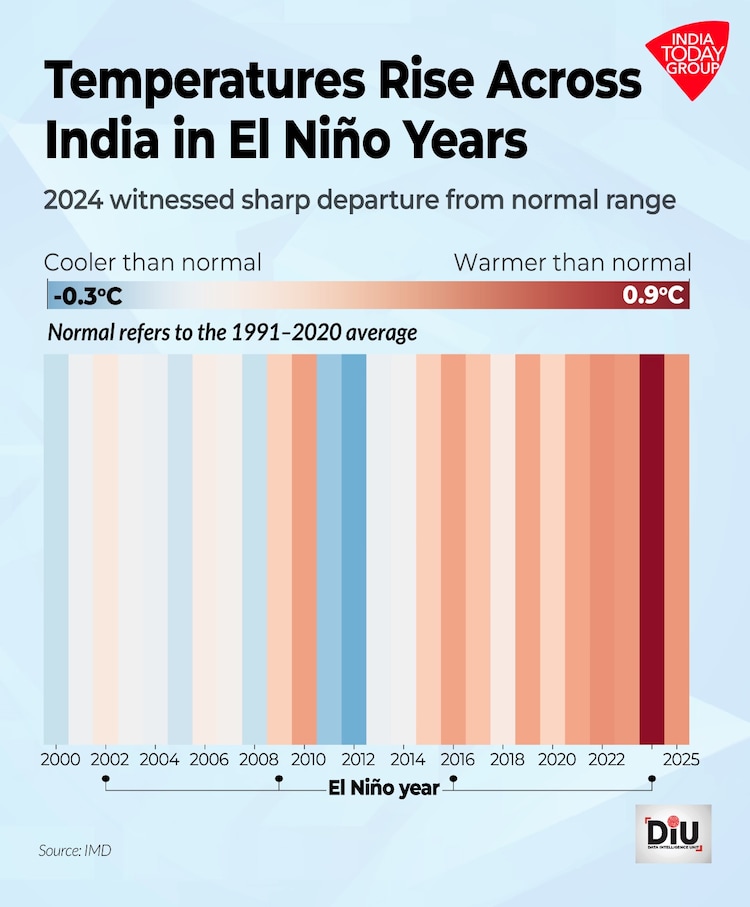
In a 2024 reply to the Lok Sabha, the government stated that India has witnessed 16 El Nino years since 1950, with seven resulting in deficient monsoons. It also noted that the effects of El Nino are more pronounced during the latter part of the monsoon season, especially in September.
Foodgrain production fell in El Nino years
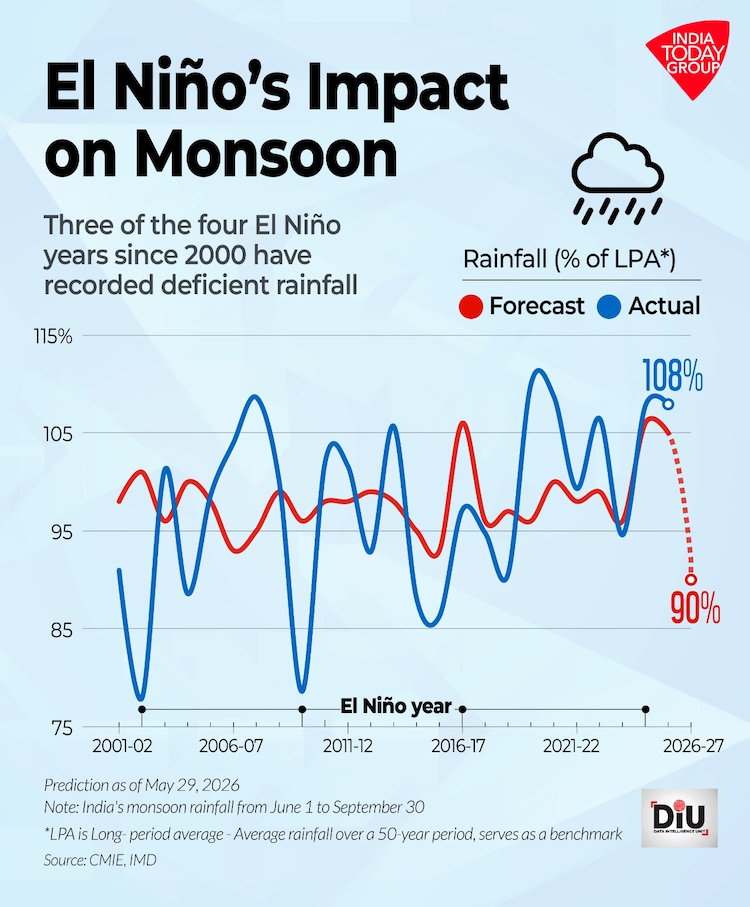
Since 2000, India has experienced four El Nino events, one of which occurred in 2002. That year, monsoon rainfall was 19 per cent below normal, resulting in a drought, the first after 14 consecutive years of good monsoons. July alone recorded a severe rainfall deficiency. According to a United Nations report, drought affected 29 per cent of the country's area, with 10 per cent under severe drought.
The combined impact of these factors led to a 12 per cent decline in foodgrain production in 2002–03. As a result, the agricultural sector recorded negative growth that year.
Another El Nino event struck in 2009. Cumulative monsoon rainfall across the country was 23 per cent below normal, making it the most rain-deficient year since 1972. Despite the large rainfall deficit, foodgrain production declined by only seven per cent in 2009–10. However, the resulting spike in inflation continued to haunt the economy through 2009 and 2010, and for much of 2011. In fact, inflation remained above eight per cent throughout 2009 and 2010.
Last two were different
However, the El Nino event of 2015–16 played out differently. While it resulted in deficient rainfall and record-high temperatures in 2015, foodgrain production did not decline. Nor did it trigger an inflation scare. In fact, the inflation rate fell below three per cent in November and December 2016.
The most recent El Nino episode in 2023-24 had no significant impact on either monsoon rainfall or foodgrain production. According to the Press Information Bureau, “From June to September, the country recorded 934.8 mm of rainfall, which is 108 per cent of the Long Period Average of 868.6 mm (based on the 1971–2020 average). This indicates that the monsoon was both timely and strong in most parts of the country.” The country, however, recorded slightly below-normal monsoon rainfall in 2023.
Foodgrain production also remained robust, rising by 8 per cent to 357.73 million tonnes in 2024–25 from 332.30 million tonnes in 2023–24. Notably, production had increased even in 2023–24 despite a slightly deficient monsoon that year.
An analysis of the last four El Nino episodes suggests that India has become increasingly resilient to the phenomenon. Although El Nino years have brought higher temperatures, their impact on monsoon rainfall and, in turn, foodgrain production has been relatively modest.