
Where could heat kill most Indians?
A single five-day heatwave could cause close to 30,000 estimated excess deaths in India, a new study finds, concentrated in the poorest and hottest states.

A five-day heatwave sweeping across India could be associated with nearly 30,000 deaths, many times the number the government records in an entire summer. That is the central estimate of a new study that maps the country's heat-death risk down to the district. Even a single day of extreme heat, the analysis published in the journal Frontiers in Environmental Health finds, is associated with about 3,400 excess deaths nationwide.
WHAT'S NEW
Those numbers dwarf the official count. The Union Health Ministry recorded about 360 heatstroke deaths between March and July 2023; independent trackers combing news reports counted 733.
"In India, heatwaves are projected to adversely affect the quality of life of up to 600 million people by [2100] under high warming scenarios. Despite this growing risk, the mortality burden associated with heatwaves remains poorly quantified. Official statistics substantially under-report heat-related deaths," the report’s authors, Piyush Narang and Ashok Gadgil of the India Energy and Climate Centre at the University of California, Berkeley, wrote.
WHY IT MATTERS
Heat rarely reaches a death certificate. Its victims are logged mostly as heart attacks, kidney failure, or old age. By counting deaths above the normal baseline during hot spells, a measure epidemiologists call excess mortality, the study argues the true burden runs into the tens of thousands and stays largely invisible.
Narang and Gadgil took heat-mortality risk measured in 10 Indian cities and extended it to all 765 districts, matching each district to a study city in the same climate zone. It is, they write, the first India-wide picture of heat mortality at this resolution.
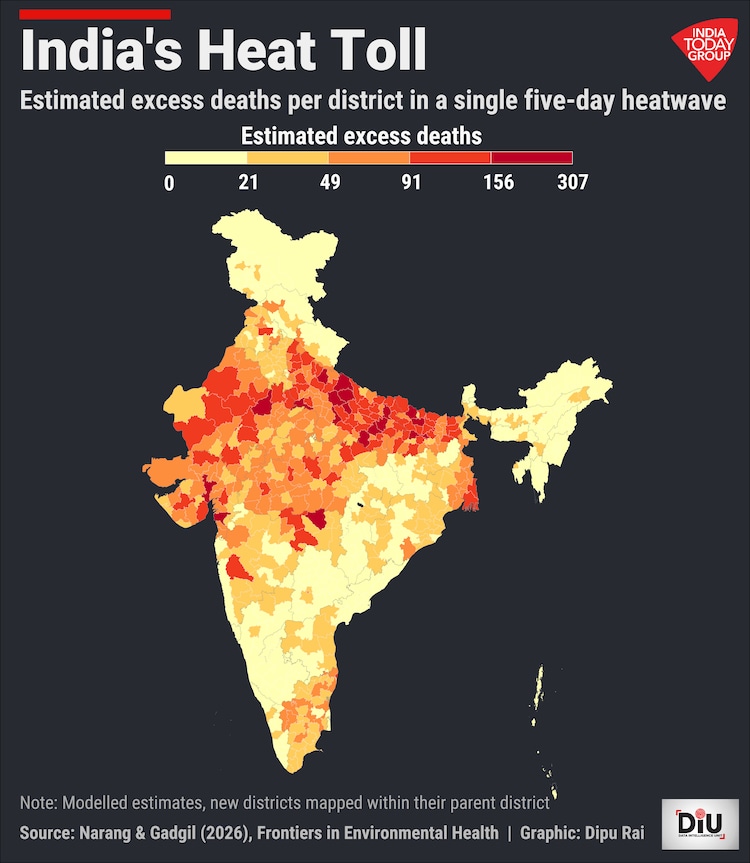
The risk is not spread evenly. Uttar Pradesh alone accounts for more than 8,000 of those deaths in a single five-day event, more than any other state. Bihar follows at about 3,600. Then Madhya Pradesh (2,960), Rajasthan (2,660), and Gujarat (2,350). Together, these five states bear about 66 per cent of the national toll.
The concentration sharpens at the district level. Ahmedabad tops the ranking with an estimated 307 excess deaths in one five-day heatwave, ahead of Jaipur (265) and Surat (261). Prayagraj, Patna, Lucknow, and Kanpur Nagar each clear 190. A single district can lose more people in five days than several states report from heat in a year.
IN NUMBERS
- 3,400 excess deaths estimated from a single day of extreme heat
- Nearly 30,000 excess deaths were estimated from a five-day heatwave
- 8,056 excess deaths estimated in Uttar Pradesh alone during a five-day heatwave
- Five states: Uttar Pradesh, Bihar, Madhya Pradesh, Rajasthan, and Gujarat account for about 66 per cent of the national five-day heatwave death burden
- These five states have 43 per cent of India's population, but only 29 per cent of India's GDP
- The top 100 districts account for 44 per cent of projected five-day heatwave excess deaths
- Ahmedabad, Jaipur, and Surat each could see more than 250 excess deaths during a single five-day heatwave
IN-DEPTH
The data also tracks a sharp economic divide. The five worst-hit states hold 43 per cent of India's population and would account for 66 per cent of deaths, yet produce just 29 per cent of its economic output, the study finds. That 2.3-fold gap means extreme heat presses the hardest on the states least able to pay to soften it: cooling shelters, water points, hospital beds, and warning systems that keep people alive.
India built its heat defences city by city. Ahmedabad's heat action plan, drawn up after a lethal 2010 wave, became the national model. The authors argue that the approach skips the rural, low-income districts that the numbers flag as most exposed, and that federal adaptation funding should be weighted toward high-burden, low-income states rather than split by population alone.
The estimates carry heavy caveats, which Narang and Gadgil stress. These are modelled projections, not a counted toll, built by applying urban risk patterns to rural populations whose vulnerability may run higher. The thresholds are calibrated to 2008-2019, before the record summers of 2023 and 2024, so the figures are best read as a conservative floor. As heatwaves grow longer and more frequent, the toll they describe will rise.
For now, the study hands India's heat planners something they have not had before: a map of where the next heatwave will be deadliest. Whether the country's defences follow it is the harder question.