
'Lot of options': Trump eyes Kharg as US-Israeli strikes surge 47%
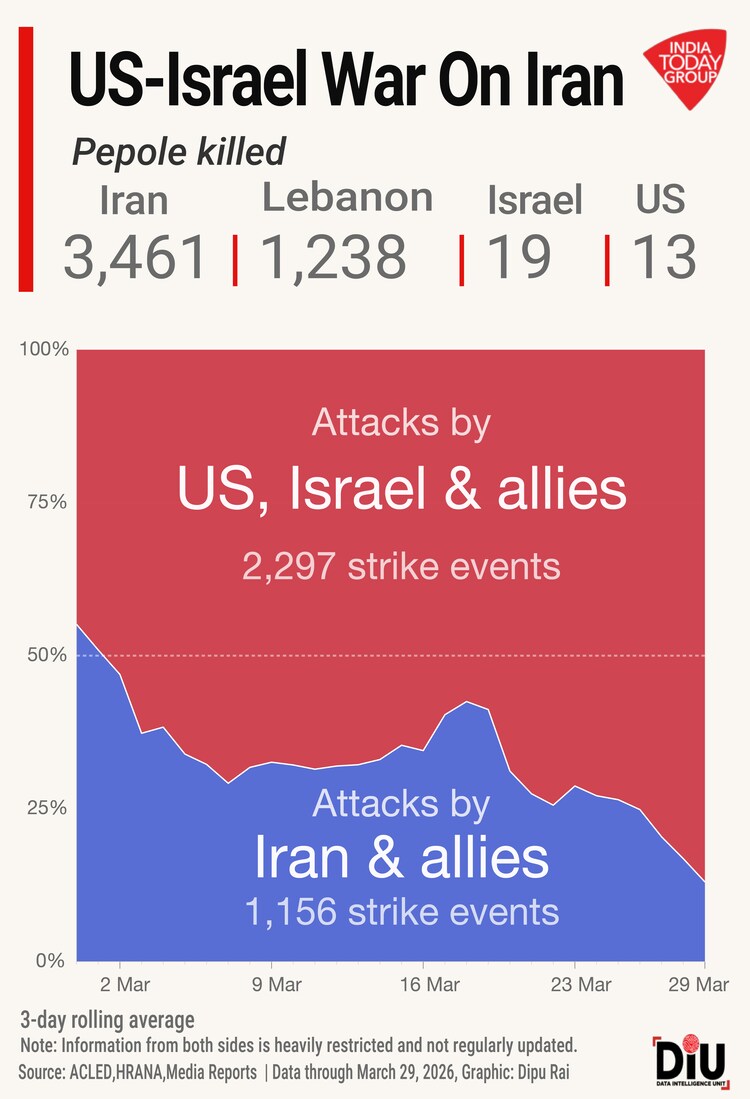
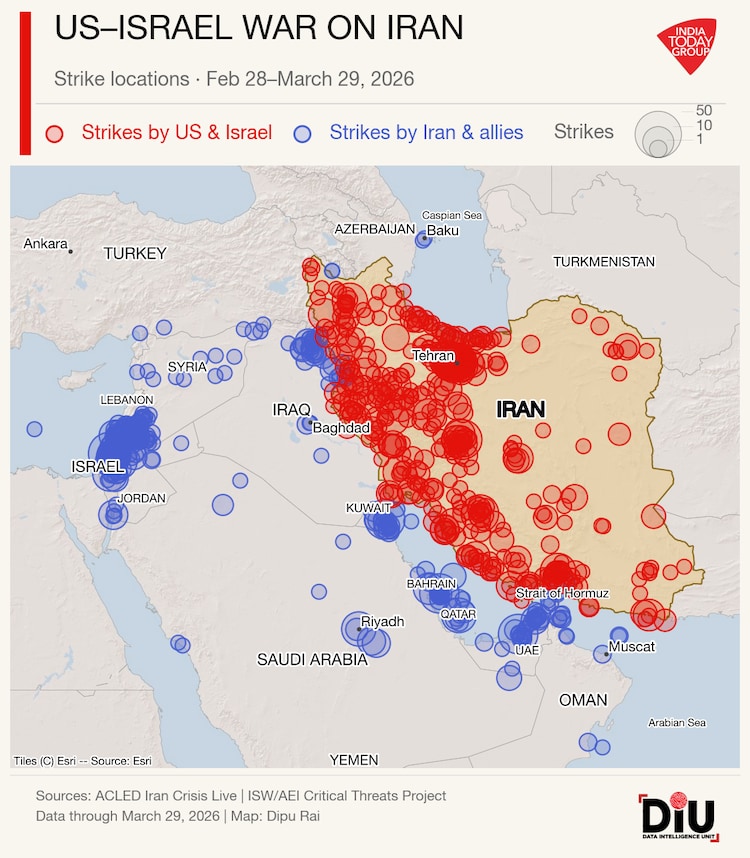
With 2,297 strike events since February and oil passing $116 a barrel, the conflict's next front may be a small coral island that handles nearly all of Iran's crude exports.

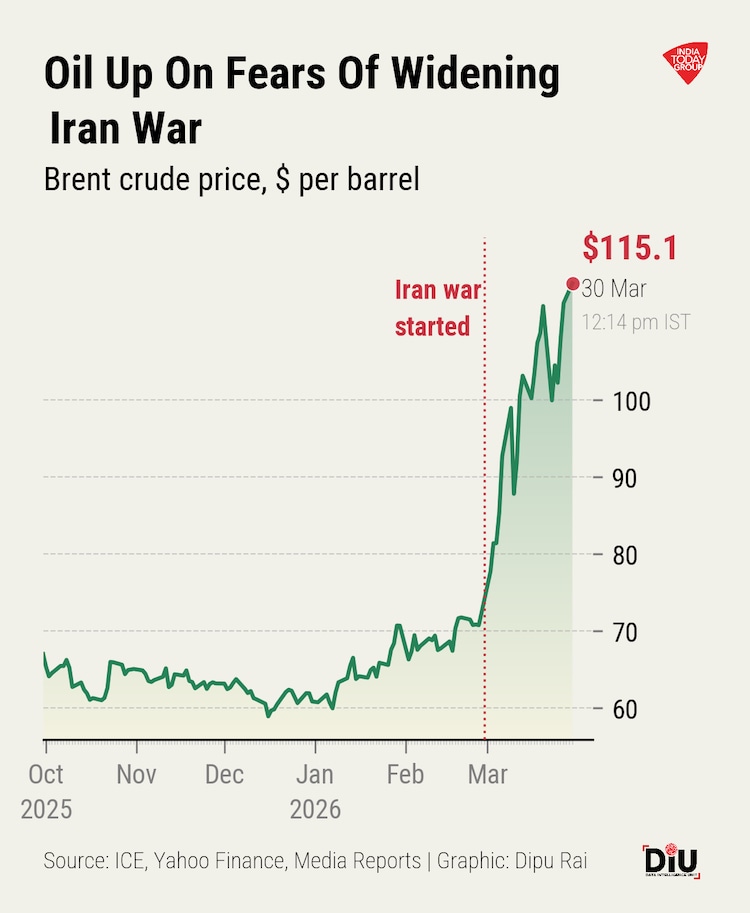
Brent Crude passed $115 a barrel this week, up 60 per cent since the Israel-US-Iran War started, and the reason can be traced to a five-mile strip of coral limestone in the northern Persian Gulf that most people have never heard of.
That island is Kharg. And Donald Trump wants it.
“To be honest with you, my favourite thing is to take the oil in Iran,” the US president told the Financial Times this week. “Maybe we take Kharg Island, maybe we don't. We have a lot of options.”
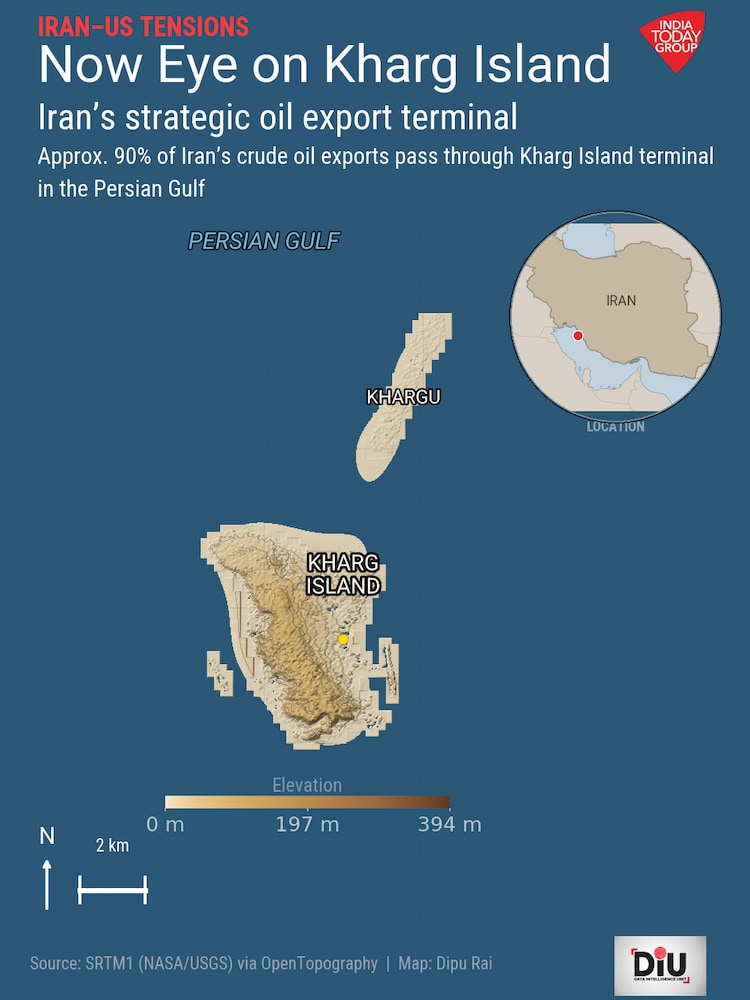
The remark sent markets reeling. Stock indices fell across Asia. Aluminium prices rose after Iran struck two metal processing plants in the Middle East. And oil traders, already rattled by a conflict entering its second month, began pricing in a scenario that would remove roughly 90 per cent of Iran's crude export capacity from global supply.
The arithmetic of escalation
According to the Armed Conflict Location and Event Data Project, US-Israeli strikes on Iran have risen by 47 per cent from the prior week's daily average. Iranian retaliatory attacks, by contrast, have fallen 32 per cent over the same period.
The gap suggests either strategic restraint from Tehran or mounting degradation of its strike capability. Neither interpretation is entirely comforting.
Iranian officials say the reduction is deliberate: they are absorbing blows while preparing a decisive response. The parliament speaker, Mohammad Bagher Ghalibaf, put it plainly: “The enemy signals negotiation in public, while in secret it plots a ground attack.”
What is Kharg?
Kharg is not an obvious military prize. It is geologically unusual: a coral island with natural freshwater springs, formed from porous limestone that collects rainfall in a region where fresh water is scarce. Archaeological evidence places human settlement there as far back as the Achaemenid period. The Dutch East India Company had built a trading post on the island in the 18th century, before being expelled by regional rulers.
What made Kharg strategic was oil. During Iran's petroleum boom of the 1960s, the island was developed into the country's primary crude-loading terminal — close to deep waters capable of accommodating very large crude carriers. During the Iran-Iraq War (1980–88), it was targeted repeatedly, yet kept functioning. It was considered, and proved to be, almost impossible to shut down permanently.
Today, Kharg sits at the convergence of two crises: a shooting war and an oil shock. Disrupting it, even briefly, would send prices beyond what markets have already priced in.
More complicated than it looks
There is a version of events in which Iranian restraint is genuine: Tehran has calculated that negotiations are more valuable than continued escalation. Trump, for his part, has not ordered the seizure of Kharg. He has only floated the idea. There is a meaningful difference, though financial markets have not been treating it as one.
Kharg itself has been fortified. Iranian officials say the island's defences have been reinforced with mines, air-defence systems, and drone batteries. Any amphibious or airborne assault would be costly, and any occupation, as Trump himself acknowledged, would require US forces to “be there for a while.”
A regional war
The conflict has drawn in actors Washington did not invite. Yemen's Houthis, who control Sanaa and much of northern Yemen, had been quiet since the US-Israel campaign against Tehran began on February 28. But they fired missiles at Israel on Saturday. Their military spokesman, Brigadier General Yahya Saree, declared support for Iran and allied factions.
Pakistan, Egypt, Saudi Arabia, and Turkey have been meeting to find a diplomatic off-ramp. Pakistan has offered to host peace talks. A US amphibious assault group has arrived in the region, fuelling speculation about a ground component to the campaign.
Trump has twice postponed an ultimatum to bomb Iranian power plants if energy shipments do not resume. He says Iran's leaders have been “very reasonable” in back-channel talks. Iranian officials say those same channels are a cover for an invasion plan.
What happens next?
The outcome will be determined not just by military force but by the price of oil. At $116 a barrel, the economic pressure on the region and on global markets is already acute. A seizure of Kharg — even a temporary one — would represent something the global economy has not experienced before: the deliberate capture of a nation's primary export infrastructure by a foreign power, in real time, with no clear end in sight. Trump drew the comparison himself. He wants to do to Iran's oil what Washington did to Venezuela's.
The question is no longer whether the conflict reaches Kharg. It is what happens the morning after.