
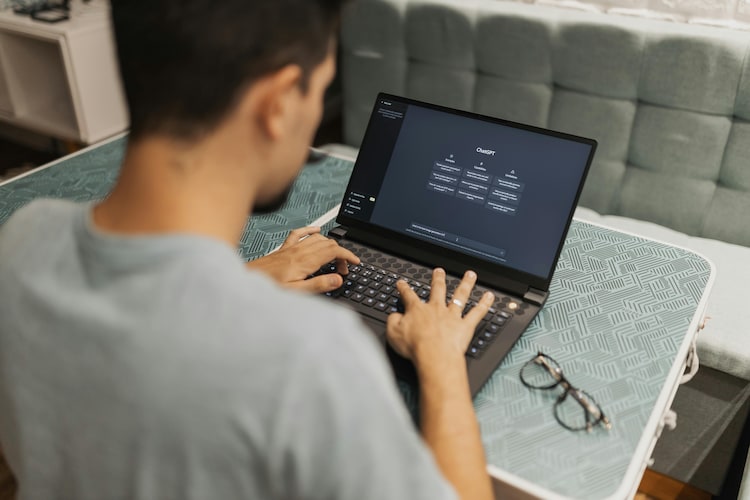
Can AI do what Kota does? India's coaching model faces its biggest test
AI chatbots are becoming round-the-clock study partners, solving doubts and personalising learning in seconds, while some now rival top JEE performers. But success in competitive exams depends on more than knowledge alone. It also requires discipline, motivation, resilience and human mentorship.
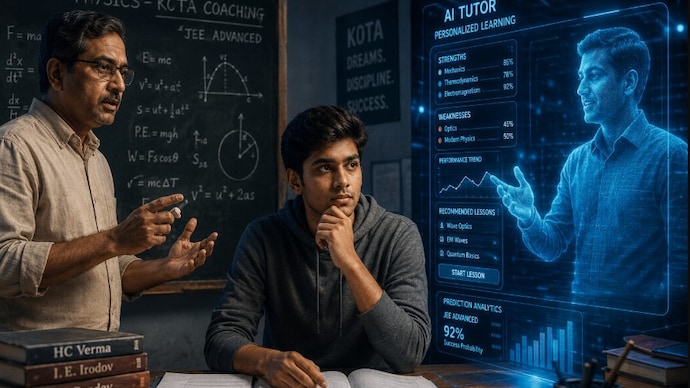
From Kota to AI: Is the era of coaching centres coming to an end? (AI generated image)

New Delhi,UPDATED: Jun 10, 2026 11:31 IST
It's 11:45 pm. A JEE aspirant is staring at a physics problem that refuses to yield an answer. The coaching class ended hours ago, the teacher is unavailable, and the pressure of a highly competitive exam is never far away.
Instead of waiting until morning, the student opens an AI chatbot.
Within seconds, a solution appears. Then comes a step-by-step explanation, a faster shortcut, common mistakes to avoid, and a fresh set of practice questions generated specifically around the concept.
For millions of students, this is no longer a glimpse of the future. It is the new reality.
As artificial intelligence becomes increasingly capable, a question once confined to technology conferences is now being debated in classrooms, coaching centres and households across India: Can AI replace what coaching institutes have traditionally offered?
AI'S RAPID RISE
The debate has intensified as AI systems demonstrate increasingly impressive performances in some of the world's toughest entrance examinations.
The pace of progress has been striking. South Korean startup GPAI recently claimed that its AI system scored the equivalent of 351 out of 360 marks on JEE Advanced 2025 questions. For comparison, the top human scorer that year secured 332 marks, while other leading AI models reportedly scored around 327 marks.
Independent evaluations on JEE Advanced 2026 papers have pushed the conversation even further. Some frontier AI models reportedly scored between 345 and 351 out of 360 marks, surpassing the top human score of 330. Even more remarkable, these systems completed the papers in under two hours, while students are allotted six.
Machines outperforming humans in narrowly defined tasks is not new. What makes these results significant is the nature of the challenge itself. JEE Advanced is designed to test deep conceptual understanding, multi-step reasoning and problem-solving under pressure. Its questions often combine multiple topics and contain subtle traps intended to separate exceptional candidates from the rest.
The fact that AI systems can now handle such layered and integrated problems has intensified the debate around education. AI is no longer just a tool for searching information or solving doubts. It is increasingly becoming a sophisticated learning companion capable of performing at a level comparable to, and in some cases exceeding, the very best human test-takers.
For students, however, AI's impact goes far beyond exam scores. It is already being used to solve doubts instantly, explain difficult concepts, generate customised practice questions, identify weaknesses and create personalised study plans.
CAN AI REPLACE COACHING?
According to career coach Pradeep Jain, AI has undoubtedly transformed access to knowledge.
"Today's students can get instant explanations, create practice questions, assess performance gaps, and even develop customised study plans in seconds. These abilities have made learning more accessible, affordable and tailored than ever before," Pradeep Jain adds.
Yet Jain believes it is too early to predict the end of coaching institutes.
"While this question is timely, concluding that AI will replace physical coaching centres may be too soon," he explains.
The reason is simple: education is about much more than information.
Success in examinations such as JEE, NEET, CUET, CLAT and UPSC depends not only on knowledge but also on discipline, consistency, motivation, emotional resilience and the ability to sustain effort over months or even years.
"Success in high-stakes exams depends on much more than academic content. It requires discipline, consistency, motivation, peer competition, emotional resilience and strategic guidance, areas where human mentors still play a vital role."
THE HUMAN ADVANTAGE
For decades, coaching institutes have offered more than classroom teaching. They have provided structure, accountability and mentorship.
A good teacher can identify weaknesses that students themselves may overlook. Experienced mentors help students navigate stress, self-doubt and setbacks during preparation.
"Coaching institutes have traditionally offered structured learning environments that help students stay focused and accountable. They also provide emotional support during stressful times and failure, something AI cannot fully replicate," Pradeep Jain further adds.
That human connection remains one of the strongest advantages of coaching centres.
Manmohan Gupta, IIT Delhi alumnus and Co-Founder of Vidyamandir Classes, believes AI will significantly influence education, but not by replacing physical classrooms anytime soon.
"At least over the next three years, AI will not be able to replace a classroom environment where a teacher is physically present and teaching students," Gupta says.
According to him, AI's greatest contribution will be personalised learning. Students will increasingly receive explanations, assignments and practice material tailored to their individual strengths, weaknesses and learning pace.
"Every child needs different kinds of help. Some students need concepts explained in greater detail, while others need to progress gradually from easier questions to difficult ones. AI can generate personalised content and personalised support at a scale that humans simply cannot."
However, Gupta argues that the role of great teachers remains secure because teaching is not only about delivering content.
"The teachers who will thrive are those who can build emotional connections with students, mentor them and guide them through non-academic challenges. AI is still far from being able to replicate that human bond."
While AI may disrupt online coaching models more quickly, Gupta believes the physical classroom experience—with peer interaction, mentorship and real-time engagement, will remain difficult to replace.

THE FUTURE: AI AND COACHING TOGETHER?
Rather than replacing coaching centres, AI may ultimately transform them.
Institutions are already integrating AI-powered analytics, adaptive testing and personalised learning tools into their programmes. The most successful coaching centres of the future may be those that combine technological capabilities with human mentorship.
Gupta sees AI as a force multiplier for good teachers rather than a substitute for them.
"Teachers will be able to use AI to solve questions faster, create customised assignments and provide more targeted support. In many ways, AI will help good teachers teach more effectively and reach more students."
As Jain puts it, "The future of education is unlikely to be a battle between AI and coaching institutes; instead, it will probably be a partnership."
Just as calculators did not eliminate mathematics teachers and computers did not replace schools, AI is unlikely to bring an end to coaching centres. What it is likely to do is redefine their role.
THE ROAD AHEAD
The real question is not whether AI will replace coaching institutes, but whether coaching institutes can adapt quickly enough to leverage AI and remain relevant.
As India moves from the era of Kota to the era of ChatGPT, the future of learning is unlikely to belong exclusively to either technology or traditional coaching.
The winners will be those who combine the strengths of both, using AI for personalisation, efficiency and instant access to knowledge, while relying on teachers and mentors for guidance, motivation, accountability and human connection.
The age of AI has arrived. But if anything, the rise of intelligent machines may make the value of great teachers even clearer.
- Ends