
One in four girls clear JEE Advanced, highest rate on record
For the first time, more than 10,000 girls have qualified through JEE Advanced for IIT admissions. The record reflects the impact of supernumerary seats and a wider shift in women's participation in STEM.

Over 10,000 girls qualify for IITs through JEE Advanced for first time

New Delhi,UPDATED: Jun 3, 2026 12:51 IST
India's premier engineering entrance examination has recorded a landmark achievement. For the first time in the history of the Joint Entrance Examination (JEE) Advanced, more than 10,000 girls have qualified for admission to the Indian Institutes of Technology (IITs), signalling a significant transformation in the country's engineering education landscape.
The JEE Advanced 2026 results reveal not only a record number of successful female candidates but also the highest-ever pass rate among girls.
RECORD-BREAKING PERFORMANCE BY GIRLS
The scale of the achievement becomes clear when compared with 2019. While 5,356 girls qualified JEE (Advanced) that year out of 36,669 registrations, the number has surged to 10,107 in 2026, an increase of nearly 89 percent.
The sharp rise, following the introduction of supernumerary seats to improve women's representation in IITs, marks a significant shift in India's engineering education landscape. In 2019, the highest-ranked female candidate secured AIR 10 with 308 marks; seven years later, girls are qualifying in record numbers and at their highest-ever success rate.
Of the 40,562 girls who appeared for JEE Advanced this year, 24.9 percent cleared the examination, the highest success rate ever achieved by female candidates.
Overall, nearly 56,000 candidates secured a place in the Common Rank List (CRL), making them eligible for admission to some of India's most prestigious engineering institutions.
FEMALE TOPPER'S JOURNEY REFLECTS DETERMINATION
Pune's Arohi Deshpande emerged as the highest-ranked female candidate in JEE Advanced 2026, securing an impressive All India Rank (AIR) 77.
Arohi said the journey to JEE Advanced was emotionally demanding and that maintaining focus throughout the intense preparation period was one of the biggest challenges. Her achievement highlights the growing presence of girls among the top performers in one of India's most competitive entrance examinations.
IMPACT OF THE SUPERNUMERARY SEATS SCHEME
The dramatic rise in female qualifiers highlights the effectiveness of the supernumerary seats initiative introduced by IITs in 2018. The policy created additional seats specifically to increase the enrollment of women without reducing opportunities for male candidates.
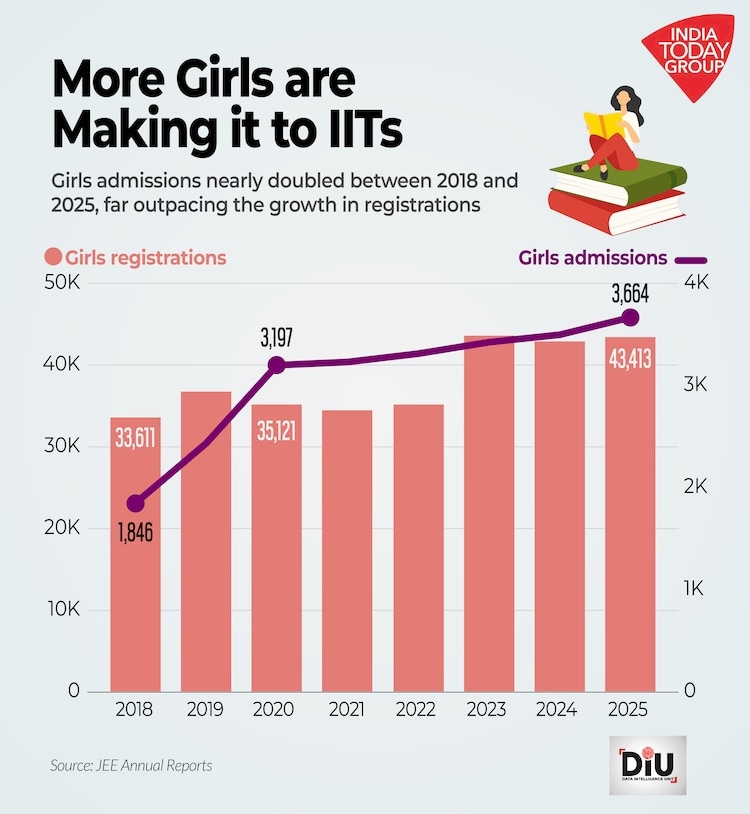
Since the scheme was implemented, the number of girls qualifying for IIT admissions has nearly doubled, while the number of female candidates appearing for the examination has increased by only about 22 percent.
This indicates that not only are more girls taking the exam, but a larger proportion are also succeeding.
CHANGING GENDER DYNAMICS IN IITS
An analysis by India Today's Data Intelligence Unit points to a broader shift in gender representation across IIT campuses. Women now account for roughly one-fifth of all IIT admissions, compared to around 15 percent seven years ago.
The share of girls qualifying through JEE Advanced reached an all-time high of 25 per cent in 2026, reflecting steady progress toward greater gender diversity in India's most prestigious engineering institutions.
ADMISSIONS HAVE NEARLY DOUBLED
The rise in female qualifiers has significantly strengthened women's representation at IITs.
The number of girls admitted to the premier institutes increased from around 1,800 in 2018 to over 3,600 in 2025, nearly doubling within seven years and reflecting the growing success of efforts to improve gender diversity in engineering education.
A MILESTONE FOR INDIA'S STEM FUTURE
The record-breaking performance of girls in JEE Advanced 2026 marks a significant milestone in India's journey toward greater gender inclusion in higher education. The crossing of the 10,000-qualifier mark reflects not only the success of targeted policy measures but also the growing aspirations and achievements of young women in STEM fields.
With role models such as Arohi Deshpande leading the way and an increasing number of girls breaking barriers in engineering education, the momentum appears set to continue.
As more women enter IITs and other premier technical institutions, India is steadily building a stronger, more diverse and inclusive talent pool that will shape the country's scientific and technological future for decades to come.
- Ends