
'Chilling effect' on textbook writers: Michel Danino after NCERT judiciary chapter row
Academic Michel Danino warned that the NCERT judiciary row could create a "chilling effect" on textbook writers, hurting creativity and academic freedom. He also said India's textbook-dependent education system and poor infrastructure could keep NEP 2020 goals out of reach.
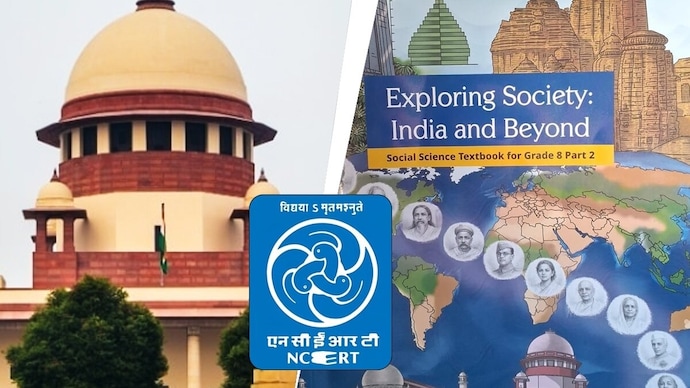

Amid the controversy over a now-withdrawn NCERT Class 8 chapter on the judiciary, academic Michel Danino on Wednesday raised concerns about academic freedom, saying the Supreme Court’s orders in the case could create a “chilling effect” on current and future textbook writers and discourage innovation in school education.
Danino, a Padma Shri awardee and chairperson of the curricular group that drafted NCERT’s social science textbooks, was among three academics — along with Suparna Diwakar and Alok Prasanna Kumar — who were initially barred for life by the Supreme Court over the controversial chapter. The court later modified its order, allowing the Centre, states, Union Territories, public universities, and institutions to take an independent decision on the matter.
Speaking to PTI, Danino said several editorials, commentators, and academics had described the impact of the Supreme Court’s February 26 and March 11 orders as a “chilling effect” on textbook writing and academic work.
"What the Supreme Court bench has done will have a chilling effect on present and future textbook writers. They will not feel so free to innovate," Danino said, adding that "creativity and innovation are essential" if India wants to create a new generation of textbooks.
Referring to the promises outlined in the National Education Policy (NEP) 2020, Danino said the government had repeatedly spoken about bringing a “revolution” in school education. However, he argued that such a transformation would be difficult to achieve if textbook writers were forced to work in fear, constantly worrying about possible objections to every sentence they write.
"Let us hope that this chilling effect doesn't become permanent," he said.
Although the Supreme Court had observed in its earlier order that it did not want to infringe on academic freedom, "indirectly, the orders it passed will have an intimidating effect", the scholar claimed.
"And therefore, this is something that the academic community needs to discuss," he said, referring to protests and public statements by academics and commentators following the textbook controversy.
He also said that more than 50 academics from across the country had written to the president of India, raising their concerns on the issue.
Terming India's school education system excessively "textbook-centric", Danino said that continued dependence on textbooks in classrooms was having a "crippling effect on the minds of students."
"Textbooks are not used in classrooms in many advanced countries. Textbooks are there only for supplementary reading at home," he said, recalling his own schooling in France during the 1960s.
"I cannot remember a single teacher in school asking us to bring textbooks to the classroom, or asking us to open the book on a certain page and then read it together," Danino said, adding that teachers instead came prepared with their own notes and materials.
Danino argued that the real debate should not be merely about reducing the physical weight of school bags, but "how do we reduce the presence of textbooks in the classroom?"
"For that, the number one challenge is how do we train the teachers in such a way that they do their own research and prepare their own material," he said.
Danino acknowledged that implementing such changes in India would not be easy, noting that “the average teacher is absolutely not ready for this”, while the condition of school infrastructure in many parts of the country remains “very poor”.
He also highlighted the digital divide in education, pointing out that despite growing conversations around online learning resources, “more than half of our schools still do not have access to the internet."
Given these realities, Danino said textbooks continue to serve as the “sole instrument of teaching and learning” in many rural schools. Calling the situation “very unfortunate”, he added that unless India recognises this heavy dependence on textbooks as a systemic issue, “we will not progress, and NEP 2020 will remain a distant dream."
(with PTI inputs)