
NEET, CBSE and Rs 1,000 crore mess: Expensive lesson that India didn't ask for
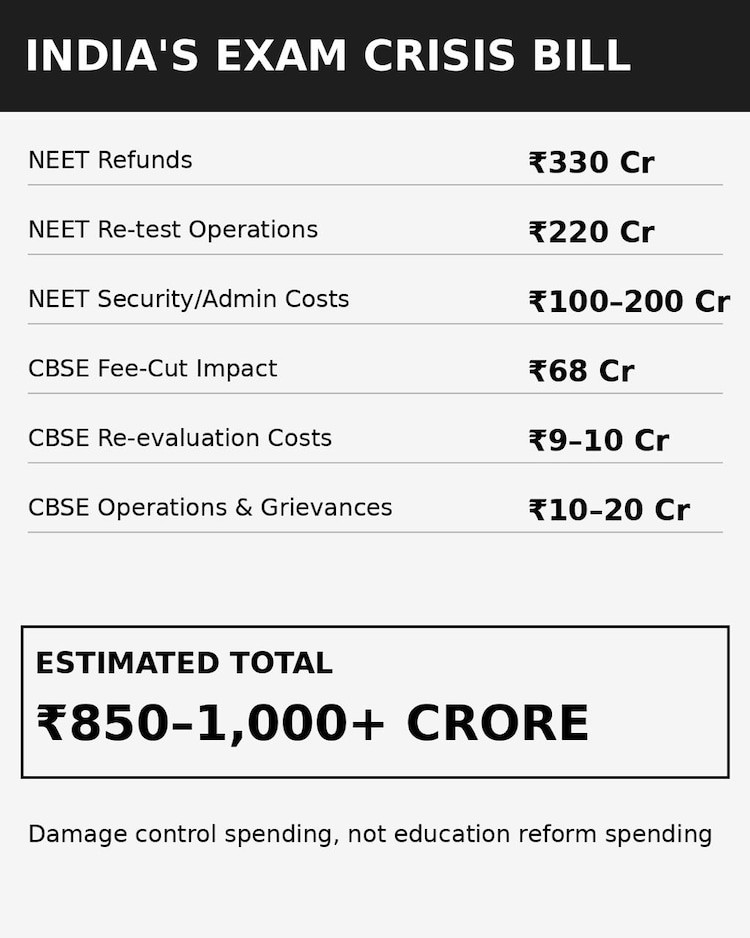
The NEET fallout and CBSE's Class 12 evaluation controversy have highlighted the escalating financial cost of exam failures. The episode has renewed questions over why authorities spend heavily on damage control instead of planning for prevention.
NEET, CBSE and Rs 1,000 crore mess: Expensive lesson that India didn't ask for

UPDATED: May 29, 2026 14:54 IST
It’s time we had an honest conversation about the price of incompetence.
Often when we talk about the “cost of education”, we usually refer to tuition fees, new schools, scholarships, or government schemes such as the Mid-Day Meal programme. Rarely do we stop to think about the cost of failure.
Yet in 2026, India ended up spending a staggering amount of money on something entirely different. And they call it damage control.
This is not money being spent on building laboratories, upgrading classrooms or training teachers for an AI-driven future. It is money being spent cleaning up after two of the biggest examination controversies in recent memory, the NEET-UG crisis and the ongoing CBSE re-evaluation saga triggered by the board’s controversial shift to on-screen marking.
In other words, this is the price of things going wrong. Taken together, these are not just stories about examinations. They are stories about public money, administrative lapses and the enormous cost of rebuilding trust once it has been lost.
And when you start doing the maths, the numbers become hard to ignore.
NUMBERS TELL A REMARKABLE STORY
Take the case of CBSE first. According to the board’s own data, more than 4.04 lakh students sought access to their answer sheets after the Class 12 results. Together, they requested over 11.31 lakh answer books.
Now I ask you to pause for a moment and think about that number. More than four lakh students felt compelled to check their answer sheets. Not because they were curious, not even because they had spare time, but because something about the process left them uncertain enough to want a second look.
Faced with mounting criticism over the OSM system, portal crashes, answer-sheet concerns and growing public pressure, CBSE slashed the fees for post-result services.
The charge for accessing answer sheets dropped from Rs 700 to Rs 100. Verification charges fell from 500 to 100. Re-evaluation charges were reduced from 100 per question to 25 per question.
For students, this was welcome relief. For CBSE, it came with a price tag.
On answer-sheet requests alone, the reduction amounts to a revenue sacrifice of nearly Rs 68 crore based on the 11.31 lakh answer books requested.
And that is before the next stage even begins.
If even a fraction of those students decide to move ahead with verification or re-evaluation, and Education Minister Dharmendra Pradhan himself has suggested that 15-20 per cent might do so, the financial impact rises much further. By conservative calculations, the reduced charges alone could push the overall cost of the exercise towards the Rs 80-crore mark.
But even these numbers on paper tell only half the story.
Someone has to process those requests, upload those answer books, respond to complaints, keep the portals functioning, review disputed answers and handle the flood of queries that follows any large-scale re-evaluation exercise. CBSE has already digitally furnished nearly 9 lakh answer books and dealt with an unprecedented volume of applications in a matter of days. That requires technology infrastructure, additional manpower, evaluators, support teams and administrative oversight. None of it comes free.
Even a modest estimate of these operational expenses would add several more crores to the bill.
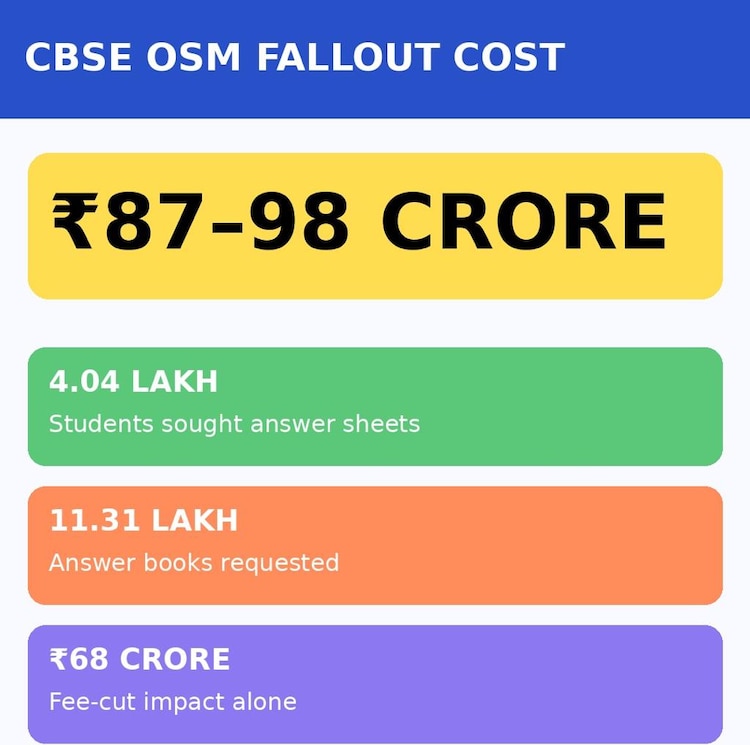
Put together, the cost of the OSM fallout could end up approaching Rs 100 crore. That is a remarkable amount of money to spend not on improving classrooms, training teachers or helping students learn better, but on reassuring students that the marks they received were actually the marks they deserved.
The board has effectively been forced into one of the largest post-result correction exercises in recent memory.
AND THEN THERE IS NEET
If the CBSE controversy was expensive, NEET was expensive on a completely different scale.
More than 22 lakh students registered for the examination, the fallout that followed meant dealing with refunds, fresh logistics, enhanced security arrangements, administrative interventions and the enormous machinery required to conduct and monitor a high-stakes national examination.
Consider just the refund component. If even a conservative average refund of around Rs 1,500 per candidate is assumed across 22 lakh candidates, the bill alone crosses Rs 330 crore.
And this is before a single examination centre is booked, a single question paper is printed or a single invigilator is deployed.
Then comes the cost of conducting the exercise itself. A nationwide examination of this scale requires thousands of centres, lakhs of question papers, transportation under secure conditions, surveillance systems, invigilators, observers, data processing teams, helplines and administrative staff. Even a modest operational cost of Rs 1,000 per candidate would translate into another Rs 220 crore. At Rs 1,500 per candidate, the figure rises to Rs 330 crore.
Add the two together and even the most conservative back-of-the-envelope calculation pushes the financial impact well beyond Rs 550 crore.
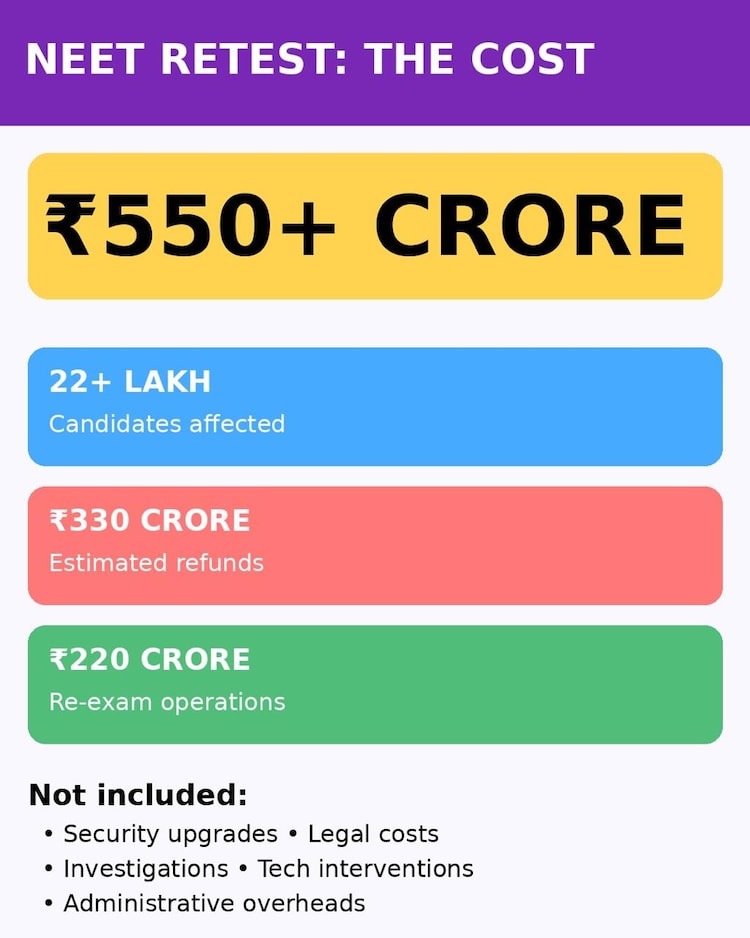
That estimate does not include additional security measures, legal expenses, technology upgrades, investigations, emergency administrative interventions or the cost of rebuilding public confidence in the examination process.
The final figure may only become clear months later through audits, government disclosures or parliamentary questions. But even using cautious assumptions, it is difficult to see how an examination involving more than 22 lakh students could be re-run, restructured and secured without a bill running into several hundred crores.
DAMAGE CONTROL IS EXPENSIVE. PERIOD.
This is where the story becomes bigger than either NEET or CBSE. The issue is not whether the final bill is 500 crore, 700 crore or 1,000 crore.
The issue is why India keeps spending money after things go wrong instead of before.
Imagine if even a fraction of these resources had been invested in stronger cybersecurity audits, independent system testing, secure examination architecture, quality control mechanisms, stress-testing of digital platforms and transparent accountability systems.
Imagine if the money being spent on damage control today had been spent on prevention yesterday. The irony is hard to miss.
The country is investing heavily in becoming a global knowledge economy while repeatedly finding itself trapped in crises that require expensive emergency repairs.
WHERE WE COULD HAVE SPENT RS 1000 CRORE INSTEAD?
This is where the debate becomes uncomfortable, because every rupee spent repairing trust is a rupee that cannot be spent elsewhere. The same money could have funded technology upgrades in thousands of government schools, it could have supported scholarships. It could have strengthened digital infrastructure, it could also have improved teacher training.
Instead, significant public resources are being diverted towards fixing problems that arguably should never have reached crisis point. That is what makes these controversies more than administrative failures.
They are opportunity-cost failures.
INDIA HAS DISASTER RELIEF FUNDS. WHY NOT EXAM RELIEF FUNDS TOO?
Perhaps the most surprising part of this entire episode is how unprepared the system appears to be for examination crises. India has established frameworks for natural disasters. There are funds for floods, funds for cyclones, there is even funds for earthquakes.
Emergency response mechanisms exist because policymakers understand that disasters are expensive and preparedness matters. Yet when it comes to examinations affecting millions of students, the response still appears largely reactive.
By now, exam crises are no longer rare exceptions. From paper leaks to cyber vulnerabilities to evaluation disputes, they have become recurring events in India’s education landscape. Which raises a simple question, why does India still not have an Examination Contingency Fund?
At some point, policymakers may need to accept an uncomfortable reality. India’s examination system has become too large, too digital and too consequential to rely on improvisation every time something goes wrong. An Examination Contingency Fund would not be an admission of failure. It would be an acknowledgement of reality.
Such a fund could support emergency re-tests, cybersecurity responses, independent audits, student compensation, large-scale re-evaluation exercises and rapid-response mechanisms without forcing authorities into ad hoc decision-making.
Because what the NEET and CBSE episodes have exposed is not merely a problem of administration, they have exposed a problem of planning.
The real tragedy is that India keeps paying enormous sums to rebuild trust after it has already been broken. And rebuilding trust is always more expensive than protecting it in the first place.
- Ends