
This 8-year-old founder learns at hackathons, factories instead of classrooms
At eight, Hyderabad's Lakshveer Rao spends his days in factories, hackathons, and startup offices, learning alongside founders while pursuing a micro-schooling path that gives him the freedom to travel, build, and explore. His journey reflects an education shaped by curiosity, exposure, and problem-solving.
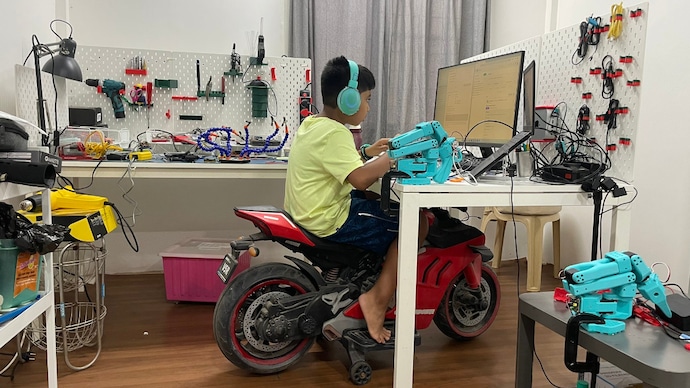

Most eight-year-olds learn how the world works through textbooks. Lakshveer Rao is learning by stepping into it.
Instead of limiting learning to classrooms and fixed schedules, Laksh spends time inside factories, startup offices, hackathons, and maker spaces across India, observing how things are built and problems are solved.
His classroom stretches far beyond four walls. It exists on manufacturing floors, in innovation hubs, and alongside founders and builders working on real-world challenges.
What makes Laksh’s story remarkable is not only that he is an eight-year-old hardware founder from Hyderabad. It is the clarity of purpose already shaping his journey: using technology to solve practical problems.
Behind that journey is his father, Captain Venkat, who has intentionally built an environment around curiosity and exposure. From factory visits to founder meetups across cities, he has created experiences where learning happens through participation rather than instruction.
Together, they are exploring a different model of education, one driven less by memorising answers and more by curiosity, exposure, and solving meaningful problems.
WHAT IS MICRO SCHOOLING?
Laksh follows an online schooling programme that gives him the flexibility to travel, explore, and learn through experience rather than following a traditional academic path.
“In microschooling, they focus only on the main topics. Once a concept is covered, they give us hands-on work and around 10–15 questions to practice. The classes are small, usually just 3–4 students, and then the session is done,” says the 8-year-old, who is currently working on a kitchen automation robot.
This resembles what many describe as micro-schooling, a more flexible and personalised model where learning adapts to the child instead of the child adapting to the system.
In Laksh’s case, education appears deeply connected to exploration, observation, and making things. Factory visits become lessons. Startup offices become classrooms. Problems observed during travel become opportunities to build.
Instead of separating learning from life, the two become intertwined.
The shift is subtle but powerful: moving from curriculum-led learning to problem-led learning.
WHY DOES EXPOSURE MATTER SO EARLY?
Laksh frequently travels to startup and innovation hubs such as Mumbai, Pune, and Bengaluru, immersing himself in environments where products are built and ideas are turned into companies. He also attended VibeCon earlier this year.
That exposure matters.
Most children learn about entrepreneurship years later. Laksh is experiencing it firsthand. He is growing up around founders, engineers, operators, and makers in real time, turning exposure itself into education.
Experiences that many adults actively seek out are becoming a normal part of their childhood.
GROWING UP AROUND BUILDERS
An interesting aspect of Laksh’s journey is that he largely interacts with adults, especially entrepreneurs and builders.
As a result, he is constantly surrounded by conversations about technology, manufacturing, product development, innovation, and solving problems.
Those interactions inevitably shape how he sees the world. He is not only learning skills; he is absorbing ways of thinking.
The surrounding ecosystem is not merely supporting learning, it is actively shaping it.
WHAT CAN EDUCATION LEARN FROM THIS STORY?
Lakshveer Rao’s story is bigger than being India’s youngest hardware founder.
It reflects a different model of learning, one built around curiosity, immersion, exposure, and self-directed growth.
His journey raises a compelling question for the future of education: perhaps learning is not only about what children study, but also what environments they grow up in and what problems they are encouraged to solve.