
Disruption spurs survival: Lab-grown diamonds now half of Surat's polished exports
In a consequential crossover for the Indian industry, lab-grown diamonds edged past their 'natural' competitor in export volumes in March-April 2026
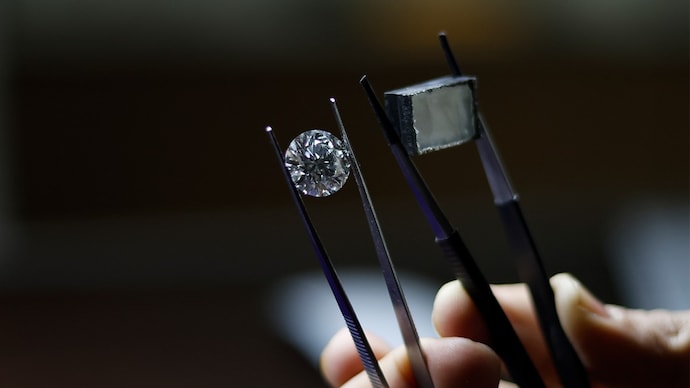

 For the first time on record, India has shipped out more lab-grown diamonds (LGDs) than natural ones by volume for two consecutive months. According to the Gem and Jewellery Export Promotion Council (GJEPC), gross loose LGD exports stood at 1.3 million carats in March 2026 and 1.4 million carats in April, against natural diamond exports of 1.2 million and 1.3 million carats, respectively.
That puts LGDs at 51 per cent of export volume in March and 50.4 per cent in April—a quiet but consequential crossover for an industry built almost entirely on the mined stone.
Almost the entire shift sits inside Surat, which polishes roughly 90 per cent of the world’s diamonds and where, by trade estimates, nearly 90 per cent of firms that once cut only naturals have now also opened LGD lines.
A caveat about the data, however, is that GJEPC began publishing volume figures only recently; so the actual crossover may have happened months earlier without showing up in the data. Besides, the April 2025 LGD share of 56 per cent was distorted by US tariff announcements on Indian polished naturals, making year-on-year comparisons unreliable. The trajectory, however, is unambiguous that LGDs were 45 per cent of export volume in January 2025.
Value, however, tells the opposite story. In rupee or dollar terms, LGDs account for less than 9 per cent of India’s wholesale diamond export value. Rough LGD imports into India average $15 per carat, mostly HPHT (high pressure, high temperature) goods from China and CVD (chemical vapor deposition) stones routed through Dubai.
The average price of polished LGDs exported from India is now below $74 per carat, against natural polished prices that remain 88-92 per cent higher. “The two products may be chemically similar,” writes Edahn Golan, the Tel Aviv-based diamond analyst, “but economically, they operate in entirely different orbits.”
India is now estimated to house over 14,000 CVD reactors, roughly double the count three years ago. The machines, increasingly being assembled in India rather than imported from Japan, cost between Rs 75 lakh and Rs 80 lakh apiece and produce roughly 125 carats a month.
For the thousands of MSMEs polishing and exporting natural diamonds, the pivot was not so much strategic as defensive. The Russia-Ukraine war and subsequent G7 sanctions on Russian-origin diamonds from Alrosa, which supplied about 30 per cent of the world’s rough, choked the natural diamond pipeline. India’s gems and jewellery exports collapsed from a turnover of $23 billion in 2022 to roughly $12 billion by end-2024. Over 50,000 workers were laid off in Surat in 2024 alone, with an estimated 2,000 units shuttering after Diwali. Daily wages fell from Rs 800-1,000 to Rs 500-600. The 2025 US tariffs on Indian polished diamonds delivered the next blow to a sector that sends about a third of its output to that country. Dozens of suicides by distressed diamond polishers followed.
“LGD companies, which need the same amount of diamond artisans as the natural manufacturing, have saved thousands of jobs and lives. The value of Surat as a diamond hub is in its unique talent pool. It needs to be conserved. If artisans don’t have work, they will move on to other professions, and that will be an irreversible loss,” says a veteran diamond exporter who has taken to LGDs two years ago.
Against that backdrop, LGDs were less of an opportunity than a release valve. Manufacturers already had the rough-buying networks, the polishing wheels and the export pipelines. As Golan notes, “They already knew how to buy rough, polish stones, and sell to jewellery manufacturers and retailers. Few were better positioned to capitalise on the opportunity.” Many small units that would otherwise have closed have stayed open, polishing LGDs, while larger players have bifurcated capacity.
However, it is the retailer economics that is doing the heavy-lifting. Golan’s earlier reporting for diamond and jewellery brand Tenoris shows why jewellers globally have embraced LGDs even as wholesale prices fall—gross margins on one-carat LGDs at US retail run between 64 per cent and 70 per cent, against 40 per cent on naturals.
Wholesale LGD prices have declined 86.5 per cent since Golan began tracking them in late 2018; a separate index puts the 2020-2024 fall at 74 per cent, from $3,410 to $892 per carat for a one-carat stone. Retailers, the data suggests, have not passed the wholesale slide onto consumers, making LGDs the most profitable category on the shop floor.
The consumer market is the steepest challenge yet. A good chunk of new younger buyers maturing now are choosing cheaper LGDs over the uber premium natural diamonds. The understanding of the chemical similarity between LGDs and natural diamonds has penetrated the western countries, but Indian consumers continue to prefer natural diamonds for weddings, occasions and religious rituals, making the domestic market a lucrative bet.
As for the legacy natural diamond manufacturers, the marketing failure sits at the heart of this transition. Golan’s sharpest argument is about positioning, not pricing. When buyers willingly choose a factory-made stone to save money rather than purchase a smaller natural one, “it points to a blind spot in natural diamond marketing. What appears to be missing is strong status positioning for natural diamonds”. The LGD industry’s message that “we are the same as natural diamonds” exploited that vacuum efficiently.
Whether Surat’s exporters can sustain a model built on $74-per-carat goods and sell 50 times more stones for the same dollar is the question. For now, the volumes have prevented the city’s diamond industry from collapsing outright.
Subscribe to India Today Magazine