
Feisty BJP, withered Congress, shaken AAP: Decoding the Gujarat civil poll scene
The bellwether assembly election contest of 2027 gives the civic polls added significance, with every seat verdict serving as a data point for parties

 A voter roll shrunk by 6.8 million, a Congress claiming haemorrhage at the hands of the BJP and an Aam Aadmi Party (AAP) crying crackdown by the administration, Gujarat heads for volatile civic elections on April 26.
Polling will be held for 15 municipal corporations, 84 municipalities, 34 district panchayats and 260 taluka panchayats, covering 9,992 seats across urban and rural local bodies. The votes will be counted on April 28.
The significance of these polls can be gauged from the fact that 41.9 million people will be eligible to vote, and with assembly elections due next year, every corporation ward and taluka seat doubles up as a data point for the three parties. Analysts view these civic polls as an indicator of voter mood ahead of the battle of 2027.
That is not to say voters necessarily see it that way. Civic elections are stubbornly local, contested on issues such as broken roads, water supply and civic governance. The OBC reservation overhaul has also reshuffled candidate profiles across the board.
A new Supreme Court-mandated 27 per cent OBC reservation policy has resulted in comprehensive delimitation and boundary changes across districts, with seven district panchayat president posts reserved for OBC candidates.
Of the total seats, 1,044 belong to municipal corporations, 2,624 are in municipalities, around 1,090 are at the district panchayat level and 5,234 in taluka panchayats. Of Gujarat's 17 municipal corporations, elections will be held in 15—Junagadh and Gandhinagar are excluded as their terms haven’t expired. Seven new municipalities have been formed and 14 redrawn under fresh delimitation boundaries. The newly created Vav-Tharad district will hold panchayat polls for the first time.
With two municipal corporations and some gram, taluka and district panchayats not going to polls, the total voters in the civic elections are estimated to be 41.9 million, about 95 per cent of the post-voter roll revision electorate size of 44 million.
A total of 27,712 candidates had filed nominations to contest in the 9,992 seats, of which 1,572 candidates withdrew, leaving 26,140 in the fray. The last day for withdrawal of nominations turned turbulent as the Congress and AAP alleged that BJP workers had coerced, bribed and even physically escorted candidates to pull out. AAP moved its Surat candidates to a farmhouse for safety.
The BJP bagged the Kadi and Gondal municipalities unopposed. In Ahmedabad’s Thaltej and Vasna, Congress withdrawals cleared the BJP’s path. A BJP candidate in Kamrej-2 withdrew after tribal community protests. The Congress also alleged that BJP-affiliated home guards could compromise poll security.
Before the Election Commission’s Special Intensive Revision (SIR) exercise began, Gujarat had 50,843,436 registered electors. After field verification, 7,373,327 names were removed in the draft rolls. After the claims-and-objections period, 56 million names were restored and the final rolls published on February 17 settled the voter size at 44,030,725 voters—a net reduction of 6.8 million voters from pre-SIR levels.
The baseline for the BJP, Congress and AAP is the 2021 local body poll results. The BJP had swept all six municipal corporations that went to polls that year, winning 483 out of the total 576 seats. The Congress managed just 55 seats. AAP, debuting in the Gujarat civic polls, won 27 seats—all in Surat. Asaduddin Owaisi’s All India Majlis-e-Ittehadul Muslimeen (AIMIM) won seven seats in Ahmedabad's Jamalpur and Maktampura wards. In separate elections in Gandhinagar that October, the BJP won 41 of the 44 wards; two went to the Congress.
The BJP heads into this election with what it calls as a ‘report card’ campaign. The party has directed cadre to present the government's performance to voters at the booth level. Alongside welfare schemes, state president Jagdish Vishwakarma is highlighting ideological achievements, such as the Ram Temple in Ayodhya and the push for a Uniform Civil Code.
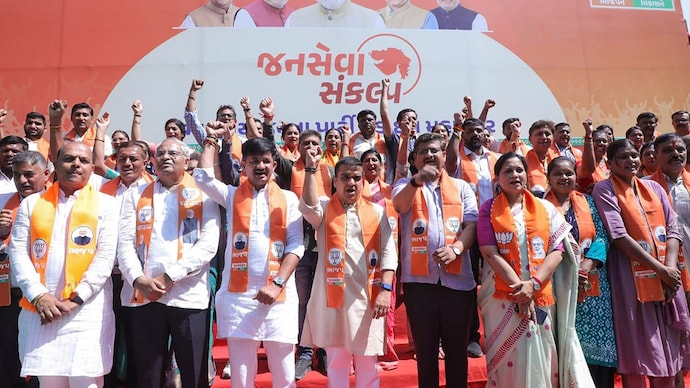
The BJP campaign was formally launched under the ‘Janseva Sankalp’ programme, with candidates collectively taking a public-service pledge across all 15 corporations simultaneously. Chief minister Bhupendra Patel, deputy chief minister Harsh Sanghavi and Union minister C.R. Patil are leading the charge across cities.
The Congress enters the elections visibly weakened, and not entirely by voter sentiment. The party has alleged that the BJP used police and administrative influence to intimidate and force Congress candidates to withdraw their nominations. In Junagadh, nine of 60 Congress candidates pulled out in support of the BJP, handing the latter unopposed victories.
In Bhachau municipality, 11 of the 28 seats were secured by the BJP even before polling day. The Congress's campaign, wherever it has managed to sustain one, centres on civic deficits—road conditions, water problems and overall poor development—a pitch that has failed to work in the past. But the SIR controversy has added an edge to its messaging: that under the BJP, the electoral machinery itself cannot be trusted.
AAP has invested heavily in these polls as a springboard for 2027, with supremo Arvind Kejriwal and Punjab chief minister Bhagwant Mann making multiple visits to Gujarat. Kejriwal toured the state for three days in January, addressing booth-level volunteers and zonal conferences in Ahmedabad and Vadodara.
In late February, he and Mann made a two-day visit to review election preparations. Mann even made a standalone visit on January 28 to highlight Punjab's welfare model. In late March, the duo undertook another three-day tour, holding public meetings in Amreli and Jamnagar focused on farmers' issues, besides a large gathering in Dahod that addressed tribal communities.
AAP's sharpest campaign charge concerns state repression. Kejriwal wrote to Bhupendra Patel, alleging that 145 FIRs had been filed against AAP workers in three months and more than 160 were arrested, with cases including serious crimes such as attempt to murder. He raked up incidents in Khambhalia, Porbandar and Jamnagar, where AAP workers were allegedly stopped on the road and booked even as those who confronted them faced no action. AAP state president Isudan Gadhvi was briefly detained when he visited a police station to enquire about the arrests.
Speaking in Rajkot in March, Kejriwal had said: “This time, Gujarat is demanding change.” Whether the 41.9 million electorate agrees will be revealed on April 28.
Subscribe to India Today Magazine