
From the India Today archives (2008) | Hindu militancy: A new threat?
The Bombay HC has discharged four accused in the 2006 Malegaon blasts case, an episode that had been blamed on Hindu militancy and 'reverse terrorism'


 (NOTE: This article was originally published in the India Today issue dated November 10, 2008)
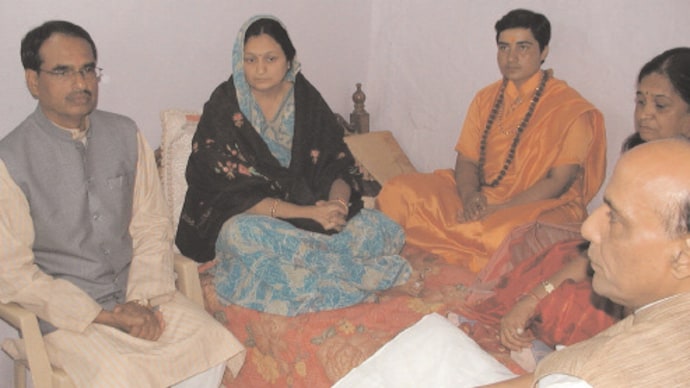
Pragya Singh Thakur, in her saffron robes and angelic face, hardly seems the poster girl for Hindu militancy. Yet, as Anti-Terror Squads (ATS) in four states made a series of arrests in connection with the bomb blasts in Malegaon and Modasa which targeted Muslims, it appeared that a new form of revenge-based terrorism had arrived, and she may be its avenging angel.
The investigations have already spanned Maharashtra, Gujarat, Madhya Pradesh and Uttar Pradesh—and all leading to right-wing organisations, some of them not even on the radar of intelligence agencies.
Those arrested are all young and volatile, believing in and preaching “an-eye-for-an-eye” philosophy. Others, like the former army officer Major Ramesh Shivji Upadhyay, are educated and well-trained.
Pragya Singh, a regular at Vishwa Hindu Parishad (VHP) meetings, was invited to various gatherings to give fiery speeches. “It was not uncommon for her to exhort the audience to kill Muslims. "For her it was not violence but justice for Hindus, having been targets of Islamic terrorism since long,” said a VHP activist, who has attended some of the meetings.
Another key figure arrested by Maharashtra ATS was Sameer Kulkarni from Madhya Pradesh, a young Hindu activist. In addition to these unlikely faces of terror, there has emerged an array of Hindutva organisations, two of which figure in connection with the blasts probe: Rashtriya Jagran Manch (RJM) to which Sadhvi Pragya was affiliated and Abhinav Bharat, of which Kulkarni was state pramukh.
The RJM is different from Hindu Jagran Manch, an ad hoc body of functionaries of various organisations affiliated with Rashtriya Swayamsevak Sangh (RSS) that come together on controversial issues concerning places of worship.
The RJM was floated less than a year ago by a bunch of RSS pracharaks and full-timers, who had broken away from the Sangh following ideological disputes. It shot to prominence earlier this year following the riots at Indore in July. The organisation protested the cases registered against 13 Hindus in connection with the riots, alleging that local factional politics in the BJP was behind the “bogus cases”.
Abhinav Bharat, with a base in several states, was headed by Himani Savarkar, the daughter of Nathuram Godse’s elder brother and daughter-in-law of Vinayak Damodar, “Veer” Savarkar’s brother.
Caught by surprise, intelligence agencies are now trying to piece together the new terror profiles. An Intelligence Bureau (IB) official admitted that they were getting reports from their local units about the emergence of the new Sadhvi.
“She was often compared to Uma Bharati in her heyday. She was known to make inflammatory speeches. However, neither the local IB personnel nor the police imagined that she would get involved in organised acts of terror,” he said.
But now, with women emerging as key players in inciting communal passions, the intelligence agencies have also turned their attention towards Durga Vahini, the women’s wing of the militant Bajrang Dal.
The VHP raised Durga Vahini in 1991. Headed by firebrand Sadhvi Ritambhara when the Ayodhya movement was at its peak, it was at the forefront of the movement in its final, decisive phase and also took the lead of the squad that demolished the controversial Babri structure on December 6, 1992. Vahini members had reportedly played an active role in the Gujarat riots.
To intelligence agencies, one thing has increasingly become clear: these organisations have been openly getting involved in violence, whether it was Godhra, Amarnath or Kandhamal, or further in the past, the 1992 Mumbai riots.
The organisations, their activities and leaders are now under the scanner. More worrying is the involvement of serving and former army personnel in the training and perhaps, even supply, of explosives. “Organising bomb blasts shows an intent and determination to carry out planned attacks against Muslims. This is reverse terrorism. The Hindu outfits are on the verge of being declared terrorist organisations,” said a senior intelligence official.
In fact, the exercise to ban some of the right-wing organisations, including the Bajrang Dal and Durga Vahini among others, is already underway. “The dossiers are being prepared. Evidence is being collected from all over the country about the attacks they have been involved in. When we have enough, the Government will put it before the Cabinet, seeking a ban. The effort is to nip it before it becomes a burning communal fire,” the official said.
The more daunting prospect lies in the political dimensions of the development, especially with crucial general elections approaching and parties eying vote-banks. While the Congress was quick to latch on to the issue of Hindu terrorism, the BJP first floundered and then decided to disown the Sadhvi. The BJP again found itself trapped in the age-old dilemma—whether to go with political correctness or stick by its political character.
That indecisiveness has allowed the Congress to attack. Says party spokesman Abhishek Singhvi: “The blasts were more terrifying than a general terror act because they involve and implicate almost a mainstream party, the BJP.”
BJP’s prime ministerial hopeful L.K. Advani and senior leader Yashwant Sinha took exception to the term Hindu terrorism and said that the Sadhvi had quit ABVP in 1997 and was not related to the party in any way. Sinha added that the law should take its course and proceed against the Sadhvi if indeed she was proven guilty of direct involvement in the Malegaon blasts.
The Sangh cadres have not taken the attitude of senior BJP leaders too well. “Whether Sadhvi Pragya was a member or not is a technical issue but the fact remains that she followed the Sangh ideology,” said a VHP leader, not wanting the BJP to be on the defensive.
The discontent among Sangh Parivar cadres was palpable at the usually quiet VHP headquarters at Jhandewalan in the capital. “The party uses us whenever it needs muscle power or lung power or to create a nuisance but at the first sign of trouble, it abandons or sidelines us,” complained a Bajrang Dal activist.
The Bajrang Dal has been given space in the vast complex to hold meetings and coordinate with other Sangh outfits. A senior VHP leader added that the party had a history of disowning those who had become uncomfortable for them. “Even Pravin Togadia has been relegated to the sidelines,” he says. Sadhvi Ritambhara, who used to travel with Advani during his rath yatra, is now almost an untouchable for the party leaders.
State party units, however, continue to back the Sadhvi. Unit chiefs of Madhya Pradesh and Gujarat, Kailash Vijayvargiya and Purushottam Rupala, respectively, came out in her support, saying she was being framed. Vijayvargiya also came out in support of Shyamlal Sahu, another accused in the blasts case.
Sahu, 42, in addition to being a BJP leader, used to run a small mobile recharge voucher and handset vending outlet in Tukoganj area of Indore. Other Hindu organisations have begun to rally around in support. On October 27, the Akhand Hindu Sena, led by Acharya Shekhar, a senior VHP functionary in Ujjain, held a yajna in her support.
Meanwhile, some Muslim organisations are demanding that the 2006 Malegaon blasts, which killed 31 people, be reinvestigated with the emergence of “the Hindu face of terror”. In fact, intelligence officials are hard put to explain their failure to pin the earlier Malegaon blasts in 2006 on Hindu outfits. Even then, the finger of suspicion had pointed towards right-wing organisations but at that time it was considered almost impossible that they would execute terror acts.
“We knew about their militant nature and also the kind of training being imparted to many of them but we could not believe that they would make bombs and organise blasts in retaliation to Islamic terror,” a former IB chief said.
To avoid communal tension and taking the easy way out, Maharashtra Chief Minister Vilasrao Deshmukh handed over the probe to the Central Bureau of Investigation (CBI) in December 2006.
Then CBI director Vijay Shanker, on the eve of his retirement, said the unresolved Malegaon blasts was one of the toughest cases he had handled. Without elaborating, he had called it a “tightrope”. For the UPA Government and security agencies, getting to grips with the new face of terror will be an even trickier tightrope walk.
Subscribe to India Today Magazine