
How Gir is battling another mining threat in core Asiatic Lion habitat
A wildlife photographer-activist's letter to Gujarat CM Bhupendra Patel again highlights the festering conflict between industry and the lion's last stronghold
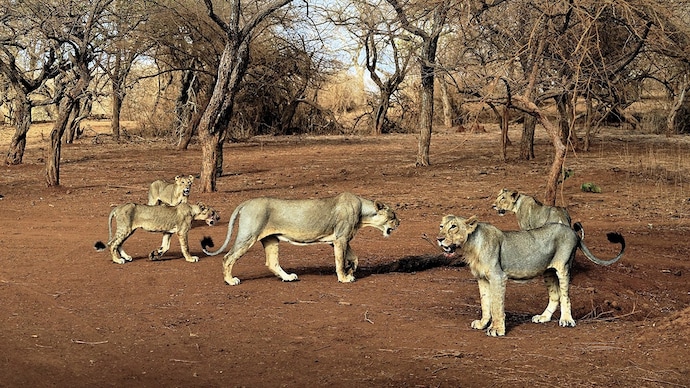

 The unenviable reality of constant balancing of industrial and human development with conserving habitats of the Asiatic Lion in Gujarat’s Gir region has surfaced again. Wildlife photographer-activist Bhushan Pandya has written to chief minister Bhupendra Patel, expressing concern over a proposal for limestone mining by a cement company in the reserve forests of Babarkot in Amreli district. Patel chairs the State Board for Wildlife, of which Pandya is a former member.
Spread over 75.94 hectares, the territory falls under the Gir East forest division. As per the census of 2025, 54 lions were reported to inhabit the region.
Pandya has demanded that the government immediately reject the proposal. “Over the last three to four months, the forest department has recorded sightings of approximately 40 to 50 lions in the proposed mining zone itself, including cubs, sub-adults, lionesses and adult males. The area holds roughly 5,000 mature trees,” wrote Pandya.
“Mining would require diverting protected reserve forest, which violates the Forest Conservation Act, 1980. More critically, the Gir National Park and Wildlife Sanctuary Management Plan, which is a legal document framed under the Wildlife (Protection) Act, 1972, designates this coastal forest as a key lion movement corridor. Approving the diversion will set an erroneous and sad precedent,” he continued.
The ecological ripple effects, Pandya argued, would compound quickly. Lions displaced from Babarkot would be pushed towards Pipavav, forcing them to cross a busy railway line with greater frequency. Lion deaths from train hits are already a subject of litigation in the Gujarat High Court. Mining would also increase salinity ingress, permanently degrading adjacent agricultural land.
The Amreli lions share their territory peaceably, hunting nilgai and wild boar, and moving across Dhari, Rajula, Pipavav and Jafarabad without serious incidents. Remove that habitat and the conflict calculus changes entirely, he stated.
Pandya invoked a November 2025 Supreme Court judgment that explicitly directs restrictions on human activity disturbing wildlife corridors. He also flags a long-running suo motu proceeding in the Gujarat High Court (under PIL 284/2014), focused on unnatural lion deaths.
An anecdote cited in the letter is a devastating punchline. Last year, a lioness entered a house in a residential area near Babarkot. The house, it turned out, belonged to a miner employed at a nearby site where work had been going on under an old permit. “Lions cannot speak,” Pandya wrote, “but this incident shows as if the lioness came to the miner’s home to complain about her habitat being snatched away.”
The Babarkot mining proposal is the latest chapter in the decades-long conflict between Saurashtra’s development ambitions and its lions. A cement factory sits less than 15 km from the Gir sanctuary in Junagadh district; five state highways cut through the forest, and sand mining has steadily increased in the region.
In 2022, the National Green Tribunal quashed the cement company’s environmental clearances for the Babarkot and Jafarabad mines, ruling that extensions to the cluster, spanning over 50 hectares, required approval from the Union ministry of environment, forest and climate change, which had never been granted. The current proposal suggests the company is seeking a fresh foothold in the same contested terrain.
The broader numbers are alarming. Gujarat’s Asiatic Lion population grew from 674 to 891 between 2020 and 2025, after accounting for the deaths of many in the same period due to age, illness, cub mortality, open-well falls, electrocution and accidents. The Gujarat government allocated Rs 40 crore in the 2025-26 budget to set up a command and control unit for wildlife protection, with preventing lion deaths on railway tracks cited as the primary objective.
The lion population growth has sharpened the crisis. Of the 891 lions, more than 497 now live outside Gir’s protected areas, and over 20 people have been killed in human-lion encounters over the past five years, with livestock attacks nearly doubling.
A 2024 Wildlife Institute of India study found that between 2012 and 2017, the number of villages reporting livestock attacks increased by an average 105 per year. “The expanding distribution of lions is pushing them into sub-optimal human-dominated habitats, because they now have to navigate barriers like highways, railway lines, open wells and illegally electrified fences,” a conservationist noted.
Against this backdrop, Pandya’s letter comes as an alarm bell. Every hectare of corridor forest that is diverted is not merely a line on an approval document but a compression of the already-thin margin within which Gujarat’s lions and its people are learning to share space. Perhaps the lioness at the miner’s door was a warning.
Subscribe to India Today Magazine