
How Long Will The War Last?
Going by the vicious slugfest and Iran's refusal to back down, it might go on for months. Only rumours of cessation talks between the warring parties hold out hope
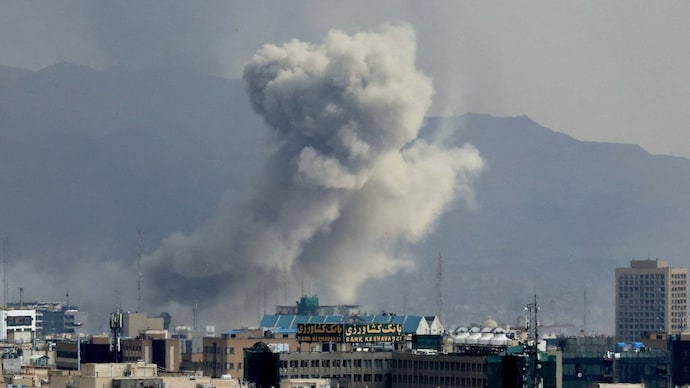

 To make any educated estimate about the duration of the Iran conflict, one has to move through a thicket of confusing signals even as US/ Israeli strikes on Iran and Tehran’s missile/ drone barrages on Israel and the Gulf countries continue apace.
Among portents hovering over the area — the US military is deploying thousands of marines and assets to West Asia, and HMS Anson, a nuclear-powered British submarine capable of launching cruise missiles on Iran, is in the Arabian Sea. On March 20, Iran targeted the US military base on Diego Garcia island in the Indian Ocean, 4,000 kms away, with a two-stage long-range missile. Though it missed its mark, the intent was there for all to see. That apart, Iran delivered a clear message: any strike on its power facilities would invite attacks against energy and desalination infrastructure belonging to US and Israel in the Gulf.
A ray of hope emerged on March 23, when US President Donald Trump said that his country and Iran “had held talks” on resolving the conflict and announced he was postponing his March 21 threat to strike Iran’s power facilities for five days. While, this was dismissed as “fake news” by Iran’s parliament speaker Mohammad-Bagher Ghalibaf, reports do indicate high-level contact between Iran and the US could result in talks—possibly mediated by Egypt, Turkey and Pakistan—in the near future. In a positive signal, Iran announced on March 25 that it would let “non-hostile” vessels to pass through the Strait of Hormuz.
Indian military observers believe that like Russia in Ukraine, the US and Israel have been drawn into a long war. Bringing Iran to its knees, they say, would require ‘boots on the ground’. With the US’ NATO allies maintaining a distance, experts say the war is not heading for a quick end. “No one has any exact strategy in this war,” noted Lt Gen Vinod Bhatia, former director general of military operations. He added that it could, in fact, enter a more destructive phase.
“The duration of the war will be determined by when Iran loses control of Strait of Hormuz, which is mined and covered by anti-ship missiles and drones,” says former deputy chief of the Indian Air Force, Air Marshal S.B.P. Sinha. Another top army officer adds, “Militarily, the Iranian side of the Hormuz Strait is a ‘defenders dream’ as it has control over all the heights and peaks.”
India’s Position
For India, the conflict represents disruption in core national interests: energy security, trade, diaspora safety and regional balance of power. India’s dependence on imported crude—much of it supplied through the strait—remains a vulnerability. Any sustained blockade can hurt India’s economy.
Strategically, the conflict places India in a delicate position. Its deepening partnership with the US and its robust defence/ technology cooperation with Israel must now be balanced against its good ties with Iran, which remain vital for connectivity initiatives such as the Chabahar port. The Gulf countries are strong allies too and crucial for such ambitious projects as IMEC (India-Middle East-Europe Economic Corridor). India must therefore avoid alienating anyone while safeguarding its core interests.
The Widest Outreach
To obviate a full-blown energy crisis, India is sourcing crude oil from sources like Russia, using its strategic reserves and increasing its coal output. PM Narendra Modi has engaged in intensive telephone diplomacy over the past four weeks, calling leaders from UAE, Israel, Saudi Arabia, Jordan, Bahrain, Oman, Kuwait and Qatar—condemning attacks on their infrastructure, emphasising India’s need for a steady supply of fuel, gas and fertilisers, and requesting them to ensure the safety of the millions of Indians in the region. On March 12, Modi spoke with Iran’s President Masoud Pezeshkian, urging de-escalation and the opening of the embattled strait. On March 24, Trump spoke with Modi and discussed the situation in West Asia.
The way forward for India has to be a balanced neutrality: advocating peace and preserving ties with all parties. Energy procurement needs more diversification—including sourcing from the US and Africa—along with an increase of petroleum reserves. The conflict shows how non-participants like India are deeply enmeshed in its consequences.
Subscribe to India Today Magazine