
How Modi's Somnath Temple puja embeds a deep BJP political narrative
Somnath Amrut Mahotsav, marking 75 years of the temple after post-Independence restoration, anchors the BJP's vision of India's civilisational future
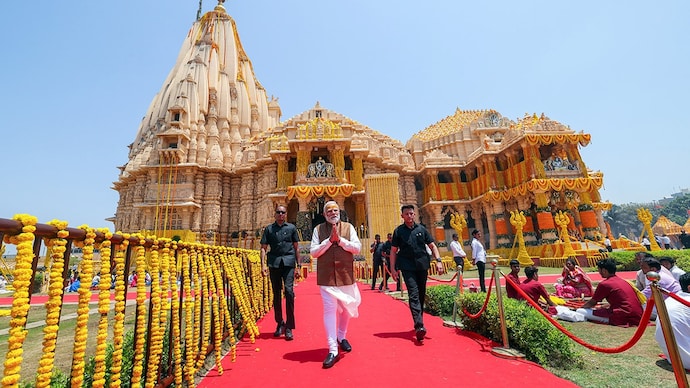

 Prime Minister Narendra Modi performed puja at the Somnath Temple on May 11 as part of the Somnath Amrut Mahotsav, marking 75 years since the inauguration of the temple restored post-Independence.
Modi released a commemorative stamp and coin to mark the occasion. He also participated in the Vishesh Maha Puja and Kumbhabhishek and Dhvajarohan ceremonies, while the Indian Air Force’s Surya Kiran aerobatic team conducted a special aerial display, involving six Hawk Mk-132 aircraft in coordinated formation above the temple complex.
“Even 1,000 years after the first destruction, there is the pride of Somnath being indestructible (avinashi). And today, in the 75th year of the consecration of this modern form, we haven’t just become part of two events; Lord Shiva has given us the opportunity to experience a 1,000-year-long journey of immortality,” Modi said at the event. He announced that special pujas would be organised at Somnath for the next 1,000 days as a tribute to those who had protected the shrine over centuries.
The shrine was repeatedly rebuilt after each destruction by a succession of Hindu kings and local chieftains—from the Solanki and Chudasama rulers of Gujarat and Saurashtra, who restored it after Mahmud of Ghazni’s raid in 1026 CE and subsequent medieval attacks, to the Maratha queen Ahilyabai Holkar, who reconstructed it after Aurangzeb’s 17th-century desecration. Alongside these rulers, countless unnamed devotees, priests and pilgrims have kept the site alive through centuries of conquest and upheaval.
The Somnath Temple stands at Prabhas Patan in what is now Gir Somnath district on Gujarat’s southwestern coast. It is a triveni sangam, the confluence of three rivers—Kapila, Hiran and the mythological Saraswati. It houses one of Shaivism’s 12 jyotirlingas—the most sacred Shiva shrines in Hinduism—making it a site of pan-Indian religious significance.
The continuous attacks and the temple’s survival were the core narrative of Modi’s visit, also the heart of the BJP’s Hindutva politics. In January 1026, Mahmud of Ghazni, leading a 30,000-strong cavalry, ransacked the temple, shattered the Shiva linga and looted an estimated 20 million dinars. He earned the title ‘The Idol Breaker’. That was not the last attack. In 1311, the temple was destroyed on the orders of Alauddin Khilji. Muhammad bin Tughluq attacked in 1326. Zafar Khan of the Delhi Sultanate invaded in 1395. Mahmud Begada looted it in 1451. Aurangzeb ordered its destruction in the 17th century.
Each destruction was followed by rebuilding. Kumarapala (1143-72) rebuilt the temple in stone “studded with jewels”, according to a 1169 inscription. After Alauddin Khilji’s general Ulugh Khan ransacked it in 1299, Mahipala I, the Chudasama king of Saurashtra, rebuilt it in 1308. In the 17th and 18th centuries, after Aurangzeb’s attempts to convert it into a mosque, Ahilyabai Holkar reconstructed the temple once more.
The current structure, known as the Kailash Mahameru Prasad, is technically the seventh temple on the site and stands 155 feet tall.
SARDAR, NEHRU AND AN UNENDING DISPUTE
The story of how the modern Somnath Temple was built after Independence is inseparable from a foundational argument about secularism, one that the BJP has propagated for decades and continues to deploy even today.
On November 13, 1947, weeks after Partition, Sardar Vallabhbhai Patel stood at the ruins of the Somnath Temple—then part of the recently integrated princely state of Junagadh—and pledged its reconstruction. Mahatma Gandhi endorsed the plan but said that funding must come from public donations, not the state. Patel agreed. When Patel died in December 1950, the unfinished project passed on to Kanaiyalal Maneklal Munshi, a Congress cabinet minister under prime minister Jawaharlal Nehru.
When President Rajendra Prasad wrote to Nehru in March 1951 saying he had been invited to preside over the opening ceremony, Nehru replied: “I confess that I do not like the idea of you associating yourself with a spectacular opening of the Somnath Temple. This is not merely visiting a temple, which can certainly be done by you or anyone else, but rather participating in a significant function which unfortunately has a number of implications.”
Prasad wrote back that the temple had been built entirely with private subscriptions and that he did not feel it right to refuse the invitation given its historic significance. Nehru replied, “I would not like to press my point any further.”
Prasad attended on May 11, 1951—75 years ago—and inaugurated the temple. In his speech, he said the Somnath Temple proclaimed that anything built with unparalleled faith and love cannot be destroyed, and that the restoration was the fulfilment of Sardar Patel’s dream.
Historians close to the Congress tradition point out that it was Gandhi, not Nehru alone, who first insisted on private, not state, funding for the reconstruction, and that Nehru’s objection was specifically to the state’s association with a religious project, not to the temple’s reconstruction itself.
The BJP, in recent years, has used Nehru’s reservations to cast the Congress as “anti-Hindu”, contrasting Congress leaders’ presence at Somnath’s 1951 inauguration with their 2024 boycott of the Ram Temple consecration in Ayodhya. Historians note the contexts differ significantly. The Somnath reconstruction was framed as national revival after Partition while the Ayodhya temple emerged from a long legal dispute centred explicitly on Hindu identity politics.
K.M. MUNSHI: THE MAN BEHIND THE TEMPLE
No figure is more central to the modern Somnath Temple than Munshi—lawyer, freedom fighter, Constituent Assembly member, cabinet minister and one of the most significant writers in the history of Gujarati literature. Munshi played a role in the integration of Junagadh into the Indian Union. It was he who accepted the Nizam’s surrender during Operation Polo in Hyderabad. While Sardar Patel had initiated the Somnath reconstruction, it was Munshi who led the effort on the ground and ensured its completion after Patel’s death.
Munshi’s literary legacy is inseparable from his political one. His Patan trilogy—Patan Ni Prabhuta (The Glory of Patan, 1916), Gujarat no Nath (The Lord of Gujarat, 1917) and Rajadhiraj (The Emperor, 1922)—written under the pen name of Ghanshyam Vyas, is a work of historical fiction set against the backdrop of the Solanki rulers of medieval Gujarat, between the 9th and 12th centuries CE. The trilogy captures the political, social and cultural environment in medieval Gujarat through compelling storytelling. The literary imagination and political mythology have given his work a durable hold on the Gujarati psyche, and Munshi continues as a household name across Gujarat. And this possibly explains the state’s ideological loyalty to the BJP.
Munshi also wrote Jai Somnath, a novel specifically on the Somnath Temple and its story. In May 1951, simultaneous with the temple’s reopening, he wrote Somanatha: The Shrine Eternal, a historical, archaeological and mythological account of the temple, published by Bharatiya Vidya Bhavan.
BJP’S POLITICAL TIMING
The 75th anniversary of the Somnath Temple’s consecration would have demanded commemoration regardless of political circumstance. But the timing and scale of this year’s events reflect a deliberate effort by the BJP to embed Somnath as a permanent fixture in the party’s civilisational narrative. The temple, and its associated political vocabulary of civilisational resilience, invasion, destruction and Hindu revival, is being institutionalised as a permanent backdrop to national politics.
THE SAURASHTRIANS OF TAMIL NADU
Among the less-told consequences of Mahmud of Ghazni’s raid is a community of roughly 2.5 million people living in Tamil Nadu today. Their migration to the southern parts of the country is believed to be primarily a result of the desecration of the Somnath Temple by Mahmud of Ghazni.
According to V.G. Ramdoss, founder of the Sourashtra Chamber of Commerce in Madurai, the Saurashtrian people came to Tamil Nadu from Gujarat following the attack on the temple. Many also came in the 17th century as royal silk weavers to the Nayak kings.
In April 2023, the Modi government ran a structured cultural reconnection exercise. The Saurashtra Tamil Sangamam was held from April 17 to 30 across Somnath, Dwarka and the Statue of Unity. It aimed to reconnect Tamil-speaking descendants of the Saurashtra migrants with their ancestral homeland.
Subscribe to India Today Magazine