
The irony of Jaipur sewer deaths: Machines sit idle as workers are sent in
The Jaipur Municipal Corporation has the best of equipment and ample funds. Yet it spends crores on sewer-cleaning contracts that rely on manual scavengers
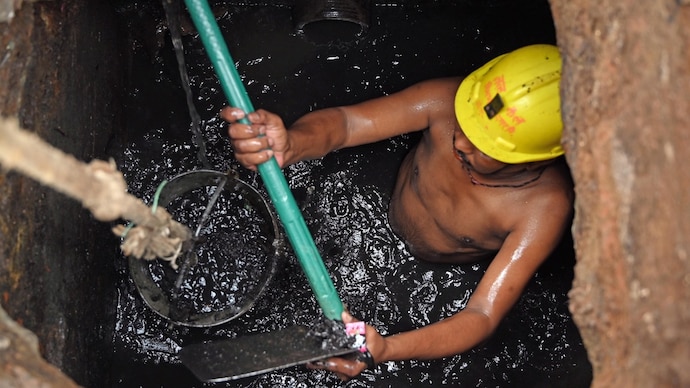

 On April 17, two men—Ajay (41) and Ram Babu (40)—entered a sewage chamber on Shekhawat Marg near Niwaru Road in Jaipur. They did not come out alive.
Their deaths are not an aberration. They are part of a system that continues to send workers into toxic, confined spaces even when the law forbids it and machines exist to replace them.
The uncomfortable truth: The Jaipur Municipal Corporation (JMC) does not lack resources. It has super sucker machines, jetting and suction equipment, and even robotic cleaners. Yet, it continues to spend crores on contracts that rely on manual scavenging. The gap is not about capacity—it is about choice, incentives and accountability.
Following the tragic deaths, the Union government and the Rajasthan State Human Rights Commission have sought an action-taken report from the collector of Jaipur and CEO of JMC. But at a broader level, the scale of the problem is national.
A report by the Centre’s Department of Social Justice and Empowerment records 622 deaths nationally between 2017 and March 2026 during the cleaning of sewers and septic tanks. Uttar Pradesh leads with 86 deaths, followed by Maharashtra (82) and Tamil Nadu (77). Rajasthan, with 37 deaths, ranks among the top 10—hardly a statistic any state would want to own.
The law is unambiguous. In October last year, the Supreme Court declared that entering sewage systems without adequate safety gear is a criminal offence, mandating strict accountability and a compensation of Rs 30 lakh for each death. Yet, the deaths continue—routinely, and often without consequence for those who authorise such work.
Why? Start with infrastructure. At least half of Jaipur’s new and developing areas still lack proper sewer lines. Households depend on septic tanks that require frequent emptying. This creates a parallel, largely informal ecosystem of cleaning, one that falls outside strict municipal oversight but feeds directly into it. When the system clogs, the quickest fix is still a human being with no protection.
Then there is the problem of technology deployment. In January, JMC showcased one of its robotic machines with considerable fanfare. The reality is less impressive. Officials admit the robots are limited to vertical cleaning, can handle only five to six operations a day, and come with operational constraints. In other words, they are useful—but not a systemic replacement. Instead of scaling up technology or redesigning processes, authorities fall back on the cheapest, fastest option: manual labour.
The Congress’s Tika Ram Jully, who is leader of the Opposition in the legislative assembly, has called out the contradiction—laws exist, machines exist, yet manual cleaning continues. But the issue goes beyond political critique. It points to a deeper administrative failure where compliance is treated as a box to tick, not a standard to enforce.
The rot is visible beyond municipal limits. Industrial units, where safety protocols are expected to be tighter, mirror the same negligence. Last May, four workers died in Jaipur’s Sitapura industrial area after being sent into a septic tank to retrieve precious metal residue. In Bikaner, three workers suffocated in a woollen mill. In Alwar, two sanitation workers, including a 13-year-old, died cleaning a sewer line at a paper mill. Deeg saw another fatality the same month. These are not isolated lapses; they are a pattern of risk outsourced to the most vulnerable.
What ties these incidents together is not just poverty or informality—it is the absence of deterrence. Contractors cut corners. Supervisors look away because deadlines matter more than protocols. Municipal bodies outsource responsibility, and industries treat safety as an expense rather than a non-negotiable.
And so, machines sit parked while men climb down. Every such death follows a grimly predictable script: toxic gases, no protective gear, a rushed rescue attempt and multiple casualties. It is a chain reaction of neglect. Breaking it requires criminal liability that actually sticks, blacklisting of contractors who violate norms, and real-time monitoring of sewer and septic tank operations.
Most importantly, it requires a shift in mindset. As long as manual scavenging is seen as an acceptable fallback, technology will remain ornamental and laws will remain ornamental. Ajay and Ram Babu are the latest names in a long list. Unless enforcement catches up with intent, they will not be the last.
Subscribe to India Today Magazine