
Jack Ryan Ghost War review: A spy thriller for the age of silent wars
Tom Clancy's Jack Ryan: Ghost War brings John Krasinski back into a covert mission shaped by rogue operatives and hidden enemies. The film feels timely because modern conflict now unfolds through data, surveillance and invisible pressure points.
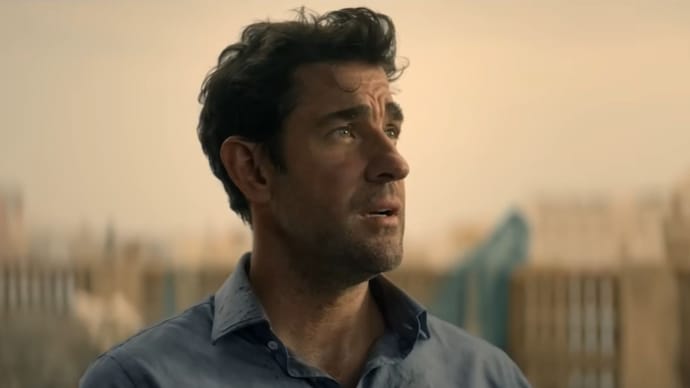

There was a time when spy thrillers were simple. The enemy was visible in flesh, borders were clear and heroes wore their patriotism loudly. Today, wars are quieter. Information leaks faster than bullets. Governments negotiate through sanctions, surveillance and strategy. Entire conflicts are fought through invisible pressure points: data, cyber networks, economic pressure and political arm-twisting. Ironically, at a time when the real world feels more politically volatile than ever, mainstream spy thrillers have started playing it safer. That contradiction sits at the centre of Tom Clancy’s Jack Ryan: Ghost War.
The new film retains the globe-trotting espionage mechanics and slick action that define the franchise, but its politics feel noticeably softer, more carefully distanced from recognisable geopolitical realities. Its enemies are vague, its conflicts broad and its conspiracies intentionally non-specific. In trying not to provoke, the film almost reflects the state of modern blockbuster filmmaking itself.
And yet, despite that softer political lens, Tom Clancy’s Jack Ryan: Ghost War still feels strangely relevant in 2026. Because today’s world already feels like a ghost war.
The Russia-Ukraine conflict, the continuing Middle East crisis, tensions around Taiwan and cyberattacks on infrastructure have transformed the nature of modern warfare. Battles no longer unfold only on physical borders. They now play out through intelligence leaks, surveillance systems, misinformation campaigns, economic sanctions and strategic pressure.
The disruption around the Strait of Hormuz, for instance, showed how one volatile geopolitical flashpoint could impact global oil supply chains, shipping routes, inflation and financial markets almost instantly. At the same time, growing cyber threats and large-scale data breaches across governments, corporations and public systems have exposed how vulnerable the world has become to invisible warfare.
Watch the trailer here:
Data itself is now currency. Countries no longer just fight for land. They fight for influence, narratives, algorithms and visibility. The modern battlefield is invisible.
The upcoming film brings Jack Ryan, played by John Krasinski, back into another covert mission involving rogue operatives, buried conspiracies and invisible enemies who already know every move being made against them. Operating in real time, the film reunites him with familiar CIA faces while introducing newer global players into the mix.
On paper, it sounds exactly like the kind of geopolitical thriller the world currently mirrors. And that was always the emotional strength of Tom Clancy’s Jack Ryan. The franchise understood early that modern warfare is rarely cinematic. It is bureaucratic, exhausting and deeply psychological. Jack Ryan was never a swaggering superspy in the mould of old-school action heroes. He was an analyst first, a man buried under satellite feeds, intelligence reports and patterns hidden inside numbers. Someone who understood that one spreadsheet could alter the course of a war.
Beneath the action, the series was about people trying to make sense of collapsing systems. Ryan was not invincible. He often looked exhausted more than triumphant. He was overwhelmed by information, burdened by responsibility and constantly chasing threats before they exploded publicly. That vulnerability made him believable in a genre usually dominated by indestructible heroes.
That emotional and political sharpness is also what makes Tom Clancy’s Jack Ryan: Ghost War feel slightly conflicted as a continuation.
The film works best when it leans into familiarity. John Krasinski still carries the weary intelligence that made his Jack Ryan distinct from the more swagger-heavy versions played by earlier actors. He understands Ryan less as an action hero and more as a man constantly processing information faster than the systems around him. There is an understated exhaustion to his performance that still works for the character.
The returning ensemble also helps steady the film. Wendell Pierce once again brings emotional gravitas and quiet authority to James Greer, while Michael Kelly remains one of the franchise’s most dependable presences as Mike November, adding urgency and clarity whenever the narrative threatens to become too convoluted. The newest addition, Sienna Miller, fits comfortably into the world of espionage thrillers as MI6 operative Emma Marlowe, bringing enough steel and restraint to make the film’s international dynamic believable.
The problem is not the cast. It is the film’s hesitation.
Ghost War moves efficiently, looks slick and delivers enough chase sequences, shootouts and espionage mechanics to remain watchable. But unlike earlier Jack Ryan stories that engaged more directly with geopolitical anxieties, the film often feels emotionally and politically distanced from the world it is clearly inspired by. The film trades layered political intrigue for safer rogue-agent conspiracies and broad, stateless threats.
And perhaps that cautiousness says more about modern filmmaking than the film itself.
The real world in 2026 already feels unstable enough. Spy thrillers no longer need to imagine invisible wars because the audience is already living through them through cyberattacks, surveillance, data leaks, economic pressure and manufactured narratives unfolding in real time. In comparison, Ghost War sometimes feels oddly restrained, almost careful not to look too closely at the realities surrounding it.
The original series through different seasons felt unafraid. Even though the franchise always carried traces of American nationalist fantasy, it still engaged directly with the geopolitical anxieties of its time. Earlier stories explored Cold War paranoia, covert CIA operations, unstable regimes and terrorism with a certain urgency. The tension did not come only from explosions or chase sequences. It came from ambiguity of who controls the information? Who manipulates the narrative?
In 2026, those questions hit harder than ever. Maybe that is the irony of Jack Ryan in 2026. The world has finally caught up with the paranoia the franchise once imagined. Wars today are quieter, narratives are manufactured in real time, and information itself has become weaponised. The original Tom Clancy’s Jack Ryan understood that early. The film, however, seems more careful about confronting it directly.
Yet, despite its softer politics, Ghost War still works because the world around it has finally caught up with the paranoia Jack Ryan imagined years ago.
The film is now streaming on Prime Video.